Vita Maria Drygas comes from a filmmaking family. Her father is Maciej Drygas, an award-winning Polish director. Her mother is a documentary maker too. Vita is half Lithuanian, half Polish. Her grandfather on the Lithuanian side directed dramatic features – and his wife was a well-known actress.
“We can say that all my family are filmmakers,” Drygas declares. She is currently promoting her new feature doc, Danger Zone, sold by Dogwoof, made through Drygas Film Productions and co-produced by Next Film. The film had its world premiere in Warsaw in the autumn before going on to screen in the main competition at IDFA.
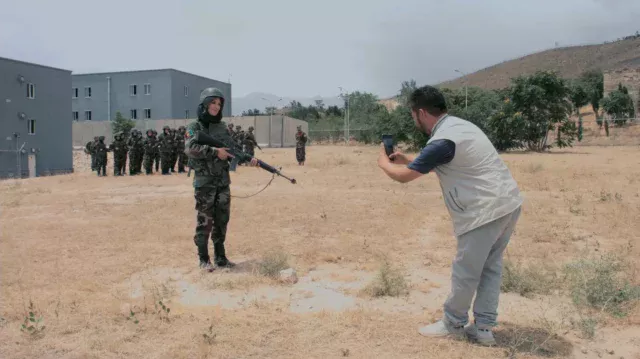
Dogwoof is pitching Danger Zone to buyers as “a front-row, unfiltered, look at the global war tourism industry.” Its subjects prefer being in the eye of the storm in the most lethal conflict zones to lounging on the beach.
Growing up, Drygas’s ambition was to become a doctor and “to go to the war zones to save people’s lives. That was the dream, to begin with. As a child, when I was really little, I didn’t understand what my parents were doing.”
However, she eventually went into the family business, studying cinematography at Katowice Film School. She became a director because she wanted to “tell my own stories.” Her father was very well known, but she was determined to make her own name.
Drygas has always been drawn to surprising subject matter. Her previous docs include The Piano (which looked at how a piano was used to reinforce the barricades during the Maidan protests in Ukraine) and Knife in the Wife, about a small circus troupe celebrated for its knife throwing routines. Now, she is homing in on the lives of war tourists like the intrepid Englishman Andrew Drury, who loves to travel to the front lines, or Rick Sweeney, the tour operator.
It was when she was in Ukraine shooting Piano, observing the local people fighting at huge personal risk for their “dignity” and their freedom, that Drygas first saw advertisements for danger zone holidays.
“I felt it was so wrong that kind of trip could exist, I thought it was some kind of separatist provocation,” the director remembers her initial reaction.
After finishing Piano, Drygas began to research the war tourism business in more depth. She quickly realised this was a big business but a very secretive one. “I started to dig. I understood it was something underground. It was really difficult to connect with my characters and also with agencies.”
The director shows two sides of the war tourism world – she goes behind the scenes with the organisers of the trips and also reveals the first-hand experiences of the customers. “But for me, the most important thing that drove me to the subject, it wasn’t to tell the story of these particular characters. I really thought it was more universal – that the subject shows the condition of our world. It was for me like a mirror of our times. My grandmother [in Poland] took part in the Warsaw uprisings. She was 16. I remember a lot of stories from the Second World War that she told me. I was raised in the feeling that war is, you know, hell, pure hell!”
Now, holidays in hell are being sold as if they are package trips to seaside resorts. The “war tourists,” though, have very complex reasons for wanting to travel to danger zones. It would be too simplistic to see them as simple-mindedly feasting on the suffering of others.
“We can’t generalise. If people ask me ‘why do people go there?’ [to war zones], I can’t give an answer because there is no one answer,” Drygas admits.
It wasn’t just “curiosity” which drove her to make the film but also anger. However, she kept her more negative feelings well under wraps. Her father had always emphasised to her the ethical responsibilities of documentary – and the importance of starting films with an open mind.
“If you come with a critical idea in your head, people feel it very quickly. They will not open up,” she says of how quickly subjects will see through filmmakers who begin a project from a hostile position. Drygas spent seven years making Danger Zone. That’s a very long time to devote to a project if you despise your characters. “In my opinion, documentary filmmakers, even if they are touching subjects that do not represent exactly their ethical attitudes toward life, are not [there] to judge them [their characters].”
Drygas spent over a year persuading Andrew Drury to appear in the film. When they met in Poland, they talked together for over eight hours. The Englishman, who ran a construction company in Surrey, was already a minor celebrity. He had been profiled by CNN and other media outlets.
“I remember that I started with questions about his childhood.” Drygas explains how she probed far more deeply than journalists he had spoken to in the past and whose stories had been “quite shallow.”
“They [the journalists] had not been digging into his personality or his experiences.”
Drygas discovered that when Drury was 11, his brother had died of leukaemia. The boys had been living in the same room which had a bunk bed. When she asked how he coped the first night after his brother’s death, Drury began to cry – but immediately tried to hide his tears. In these moments, she saw “a very fragile man” quite different to the macho, self-assured character written about in newspapers.
The director shot close to 300 hours of material. She and her cinematographers, Bartosz Bieniek and Mateusz Wajda, decided not to use talking heads. One drawback to this was that they couldn’t show the faces of their subjects when they were being interviewed and showing deep emotion.
At times, the director protected her subjects from themselves. She didn’t want to include footage that would cause them to be vilified later.
Drygas acknowledges that the documentary has been affected by all the different new conflicts that have sprung up since she started making it. In the middle of the current Ukraine war and Gaza conflict, talking about war tourists risks seeming perverse in the extreme.
“I know that this is very controversial. People prefer in general to watch movies about people who are fighting for freedom or who are more positive. We often like to feel some bond with characters.”
The director points out that her protagonists aren’t easy to categorise – and most have changed as a result of their experiences. Rick Sweeney doesn’t just arrange the tours. He is also now supporting ambulance drivers working on the front lines and working hard for charity. Some of the war tourists turn up with food for all the abandoned and starving pets – and then to try to find them new homes. They are raising money for Kurdish refugee camps. The idea, then, that they’re there simply to enjoy other people’s misery and to get an adrenalin rush from the explosions is not at all accurate.
UK company Dogwoof came aboard the project at an early stage as sales agent and co-producer. The film was pre-sold to US broadcaster Starz. Further deals are expected to be announced soon.