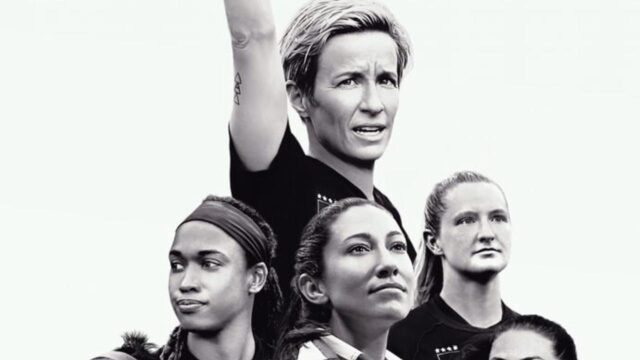
The title of the latest feature documentary from Sean Fine and Andrea Nix comes from the fist-pumping, team-bonding, high-fiving pre-match battle cry of the US women’s national football team…Let’s Fucking Go!
By common acknowledgment, the team is exceptional. It wins major trophies on a regular basis. Some of the players, among them Megan Rapinoe, Jessica McDonald and Becky Sauerbrunn, are household names. However, as the film reveals, they are still paid a relative pittance. Fine and Nix tell the subsequent story of how and why the team launched a class-action, gender discrimination suit against the US Soccer Federation just before the start of the 2019 World Cup.
“If they are going to do that, what’s behind [it]?” Nix asks what led the elite players to become embroiled in a legal case against their own governing body just before the tournament they most wanted to win. “They seemed so successful. How could this successful team still feel they are not being recognised and paid correctly by their own boss?”
The filmmakers did a little “digging” and very quickly discovered that the women had been campaigning for better pay for decades. This dispute went back to the 1999 World Cup, which the US won in front of a TV audience of more than a billion people, and beyond.
“It really seemed there had been such a frustration and anger. None of that seemed to be known,” Nix said.
The filmmakers produced LFG alongside Abby Greensfelder, CEO of Everywoman Studios. It was Greensfelder who discovered that no other filmmakers were tackling the subject. As soon as they realised this, Nix and Fine jumped right in.
There is a startling moment early in the documentary in which Jessica McDonald talks about trying to combine her career as a top footballer in a professional league with bringing up her baby. She couldn’t afford childcare and so sometimes had to bring the kid to training, changing diapers between practising free kicks.
“That statement was from before she was on the national team, but still [it was important] for us to shed light on that, what it took for her to be a professional soccer player at the top of her game, the sacrifices she made,” says Fine.
After the 2019 World Cup tournament, in which McDonald appeared briefly, the filmmakers followed her for a day back at home. Fine remembers being startled by “the amount of things she had to do as a single mum just to pay the bills.” She was playing in the NWSL Championship, the top tier of women’s football in the US, and yet was still having to coach kids in order to make ends meet.
Understandably, the US Soccer Federation has given a very cagey response to LFG since its world premiere in the summer at the Tribeca Festival. Federation officials have paid lip service to the idea of equal pay for the US women’s team but real change is yet to happen.
“You can say it all you want, but the truth of the matter is that the women were never ever offered the same deal that the men were offered, at the same rate of pay,” says Nix. “What they like to say, and it’s a little bit a sleight of hand, is ‘look, the women chose to get paid the deal they got.’ Well, the reality is they were never offered the same deal that the men were offered.”
The Federation was invited to be part of the film but declined. In a strong set of tweets, it subsequently accused the filmmakers of being misleading and dishonest.
“You know the film is making an impact when, all of a sudden, US Soccer starts to put out statements against the film,” Fine reflects on the hostile response the doc has received from the governing body. The documentary makers insist that LFG is “truthful, factual,” and that its arguments are presented in a way that “people can understand.”
“While I am not happy about their response, having a response [like that] shows that they are worried and shows they have to come to the table,” Fine continues.
The Federation has claimed that giving in to the demands of the US women’s football team would put it under severe financial strain. As Megan Rapinoe points out in the film, that’s a very weak argument for maintaining a “discriminatory” business model.
Former President Trump waded into the debate, attacking Rapinoe and later claiming (after the Olympics) that the team was led by a “radical team of leftist maniacs.”
“It’s appalling,” Fine says of Trump’s interventions. “I think it’s also indicative of this white, wealthy older male attitude about sport and about everything in our country. There is a change coming and some people just don’t want to see that. I think President Trump is one of those people.”
Nix agrees. On the one hand, Trump’s comments have drawn attention to the inequality the film highlights. On the other, though, they are “disgraceful.” Trump simply can’t bring himself to acknowledge the excellence and the professionalism of the team. “The fact that the President of the United States was being so sexist and so unpatriotic is just so out of line. It felt good to be able to include it so that people could remember that he said it but I don’t think we were psyched to hear it…it just feels shameful.”
There has been a sense of Groundhog Day about the women’s fight for equal pay. The same arguments have been made again and again without meaningful changes being made. Nonetheless, the filmmakers are optimistic that the cycle of discrimination may now be broken. A summary judgement went against the women last year but they didn’t give up.
“I think we are going to have to see where this lawsuit goes. They’re in appeal right now. I think they have a really good shot of getting their appeal but this takes time,” Fine reflects. “But I think they’re not going to give up. They are going to keep on fighting.”
LFG may be a film about a lawsuit, rather than a sports movie, but the directors were determined to make it “compelling.” They took their inspiration from the women themselves, ever resilient and ever defiant with their “let’s fucking go” attitude.
The film’s theatrical run was curtailed by the pandemic. However, it has been widely seen on HBO Max and CNN and is now regarded as a leading awards contender in the documentary category.