

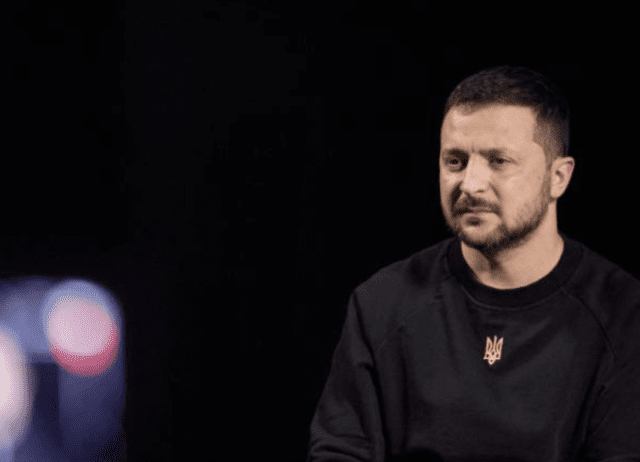
There have already been several documentaries about Ukrainian president Volodymyr Zelenskyy. Since the country suffered the full-scale invasion by Russia in February 2022, the international media has clamoured to find out more about the wartime leader. US filmmakers Sean Penn and Abel Ferrara have made movies in Ukraine for which they’ve interviewed the President. David Letterman spoke to him in a bunker. Many broadcasters have looked to talk to him. Now, though, comes arguably the most thorough and in-depth account of how the former comedian and actor came to power.
Meeting Zelenskyy, directed by André Singer and US actor Liev Schreiber, has a similar structure to Singer’s earlier movie, Meeting Gorbachev (2018), which he made with Werner Herzog. It combines an interview with its subject, conducted by Schreiber, with archival material and insights from those who know Zelenskyy best.
Herzog had his “own unique style” of talking to Gorbachev. However, the visionary German director didn’t seem the right fit for Zelensklyy. He had a Russian wife. Singer needed to find someone else. He knew that although the Ukrainian leader was scrupulously honest and open with the media, he wouldn’t have wanted to be grilled aggressively. Singer wanted someone who would be able to speak to him in a “relaxed conversational style.” That’s where Schreiber came in. The Ray Donovan star had Ukrainian relatives. He was a similar age to Zelenskyy. He too had a Jewish heritage. He was very sympathetic to Ukraine and was already running a charity that was delivering medical aid to the country. He had briefly met the President already and they clearly got on. It helped too, of course, that he was charismatic and looked good on camera. He seemed the perfect fit. What’s more, Schreiber was immediately keen to do the film and threw himself into researching the project.
As Singer acknowledges, media interest in Ukraine has diminished since the Hamas/Israel conflict began in Gaza last autumn. “When Zelenskyy went to Washington and he was lauded in Congress and so on, everybody was really interested in what was going on and very supportive. I suppose some of the expectation was that the war would be over quite quickly in one way or another. It has been quite clear in media terms that the general interest has waned somewhat,” Singer says.
Broadcasters were initially buzzing around the film, but by the time a version was ready to be shown to them, “the atmosphere had changed somewhat. Politically, there was a sense of weariness about the war in Ukraine. It wasn’t so much front-page news any more. There was a kind of tiredness about what was going on. But then when the October horrors in Gaza happened, the attention very rapidly switched to what was happening in the Middle East.”
The net result is that Meeting Zelenskyy, an important film which ought to have huge topicality, is taking longer than initially expected to finalise its distribution. Singer is currently hoping to launch it at the Sheffield Doc Fest in June. Work-in-progress screenings have already been held at the Astra Festival in Romania; in Washington, where it screened on the second anniversary of the war, and at DOCUTAH.
For insurance purposes, Singer and his cinematographer Richard Blanshard were obliged to take a “risk assessment course” run by ex-British army personnel. This gave them background on what might happen if they were kidnapped in a war zone and what they might face when they arrived in Ukraine.
“It was a very gruelling few days, quite a dramatic episode in preparing for the film,” Singer recalls of a week when he and Blanshard had bags put on their heads and were made to undergo mock interrogations.
During their time in Ukraine, the filmmakers were mainly based in Kyiv but they did visit “more exposed” towns that had been recaptured by the Russians.
One element foregrounded in the film is the so-called “Budapest memorandum” of 1994. Ukraine agreed to remove all the Soviet era nuclear weapons from its soil in return for assurances that it would not suffer aggression from the signatories (who included Russia). Obviously, if Ukraine still had had nuclear weapons, Putin would have been far more wary about invading.
“It wasn’t as much a treaty as an understanding [between] Clinton on the one hand, John Major on the other, and Russia, that the territorial integrity would be protected if they [Ukraine] would hand back all the nuclear weapons they had.”
Ukraine at that time was the third’s biggest nuclear power in the world. Nonetheless, the agreement was completely disregarded inn 2014 when Crimea was invaded and was ignored again in 2022 with Putin’s full-scale invasion of Ukraine. Singer speculates that Putin felt he could overlook the memorandum because it was signed by Boris Yeltsin, not by him. The west, meanwhile, seemed too worried about upsetting him in 2014 to pay attention then – and they are paying the price now.
“Basically, I felt Ukraine was hung out to dry that time, in 2014…I think that was a huge moment of international perfidy,” says Singer.
The director went into the project with plenty of knowledge about his subject. He admits that he had “a certain level of cynicism” about how Zelenskyy might use his skills as comedian and actor to try to charm and win over his interviewer. However, he quickly concluded that the President was not putting on a face. “Of course, he is good at play acting. That’s how he got to where he is. But there was no sense of him playing to an audience. He responded to the questions, I felt, very honestly and quickly. He didn’t ask for a list of questions so he could vet us. He was perfectly happy for us to ask what we wanted to ask. I genuinely found him to be a pretty honourable and honest player in difficult, impossible circumstances.”
The director understands why Zelenskyy gives so many interviews. Politically, he needs the attention. It’s a way of encouraging the west to continue supporting Ukraine. Singer’s film starts from a different perspective to most of the others. Its aim is to “understand the man” and to tell the story of how a comedian and actor with no political experience ended up leading his country. The film also covers Ukrainian independence and the Orange Revolution, providing the political and historical context from which he emerged.
Some of the President’s contemporaries do appear on camera including his childhood friends, footballer Andriy Shevchenko, boxer Oleksandr Usyk and Oscar-nominated filmmaker, Alexander Rodnyansky.
The President’s wife Olena also features prominently. She grew up with Zelenskyy, went to school with him and knows him better than anyone. She didn’t want him to enter politics but has now become his most fervent supporter. “Like him, she’s very honest in what she says. She doesn’t hide or duck behind things,” Singer says of her. “Now she has such a difficult life because you can’t even think how vulnerable she and the children are in a country that has so many Russian speakers and supporters in it. They have to live in semi-hiding. I thought she was a wonderful interviewee.”
Singer plans to launch the film later in the summer. It has already shown in Kyiv in an early cut. Sales are being handled in the US by UTA and in the rest of the world by Boat Rocker.





