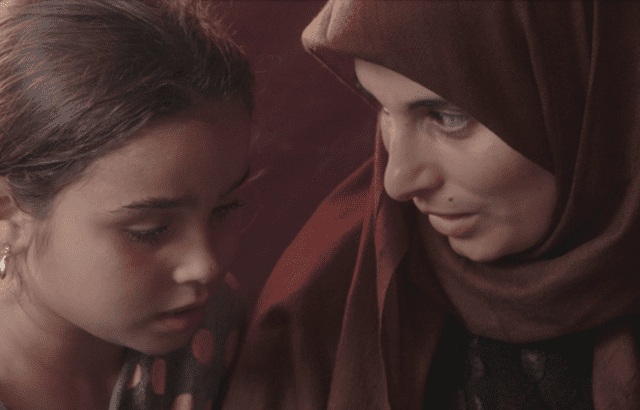
Megan Mylan has one Oscar to her name already, for her 2008 film Smile Pinki, which won the Academy Award for Best Documentary short. Now, she is in the running again for her feature documentary Simple As Water, The film, shot between 2016 and 2018, examines the lives of various Syrian families, most of them refugees, in the wake of the civil war which devastated their homeland.
“My family still talks about it a whole lot,” the director laughs at the memory of that first Oscar. She quickly adds: “I’m sure you get this from most documentary filmmakers, but I don’t make films to win awards. That would be a horrible, horrible life to lead because they [awards] are few and far between…but I do make films for audiences to see them – and there is nothing like the attention of the Oscars for audience.”
Simple As Water is an immensely complex and ambitious project. Mylan conceived the documentary in 2015 as she heard many of the heart-rending stories about Syrian refugees who had escaped apocalyptic violence at home only to endure further suffering at the hands of smugglers and the often callous western bureaucrats they then encountered.
“What was going on in my own life at the time was that I was the mother of a three-year-old. So that very primal shift had happened where I was experiencing everything through his eyes, both the world’s joy and beauty but also its injustice,” Mylan remembers. She kept asking herself how she might cope if she was placed in the same situation as the refugees, among them many mothers a similar age to herself. Would she “crumble” or would she “rise to the occasion?”
Mylan had already made one film about refugees, Lost Boys Of Sudan (2003), which followed two Sudanese youngsters on their very perilous journey from Africa to the US. When looking for a “point of entry” for the new documentary she decided to focus on the family angle.
“But very quickly I felt that one family’s journey would be an anaemic response to the scale of what was going on,” the direct explains her decision to include several different protagonists in locations ranging Greece to Germany, from the US to Syria itself.
“I knew enough from experience of working with the Southern Sudanese community that it is so multi-faceted. People are not a monolith…there are so many different experiences and different locations. I pretty quickly decided I wanted to do something that had multiple storylines.”
Mylan also realised that it would be impossible to follow ”the complete arc” of any individual family’s journey. Instead, she wanted to concentrate intensely on revealing moments in her subjects’ lives – to look for ‘hidden gems,’ as she puts it. One of her inspirations was François Girard’s Thirty Two Short Films About Glenn Gould (1993), which told the story of its subject, Canadian piano virtuoso Gould, in deliberately fragmentary fashion rather than as a single coherent narrative. She wanted the documentary to be “intimate” and “organic.”
The director researched the project very intensely before production began, speaking to journalists, aid workers, human rights activists and anyone with expert knowledge as well as to as many Syrians as she could find.
Certain themes began to emerge. One was children being forced to take on adult responsibilities because one or both of their parents were absent. “Fathers going ahead is very typical when families are fleeing war,” Mylan notes. “The men will go ahead to see if there is a safe passage but they get caught up in these Kafkaesque bureaucracies that keep families apart.”
It was also crucial to find families who were willing to invite the filmmakers into their lives at what were often very fraught moments.
Although HBO came on board the project after the film’s premiere at Tribeca, Mylan and her team were working on a modest budget. “We didn’t have a lot of production days but we had loads of pre-production days. We took it very slow.”
One question the director continually had to ask herself was how closely she and her crew should become involved in their protagonists’ lives.
”Obviously, I am there as a filmmaker, not as a social worker. It is really challenging. I think the heaviest toll of making this film had nothing to do with logistics or fund raising. It was sitting and bearing witness to what the families were struggling with; it was being with the heaviness and the injustice of what they were having to deal with…it’s a balancing act constantly between your humanity and your professional [responsibilities] and I try to get it right.”
The filmmakers were as candid and transparent as possible with their subjects. They didn’t know what was going to happen to the Syrian families: whether wives would be reunited with their husbands or children with their fathers. In the documentary, matters are ultimately left in flux. The director talks of not wanting to “wrap things up in a neat bow” or to provide a contrived happy ending.
“I am a pretty orthodox observational filmmaker. I don’t set things up or ask you to do this, that or the other,” Mylan states. “The moment you start intervening and directing people’s actions, they become more and more self-conscious and you lose those things that were going to happen spontaneously – and which for me are always better than what you might have planned. The reason I love observational verité is that I love reacting to the moment – and then [solving] the puzzle in the editing room of finding moments like that.”
Mylan was working with the renowned Danish cinematographer Lars Skree (whose other credits include The Look Of Silence and The Act Of Killing). Together, they set out to capture the “dailyness of family life that continues in spite of the chaos.” Parents may be trying to claim asylum and build new lives but they still have to make sure their kids are fed and have a place to sleep.
Thankfully, there was a happy postscript in several of the cases. Families have been reunited, kids are successfully enrolled in new schools and young men have found jobs. Others, though, still don’t know what has become of their loved ones. And, yes, the director tries to keep communications channels open, even after the camera stops rolling.
“I’ve got some people from films I made 20 years ago who have Thanksgiving with my family at times and others who I’ve lost touch with. You can’t dictate how a friendship or relationship is going to continue…”
Simple as Water is one of the 15 films on the Documentary Feature shortlist for the 94th Academy Awards.