

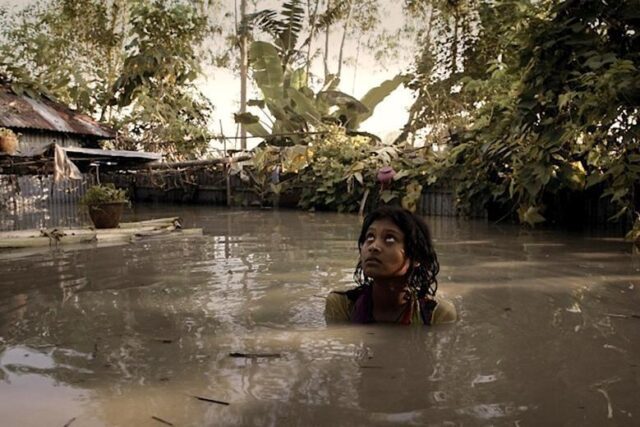
When the storms hit and the flooding began in earnest around the Brahmaputra mud island in Bangladesh, filmmaker Angelos Rallis was ready to start shooting. He was in the region filming a young orphan called Afrin and the Greek director was determined to show what the torrential rainfall meant for her and her community.
“That was a very important process – to actually be there instead of coming in the aftermath,” Rallis explains how he caught the astonishing, apocalyptic imagery shown early on in his new feature Mighty Afrin: In The Time Of Floods. “It’s a very dangerous situation. These mud islands are in the middle of a very wide river. In some parts, it is 7 or 8km wide. Going to the shore is not easy at all.”
When the rains hit, everyone [and every animal] scurried for shelter. Rallis remembers finding a 4-metre python just a few yards from him, also trying to keep dry. He was shooting on his own with just one assistant. They had to put underwater covering on the camera so it wouldn’t get wet and humid. Even so, some of their equipment was lost and destroyed in the cyclone. They had no electricity but were using “20 or 30 batteries.” Every couple of days, the director had to send these to the mainland to re-charge them.
“It was not easy to shoot in these conditions,” Rallis says with evident understatement. He wasn’t only filming. He was helping take people to the hospitals. “There were no toilets. They are covered by water. There is no fresh water and only dried food stocks. It was a situation where the elders and younger kids get sick and need medical treatment. It was very a difficult process to film, to stay there, to be accepted by the community.”
Mighty Afrin, represented internationally by Cargo Film & Releasing, has been winning awards wherever it has shown. Following its premiere at the Thessaloniki International Documentary Festival, it recently picked up two prizes at the Giffoni Film Festival. ZDF/Arte are backers and will be broadcasting the film in 2024. Before then, the film is expected to have theatrical releases in several territories.
“Initially, my intention was to make an observational film about the situation in the broader area. This is when I met Afrin,” the director remembers. He quickly realised that her problems weren’t unique. “She symbolised millions of other children and young people who were facing the same situation.”
The film is part-documentary, part-drama. After the storm hits, Afrin heads on a perilous journey on the rooftop train to the big city, Dhaka. She hopes to find the father she has never met there. Urban life has its own challenges. She is living on the streets with other kids, hunting for food, eking out a living by burning rubbish.
Afrin is a courageous and endearing character. The film is partly a rites of passage story about her growing up. The director talks of “working in between the limits of documentary and fiction in order to achieve a more powerful storytelling experience.” He sees “no limits” between documentary and fiction and argues that with both he is using “light, images and sound” to “create a bond between my characters and the audience.” She is “not acting” as such. This is Afrin’s actual story even if she is occasionally “improvising” and recreating incidents.
At the same time as focusing on his young protagonist, Rallis is also addressing climate change and issues around environmental politics. Shooting carried on over a period of five years.
“The whole structure was formed in the edit which was a very long process. It lasted for almost a year and involved a lot of music, some VFX, observational documentary and some more controlled shooting,” the director explains. He had a top editor, Nadia Ben Rachid (a César winner for Timbuktu) to help him. Early on, Rallis “relied on my own finances” to kick start the film.
The director realised that people in the community around the Brahmaputra mud island had “no references from cinema and films, but they do have [references] from folk theatre which is the main form of artistic expression together with the travelling nomad performers, music and Eastern mysticism (snake charmers, Sufi dance). These are all elements of the River culture in the Bengali delta together with the writings of the novelist Tagore who has shaped their culture throughout the ages.”
Rallis wanted to highlight these aspects of the delta communities’ cultural heritage while using “raw realism” to depict the impact of the flooding.
The director studied filmmaking at Goldsmiths University in London and later worked in the city as a photographer. One of his early projects was recording the lives of the Bengali communities in south and east London. In 2016, he visited Bangladesh with his wife, Maria del Mar Rodriguez Yebra, a physicist who is also the producer of the film. Rallis was immediately fascinated by the resilience of the people living in the delta in the face of the flooding. “Seeing little children and especially elders living in these conditions was something I wanted to bring out with this film so I can give visibility to these communities.”
Since the film was completed, Afrin, now 17, is back in full-time education and hoping to fulfil her goal of becoming an actress in folk theatre. She will be in attendance when the film receives its Bangladeshi premiere at the Dhaka Festival later in the year. “She is in a good moment. There is hope and excitement regarding her future,” Rallis says of her.
The director himself is now developing a new project related to climate change in his native Greece. This will look at the forest fires taking place all over the country. “It’s a recurring event, year after year, severe heatwaves and then we have winds and fires.” The project, yet to be titled, is in early development stage but Rallis hopes to have the first material ready in the coming months.





