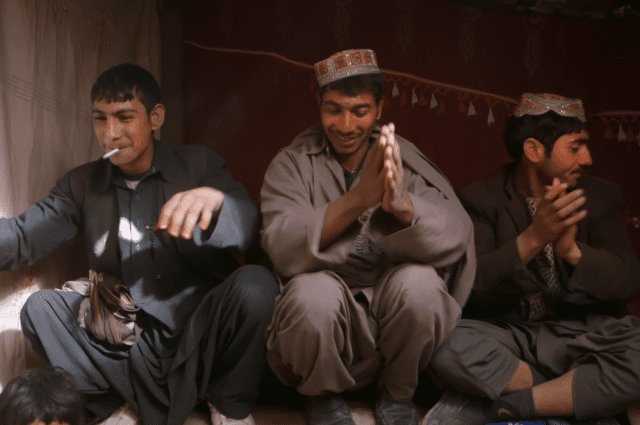
There’s a striking four-year leap in time in Gulistan and Elizabeth Mirzaei’s Three Songs For Benazir (shortlisted for the short documentary Oscar and which has recently premiered on Netflix).
The first part of the 20-minute documentary shows its young protagonist Shaista, happily married to Benazir and living in a displacement camp, planning his future. His options are limited.
Thanks to all the years of warfare and upheaval, he is not well educated. One choice, which he favours, is to join the Afghan army and fight for his country. His father disapproves, worrying he’ll be chopped to pieces by the Taliban.
Another idea would be to go with his friend and work on the poppy harvest – opium is big business in Afghanistan.
In the documentary, Shaista is shown trying to register with the army. Security is very tight. He has a form he must get someone else to fill in – he’s not capable of doing it himself. The filmmakers accompany him through the check point.
“With that scene, we did have to get permission [from the Ministry Of Defence) in advance…there is no way you can just walk in there without permission, but we told them in advance that we wanted to be observing…and just to film whatever happened,” the filmmakers explain.
The documentary then flashes forward and we’re shown the consequences of the decision that Shaista took.
Not that anything was straightforward. The film was made before the Taliban takeover of the country last summer, a development that further endangered the lives of young soldiers. Meanwhile, among the poppy pickers, addiction is rife. The heroin addicts end up “under the bridge.” (Their plight was examined in the filmmakers’ earlier documentary, Laila At The Bridge, made in 2018).
“When we made this film, we were based in Afghanistan full time. Telling this story without being based there I don’t think would have been possible. We were really after these moments of ordinary life that were so fragile and precious. That is what we wanted to capture. That only comes about through friendship with Shaista and being there, filming in the camp.”
Gulistan and Elizabeth are speaking to Business Doc Europe from California where they are now based. Gulistan spent time as a refugee in Iran before returning to Kabul in 2001 and was involved with the Kabul Weekly, the first independent newspaper in Kabul after the Taliban left. Elizabeth moved to Kabul in 2007 and lived in Afghanistan for over eight years.
Now, for very obvious reasons, it is hard for the filmmakers to return to the country. They haven’t been back since the end of 2019. Gulistan has a lot of family members still there but, with the Taliban in charge, the obstacles in visiting Afghanistan are considerable.
Nor is it easy to stay in touch with Shaista whom they’ve known for many years and consider to be a close friend. “There is no electricity in the camp. He [Shaista] has to always borrow a solar powered charger. His phone is always getting lost or stolen.”
Through a producer contact who is still in Kabul, they learned about Shaista’s addiction and immediately made arrangements for him to be taken to an addiction centre. They took the “bold structural choice” to jump four years ahead as that was the only way they could see the film working.
In synopsis, the documentary may sound dark but Gulistan and Elizabeth describe Three Songs For Benazir as a love story.
“The film is about a relationship, about two people in love and about a young man who wants what all of us want…stability, peace, happiness, love,” Elizabeth explains. “That was what drew us to these ordinary moments, which are actually extraordinary moments, in the film.”
She adds that the “harshness” of life in displaced people’s camps has been documented exhaustively already in news reports. She and her partner were far more interested in the “love and intimacy” between the couple – and how that eclipses all the suffering around them.
The filmmakers initially thought that Shaista would be able to join the army without any problems. “When that didn’t happen, we were just following him for the [rest of his] journey and what did take place. We weren’t sure what the film was going to be. We let [the] story dictate that to us.”
Their protagonist is in much better circumstances than when he was “under the bridge.” However, life remains tough and new restrictions on personal liberties don’t help. Earlier this month, Shaista had hoped to celebrate the Netflix premiere of the documentary with his friends.
“A couple of days ago, the Taliban opened a police office right in back of his brother’s store,” Elizabeth explains why that idea was very quickly nipped in the bud. “It’s too risky now even to play music and have a celebration of the film.”
But, yes, Shaista has seen the film. The filmmakers showed it to them through a WhatsApp feed on their cellphone.
Netflix discovered Three Songs For Benazir through sales agent Cinetic. “They came on board in November…it has been amazing to have them as a partner telling this story, to have this global reach we could never have imagined,” Elizabeth notes of the huge boost in visibility that the streaming giant has already given their documentary.