When Guinean director Thierno Souleymane Diallo finally finds a 1955 review in Le Monde of Mouramani, a short film by the young Guinean filmmaker Mamadou Touré, it isn’t favourable. Nevertheless, the paper does notice ‘une sorte de langueur qui n’est pas sans charme’ – the film has ‘a kind of languor, which is not without charm’.
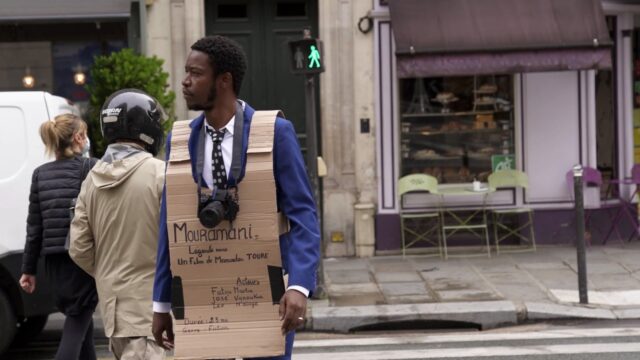
Interestingly, the latter compliment also applies to The Cemetery of Cinema, Diallo’s engaging feature doc debut which goes in search of Mouramani. Without in any way being ‘slow cinema’ – as a great deal happens, on various levels, during the film’s 93-minute running time – there is a pleasant, leisurely flow to the proceedings, as Diallo travels across Guinea barefoot (in protest, we later learn, at the lack of film funding in his country) and on a donkey, accompanied by upbeat, hopeful music by Dom Peter.
It is one way in which Diallo’s film seems to mirror its subject, except that Mouramani is lost. As a kind of running gag, Diallo keeps meeting people who have heard of the 1953 short – known as the first film directed by a Black filmmaker from francophone Africa – but who haven’t seen it. “I don’t know anyone who’s seen it,” warns French film scholar Olivier Barlet.
On the surface, The Cemetery of Cinema is straightforward enough: Diallo is a young, enthusiastic Guinean filmmaker in search of the lost film that reputedly launched Black Guinean cinema. Therefore, he meets with older Guinean filmmakers and people who might have known about the film or its maker.
On another, related, level, The Cemetery of Cinema works as what Martin Scorsese might have called ‘a personal journey through Guinean cinema’. Not by showing clips, but by actually journeying: seeking out people and old cinemas. Tragically abandoned cinemas, where rusty canisters and unrolled celluloid litter the dusty floors behind broken windows. Any film lover will weep to see the ruins of the one-time cinema halls Diallo visits with their often heartbroken owners and caretakers. There’s a depressing nostalgia here, tinged with anger at what has been allowed to be lost.
Beneath this, there is yet another level. Without going into detail (my own lack of knowledge of Guinea’s 20th century history meant I didn’t always know exactly what people were referring to, although the general ideas were clear enough), the ghosts of military dictatorships and one-party rule loom large behind the stories of a once important regional cinema hub forced to close for political reasons.
And although we keep coming back to Mouramani (whose surviving synopses don’t even agree on what it was about) a larger theme slowly emerges, and on a level even deeper than politics: the importance and significance of archives. Of preserving the culture and history of a people. Of recognising – and safeguarding – the creations of one’s ancestors. “We do not have a culture of archives,” declares a former film censor whom Diallo interviews, emphasising every word.
The people Diallo meets who share his interest and commitment to film history – as part of national history – are moving in their efforts to preserve what they can while everything around them crumbles. Like the man who explains he is keeping the rusty film canisters in an abandoned theatre ‘for posterity’ – without any funding nor any way of keeping them safe or in the right storage conditions. Or, even more strikingly, the man who made a list of all the films he knew were going to be burned, “to keep a trace of everything we lost”.
There is much bravery in these archivists, against all odds. While history moves on, people forget, politicians destroy what they can’t use and impoverished youths steal old cameras to sell for scrap metal. But lone archivists save whatever they can – even when it’s very little, even when they do not even know what will happen to their canisters, their lists, once they themselves are gone. Because, as Diallo laments, there is no infrastructure in Guinea to protect these materials and this information.
But in the end, this isn’t a sad movie. For just as the film’s langueur and charme relate The Cemetery of Cinema to its lost ancestor, Diallo’s film steps into other empty spaces left in Guinea’s film history. At one point a village elder – who even worked as a cinema ticket clerk in his youth – says that cinemas were much more “upstanding” than what kids watch online nowadays, and states “I’d like to see films of Diankana daily life. How people live, how women work the land.” The next shot is of Diallo filming women at work and before we know it, he has organised an open-air screening for the whole village, who turn out in large numbers, laughing as they see themselves and each other on screen.
It’s a simple and brilliant intervention by Diallo, and it justifies his personal approach to what, in other hands, could have been a straightforward documentary, filled only with talking heads and a knowledgeable voice-over. Instead, The Cemetery of Cinema is relatively light on information (without feeling too superficial) and is as much interested in searching for the lost emotions and experience of cinema as it is in the historical facts and dates.
Put differently, the documentary doesn’t just note the names and dates on the tombstones in the ‘cemetery of cinema’, but actually spends time wandering among the graves, enjoying the graveyard’s beauty and recollecting and even re-enacting the memories that haunt it. As Diallo has written elsewhere: ‘Researching this film is for me a way of making my own Mouramani.’
I’ve lost count of the number of levels I’ve already mentioned, but I want to stress that this multi-level approach does not in any way make The Cemetery of Cinema a heavy-handed or complicated affair. Watching it is as easy as taking a walk in the park. Although a lot happens, the film just glides through it all, propelled by Diallo’s winning personality and his unwavering optimism about his craft and his art.
And then – you’ve guessed it – there’s another, more subtle level that runs through the film. All the time that Diallo is making his documentary as a one-person film crew with a camera and a boom, he is being filmed by a crew he never acknowledges as even existing. It’s a great little conceptual twist, making the film not about finding Mouramani, but about Diallo looking for Mouramani, and at the same time acknowledging the documentary as a construct, as something aware of itself, as something up for interpretation and discussion. Suggesting, even, that this discussion, about film, about cinema, is ultimately its goal.
Similarly, when Diallo meets with a group of film students, he tells them about what Dutch documentary master Joris Ivens once did in Cuba when he didn’t have cameras for all his students. He gave them fake wooden ones. Diallo does the same thing now. His students are up for it, filming outside with their pieces of wood, discussing shots and angles, thinking through their project. And then, afterwards, they discuss the film they’ve made – in their heads – with Diallo and their classmates. It’s a lovely scene, and funny as well, and almost effortlessly carries great metaphorical weight. It’s not just that when films are missing (because they’ve been lost or there’s no money to make them) we have nothing left but to talk about them – no, the scene demonstrates that sharing your thoughts about a film which exists only in your mind can be an invigorating cultural experience in itself.
Which is the same as saying that the list the archivist made of burned films is not just sad, it’s important. Meaningful. Beautiful. It says that searching for a lost film is itself beautiful – whether you find it or not.
Guinea/France/Senegal, 2023, 93 minutes
Director Thierno Souleymane Diallo
Production JPL Productions, Lagune Productions, Le Grenier des ombres, L’Image d’après
Producers Maud Martin, Jean-Pierre Lagrange, Marie-Louise Sarr, Alpha Amadou Diouldé Diallo
International sales Reservoir Docs
Script Thierno Souleymane Diallo
Cinematography Leïla Chaïbi, Thierno Souleymane Diallo
Editing Aurélie Jourdan, Marianne Haroche
Sound design Brice Kartmann
Sound Ophélie Boully, Jean-Marie Salque
Music Dom Peter
With Thierno Souleymane Diallo, Penda Lam, Aboubcar Condé