

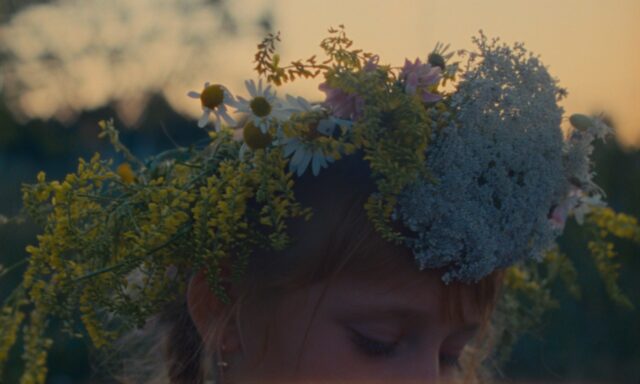
For a kid, it must seem idyllic. The former military barracks at Scheinfurt, the town where co-director Daniel Asadi Faezi grew up, offers up vast areas for exploration, corridors to roam along, abandoned offices and hallways to discover and flower-laden meadows in which to gambol, pick flowers and make wreaths and garlands to wear. And all is bathed in warm Spring sunlight.
But the kids shouldn’t be here. Back home there is a war, and therefore their families are incomplete, as evidenced by a touching video call during which a young lad implores his dad, back home alone in Ukraine. to drive past the kindergarten that the boy misses so much, just so he can see it once more, if only on a smartphone screen.
On the barracks walls, originally built by the Wehrmacht, there are high friezes which detail former conflicts, the significance of which the kids muse over. Meanwhile a girl writes ‘Putin, stop killing people’ ad infinitum in chalk along a roadside kerb, and a serious faced adolescent boy steadfastly sets about repairing a puncture on his bike.
The film, a small jewel, was shot over two weeks and works as a poignant snapshot of life during wartime, with protagonists who, of course, understand the nature of the conflict they have left behind but also whose primary concern is to do what kids do – to play, to explore, to be curious – and to adapt to new life in the process.
“We felt that the children had a really interesting way of moving through space,” says co-director Zhluktenko, who was also co-editor on the recent Sundance feature doc Iron Butterflies by Roma Liubyi. “What is particularly special about them is that they have a different feeling of time. From what I experienced they live very much in the present, but sometimes the past also breaks through. Meanwhile, the mothers and the grandmothers are very much caught, of course, in their thoughts and pre-preoccupied with the situation. But the children seemed to forget sometimes what was happening.”
That said, whereas the German kids would play ‘hide and seek,’ the Ukrainian kids were as likely to play a new game called ‘air-raid,’ Zhluktenko adds. “And they were moving in a place with a heavy history, but without knowledge about that history, because of course, they’re young and they still didn’t maybe learn somethings in school. And they were discovering this space as if they were archaeologists who found something unknown. And we thought that was also very interesting to portray and to see and to show. Of course, it was very important to us to bring it closely to the audience, how people feel for the first time after they have just lost their home country.”
The directors were determined not be a burden on the kids when they were making their film, and that the creative process was stimulating for them. “We had an agreement with the children, because we shot it in vacation time, that they could also leave us if it’s not fun. So we had to adapt a lot because they were, of course, free to go and to do whatever they wanted to. We tried to create an atmosphere in which they would like to be on the set, and it would be interesting for them.”
Co-director Faezi reminds of the initial premise for the film and the subsequent shift in emphasis. “Our main focus of research was the building and the history of the barracks. We had already bought film stock to shoot, and then suddenly the attack happened on Ukraine and a lot of refugees came to Schweinfurt. We were faced with the situation that now the whole environment of the barracks changed because over a couple of nights 200 mothers and children moved into that building,” he says.
“So then we decided, okay, we want to react without being activistic about the situation, and to create something more sustainable than just a TV reportage on this situation. But still, we were kind of experts on the history of the building and the military territory. So we used this knowledge about this place, and of course through Mila’s access and [knowledge of the] language it was way easier to research, to get in touch with the people, to get their trust, and then to work with them on the film.”
The filmmakers believe that the film’s selection for Berlin Generation has a particular resonance, given that the protagonists and their mothers will be in attendance. “I think it will be super interesting for both sides, for the Ukrainian children, but also for the children and the audience to interact after the film, or just to give representation to the children who are involved in this film, and who made it so beautiful,” says Faezi.
“A lot of German children at Generation will have Ukrainian classmates in their schools,” adds Zhluktenko. “And I really hope that this film will create more empathy for their situation…and of course to talk about Ukrainian topics and what is happening right now to an adult audience.”





