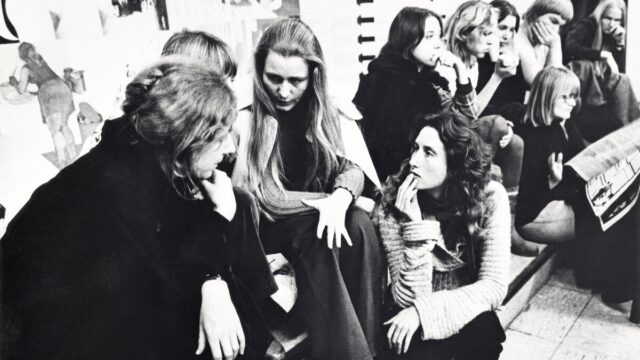
It may have been shunned by Norwegian television executives (male) back in the 1970s and subsequently shelved for nigh on 50 years, but Vibeke Løkkeberg’s chronicle of the first International Women’s Film Seminar at Arsenal Cinema in Berlin, in 1973, still packs a political punch in offering up a timeless reflection on gender equality (or lack thereof) and representation.
The event was the brainchild of filmmaker/activists Helke Sander and Claudia von Alemann, and was presented in the spirit of 1968, when the worlds of politics and idealism were turned on their heads. Yes, it was a conference and seminar, but it was also a festival, and one of the directors in tow was the Norwegian Løkkeberg, there with her film Abortion, itself influenced by the Nouvelle Vague, and which argued for abortion reform in Norway.
When Løkkeberg turned up in Berlin, she was carrying a movie camera, because she was determined to record the opinions of fellow female filmmakers and, when possible, the conference debates. Her resulting film is testimony to the ambition, courage and an unwavering fight for equality among her fellow colleagues.
Delegates answer Løkkeberg’s questions with transparency. If a female worker approached a production job in any other than proscribed, standardised fashion, they were deemed “mad, bad and stupid,” says one respondent, who adds that “technical knowledge” was as likely to provoke anger as praise among male colleagues.
In New York, a request from a woman to hire equipment was much of the time met with derision, which spawned a need among female professionals to “prove, prove, prove” they could be “better, better, better.”
“If we know what we want, this is already an aggression,” another woman stresses of the situation back in 1973, and yes, the likelihood of sexual exploitation was a given. Elbows had to be three times sharper, but on the other hand there was a requirement to “stay feminine” so as not be considered “too manly,” says a further contributor.
But as we see in the archive film, professionalism, resilience and ambition are attributes that all interviewees possessed by the bucketload. “You have to be very active and aggressive, and insist on your point of view and your rights,” says one German news editor. “Woman’s issues are fundamental issues that run ‘horizontally’ across everything. You cannot isolate them.”
“Making is power,” says another. “Power is necessary to be able to speak and write.”
The film is a snapshot in time. It is monochrome, everybody is smoking (even inside the building) and the photocopier is straining to print out the agendas, but the groovily clad personnel could be transplanted into any 2025 setting…where they would still encounter a glass ceiling, argues director Vibeke Løkkeberg, now 80 and still very much an activist. (She was 28 when she filmed the seminar).
“We still have no power to stop anything or to influence on anything,” she tells Business Doc Europe. “We have [achieved] small things which will, in some years time, show that we were trying. But really I think we have no more power than I had hoped for and believed in 1973.”
Does that mean the #MeToo movement was all for nothing? “There is some progress and that is very good. But actually we see that the guys are still getting much higher budgets than the women and also getting more films to make, especially movies for theatre.”
“I am shocked in a way to have that feeling of ‘well here we are again.’ This is exactly the same thing we were struggling with in 1973. It is a system which is not made for women,” she underlines.
It is also an argument that is just as applicable across the wider political spectrum, if not more so, she adds. “There’s men in black suits who decide if it’s going to be a war or not. There’s not one woman in there. Or if there is, I can’t see them.”
In 1973, abortion had been legalised in the US. Now it is all but totally outlawed. “You can go to jail. It is terrible,” she says of the 180-degree turn following U.S. Supreme Court’s repeal of Roe v. Wade legislation, thereby opening the door for states to ban abortion outright.
Which is why the business of filmmaking is, in itself, a political act, Løkkeberg argues. “For artists, the time has come to de-glamorise their cinematic expressions and to prioritise closeness to content over a polished form that risks creating distance or obscuring the message,” she writes. “Every major turning point in the world creates a new canvas for artists. I would argue that our turbulent world today is experiencing just such a turning point.”
The Norwegian director will be tackling the subject once more in feature doc sequel, together with her filmmaker daughter Tonje Kristiansen, and will interview again some of the original cohort of filmmaker/activists from 1973 alongside their contemporary counterparts.
Additionally, Berlinale’s February 14 Directors in Dialogue session at the Felleshus Auditorium will feature a thought-provoking on-stage conversation between the mother/daughter pairing, reflecting on 50 years of gender imbalance in cinema.
“We want to find out why it is still like it is. Why are we not in the director’s chair where we have the authority to move people?” Løkkeberg signs off.