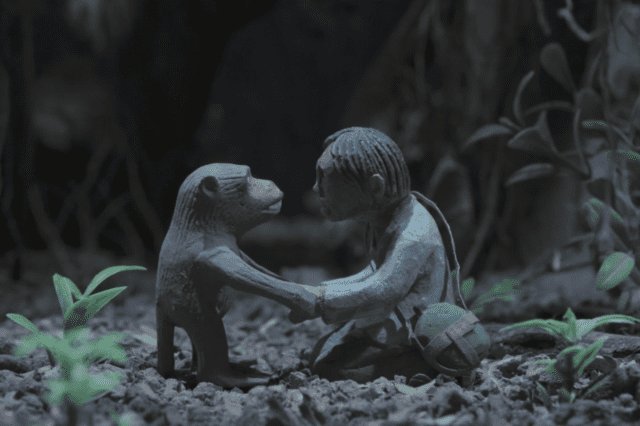
Rithy Panh’s Everything Will Be OK won a Silver Bear for Outstanding Artistic Contribution in Berlin earlier this week. It’s a bleak essayistic documentary which uses both archive material and clay figurines to tell a story of cruelty and destruction.
In earlier works like The Missing Picture and S21: The Khmer Rouge Killing Machine, the Oscar-nominated director dealt with Cambodia’s experiences under Pol Pot. This was the period when the Khmer Rouge “emptied the city. They deported all the population outside the city to the countryside. Everything was empty on the streets.”
The new film has a much broader and more generalised vision. Its theme is what Shakespeare called “man’s inhumanity to man,” the violence and destruction that human beings have wrought on each other. Alongside imagery of genocide, there is footage of cattle being killed in abattoirs and chickens slaughtered. As in Orwell’s ‘Animal Farm,’ pigs seem to be in control, overseeing the carnage.
Despite its subject matter, the film (sold by Playtime) is delicately and intricately crafted. Every frame is a mosaic of suffering.
Interviewed in the Hyatt Hotel in Berlin, the Cambodian-French director concedes that Everything Will Be OK is “not a narrative film.” He is asking audiences to watch it with “a poetic eye.”
The director wants spectators to “reach a childhood feeling, a pure beautiful feeling in each of us…a pure voice, a pure beauty. I would like to wake this thing up and bring it to match with our figurines, our history.”
Put it to the director that the film’s vision is bleak in the extreme and he demurs. The title Everything Will Be OK comes from the t-shirt a protester had been wearing when she was shot dead in Myanmar after last year’s coup. Panh insists that he is not being “sarcastic” by using it.
“It [the slogan] is like a hook. I know what is the nature of the human being. You know it. You read history. You know what happens in the film.”
Everything Will Be OK is fill of cinematic references – to Dziga Vertov, to Fritz Lang’s Metropolis with its vision of human beings enslaved in a futuristic world, and to Chris Marker’s La Jetée.
Vertov, the Soviet Russian director of 1930 classic Man With A Movie Camera, intrigues and confuses Panh. “I don’t understand exactly if Vertov makes propaganda or if Vertov makes a film against the regime of the time. [Sergei] Eisenstein is the same. Sometimes, it’s like it’s propaganda, the film, but sometimes it is a very strange point of view.”
Earlier in his career, Panh used to believe that he “had the capacity to change things.” In his 20s, the director would go out with his camera, shooting on the streets and in the rice fields, convinced that he was capturing some deeper human truth. “At the beginning, when I started making films, I sincerely believed in the truth of cinema.” That belief has dissipated over the years but filmmaking is still his medium of choice.
“Cinema exists. It is here, like poetry, and so I take cinema,” he says.
Panh is a difficult interviewee. He doesn’t so much give answers as make gnomic utterances, some of which are very hard to interpret. One point he does make clearly is about food production. He argues that it is not at all natural to take protein from one animal to feed to another and thereby to create nourishment for humans (for example, to take protein from cattle to feed fish). His film features grotesque scenes of humans filming themselves on social media, eating live animals
as part of eating competitions for the benefit of viewers on Tik-Tok.
“It’s an obscenity in our society. We have what we want but we don’t share. We go to contests. We eat octopus that is still alive, we eat raw meat…”
Now, Panh points out, there are “space tourists” who have so much money they can afford to book themselves onto intergalactic flights. At the same time, there are children who don’t even have clean water to drink. “As a humanist, I cannot not compare,” he uses a double negative to explain why he is so keen to expose inequality.
Alongside his filmmaking, Panh has a second career as a teacher and guru. He is lead mentor at the Doha Qumra Short Documentary Lab where he helps aspiring filmmakers from all over the Middle East with their documentary projects.
Asked if he feels uncomfortable about working with patrons from countries accused of human rights abuses and he replies: “frankly, if you look at everything like that, we must stop. It’s a deal, a negotiation.”
The question is whether it is better to stay “outside shouting for human rights” or (as Panh puts it) ”to go inside and try to do something.”
“In my Lab, the students come from Palestine, Jordan, Sudan,” the director continues. “Most of them are women. I know what happens today. I can say also that European countries sell a lot of planes to those countries.”
Panh’s students tend to be very young. “I am not pushing them to protest. That is not my proposal. My proposal is to train them to make film…they [learn to] know the value of images.” Through the Lab, Panh gives opportunities to filmmakers who might otherwise never have picked up a movie camera.
Returning to Everything Will Be OK, the director again accentuates the positives. The film may be a chronicle of death and destruction. That, though, is only part of the story. “We know that human beings are very strange animals…but we have hope,” he concludes.