

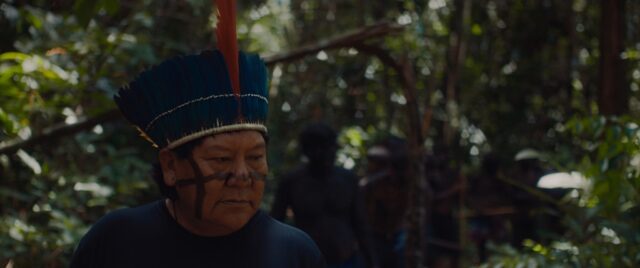
The Last Forest, Luiz Bolognesi’s remarkable new film, is set in an isolated Yanomami community deep in the Amazon forest in Brazil. Its subjects go about their daily lives even as rapacious miners and gold prospectors venture onto their ancient lands.
Thanks to President Bolsonaro and the Brazilian Congress, old laws which kept the outsiders at bay are being eroded. The Yanomami are in danger as never before. Police and soldiers no longer intervene to protect them.
The film (sold by Brazilian outfit Gullane) sprang out of its predecessor, Bolognesi’s 2017 doc Ex-Shaman, which also screened in Berlin, and which focused on a former shaman in an indigenous community forced into evangelic Christianity. He loses his powers as a result.
In the new film, another powerful shaman, Davi Kopenawa Yanomami, is still at the centre of his community.
Bolognesi and Davi met for the first time in early 2019. They struck up an immediate rapport. Firstly, the director went on his own for a two week stay in the Yanomami village. Then, three months later, he returned with his crew. They stayed for five weeks.
“In the beginning, they [the Yanomami] were not too comfortable with our presence and the camera there, but they began to understand it [the filmmaking process],” the director remembers. Their only request was that the filmmakers shouldn’t film the babies as they felt that might “make their souls sick.” Adults, though, were considered robust enough not to be affected by being caught on camera.
In the doc, the Yanomami share stories about their creation myths, their life and their culture. Bolognesi says the Yanomami were determined to “show white people how they are” so as to receive the respect they deserved. They also wanted to leave a record of their lives.
“After two or three days, they didn’t care about the cameras,” the director notes. As shooting continued, they began to regard the camera as “one more shaman with the power to open minds and listen to the spirits.”
The film gives a strong sense of the women’s role in Yanomami culture, which Bolognesi was keen to emphasise wasn’t patriarchal. What’s more, among the Yanomami, dreams are taken every bit as seriously as “real” life. They believe fervently in the spirit world. When they watched some of the images that Bolognesi had been shooting, they said ‘this is magic,’ as if the filmmaking process was an extension of their own rituals.
“Everything they do is so beautiful,” Bolognesi rhapsodies about the everyday poetry in their lives: their storytelling, their relationship with nature, their myth-making and their craft tradition.
The director was struck by his subjects’ extreme cheerfulness. They never plan ahead. That means they don’t worry about the future. “The consequence is that they are very, very focused on the moment,” he says. Stress levels among the Yanomami are very low. Even in dangerous situations, they stay level-headed. Bolognesi talks about walking with them through the jungle and hearing a jaguar nearby. He immediately got very nervous and frightened. They stayed cool. “They know it is not useful to be angry, to be furious, to see red. Even when they are fighting problems with these miners who are coming to their lands and destroying everything, leaving mercury in the river that kills fishes and animals, they keep calm.”
“They keep laughing!” the director further exclaims. “They go to fight against miners and when we are on the journey, they are making jokes. Even when they can die, maybe someone can shoot them, they are laughing all the time.”
The film includes footage of Davi addressing students at Harvard College. “I thought it would be interesting to show people that this shaman who lives in the forest, who seems to be a poor man, is invited to talk there.” The visit to the Ivy League college really did happen. As one of Brazil’s most important shamans, he receives invitations to many other universities and cultural institutions. In 1989 he won the UN Global 500 award. This year, he has become a member of the Brazilian Academy of Science.
Davi has also written a book, ‘The Falling Sky’, in which he shares his beliefs and discusses the violence and disease his people have suffered from white missionaries and gold miners encroaching on their territory.
However, in keeping with the rest of the documentary, the trip to Harvard is a given a dream-like quality. Audiences are left to make up their own mind as to whether he is actually there or whether this is another of the shaman’s visions…





