Victor Kossakovsky’s Architecton is a companion piece to his earlier documentary about water, Aquarela (2018). He even begins the film with a direct comparison, stating that after water, concrete is the most used ‘substance’ on Earth.
This seems unlikely. It partly depends, I suppose, on what you consider a ‘substance’. CO2? O2? But if water is a substance, then surely sand is too. And sand is used not only in concrete, but also in many other ways. Which would make sand more widely used than concrete, I would think.
But it’s true that concrete is ubiquitous in architecture. The amounts used worldwide are staggering – and growing. In 2015, a news headline in The Washington Post stated that China had used more concrete in the previous three years than the United States had in the entire 20th century.
This is a fact you will not find in Kossakovsky’s film, however. As usual, his approach is much more cinematic than journalistic. And cinematically, he has few peers in the grandeur of his approach to seemingly everyday subjects.
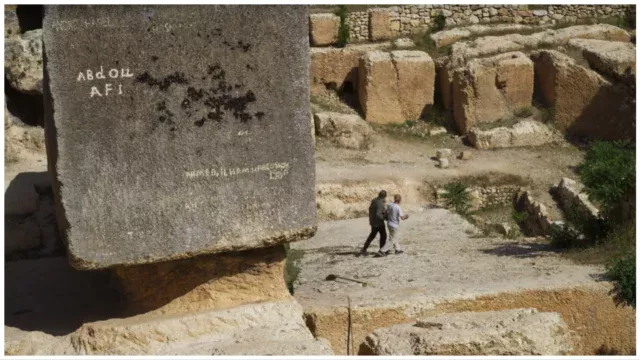
And it’s not water this time, but rocks – the rocks that provided the stones for ancient archaeological sites, with some columns still standing, steps still leading upwards, squares still awe-inspiring with their magnificent proportions and views, after thousands of years.
And the rocks being blown up in quarries, filmed spectacularly both from afar, Nature seemingly shattering from within, and up close, rocks and gravel falling and rolling in slow motion, almost, perhaps not coincidentally, looking like streaming water. Fascinating, mesmerising, Cinema. My only regret with this hyper-textural and spatial approach is that it wasn’t filmed in stereoscopic 3D.
Kossakovsky uses drones to move slowly past rock facades, accompanied by Evgueni Galperine’s solemn music. And here, I must be honest in a way we film critics rarely are. As I write this, I’m halfway through the Berlinale and this was an early morning screening. There’s almost no dialogue in Architecton, and for long stretches we don’t see any people, just these slow panoramas of stone and the droning sounds of Galperine. You can probably guess what I’m going to say next: at times, I almost dozed off.
In the end, I did not miss any of the content of the movie. But I have to admit I did not fully immerse myself in its hypnotic metre. Which is, I’m sure, the film’s strongest quality. Shots like the aforementioned ‘streaming rocks’ are gorgeous and awe-inspiring. Sublime, even. As is the long drone pan past a rock face which ends at a point where the facade suddenly explodes in slow motion, as if the earth itself had erupted in anger.
Had I been more focused, I expect I would have had a more zen-like experience of the film as an art piece. Because more than making a statement about rocks, concrete or architecture, the film makes you experience them. And Kossakovsky is extraordinarily good at this.
In between, we keep coming back to the Italian architect Michele De Lucchi, building a rock circle in his garden. The plan, we learn, is to never let any human (or the automatic lawnmowers that are circling the circle) enter this circle, and to let it grow naturally and wild. So that there exists at least one place where humans don’t come first. A place that teaches humility.
De Lucchi wants to build these circles in the centres of cities, which is artistically and philosophically interesting, but practically unlikely: what city would cordon off its most prized location to its citizens?
In the epilogue, Kossakovsky questions De Lucchi on what appears to be the central thesis of Architecton: how is it possible that thousands of years ago we knew how to make architecture of lasting beauty, and now we can only make ugly buildings which last only 40 years? It’s a simplistic question (most buildings of the past have crumbled, especially everyday ones, and there are certainly still beautiful buildings being made today), but more disappointingly, De Lucchi’s only answer is that he is indeed ashamed to have contributed to the creation of concrete blocks in beautiful cities like Milan. And that’s it.
This is where Architecton falters. There are so many ways to answer Kossakovsky’s question (including that most buildings that survive from antiquity were centres of power and wealth, like temples and palaces, built by oppressed workers and enslaved people; and that there could never be enough marble and similar materials to build normal houses this way today), but we get, essentially, none.
Also, the climate arguments against the use of concrete, which Kossakovsky emphasised in the press notes and during the Berlinale press conference, are nowhere to be found in the film. Nor is the shocking fact that the world is actually running out of sand. At the same time, Architecton opens with the shelled ruins of Ukrainian apartment blocks – exactly the kind of buildings Kossakovsky says shouldn’t have been built this way in the first place. Aesthetically, these drone shots are dramatic and striking, but thematically they confuse the narrative.
Another example is Kossakovsky’s use of the Cretto di Burri, the land art project by Alberto Burri which immortalised the Italian town of Gibellina, after it was completely destroyed by an earthquake (an artwork also featured in another Berlinale documentary, Costanza Quatriglio’s The Secret Drawer). Burri recreated the entire city plan in concrete with astonishing, almost otherworldly effect. It’s about the best use of concrete imaginable – but in Architecton it is presented, I’d say insultingly, as a dystopian vision of our architectural future. Again, Kossakovsky muddles the argument. But even though narratively, these scenes don’t do Cretto di Burri justice, visually they are just as gorgeous as the rest of Architecton.
Germany / France 2024, 98 minutes
Director Victor Kossakovsky
Production Ma.ja.de.
Producers Heino Deckert
International sales The Match Factory
Script Victor Kossakovsky
Cinematography Ben Bernhard
Editing Victor Kossakovsky, Ainara Vera
Sound design Alexander Dudarev
Sound Alexander Dudarev
Music Evgueni Galperine
With Michele De Lucchi, Victor Kossakovsky