It’s mid-morning in the Berlinale Palast and the first press screening of Architecton, Victor Kossakovsky’s new feature doc, has just finished. The film, sold by the Match Factory and made through Heino Deckert’s ma.je.de, is in the festival’s main competition.
This is Kossakovsky on architecture – a lyrical, hypnotising and often disturbing documentary that includes everything from massive landslides to shots of bombed out Ukrainian buildings, from ancient monuments to scenes of Italian architect Michele De Lucchi creating a stone circle in his garden.
How did the Russian director capture those astonishing moments in which stones are shown cascading down a mountain in rumbling, furious waves? “It’s a secret. I don’t want to disappoint you,” he laughs. “It’s not what you think…”
However, Kossakovsky is happy to explain why he included the early shots of bombed out Ukrainian cities.
“As a Russian citizen, I can’t enter Ukraine. I found people who know me and they filmed a few towns in Ukraine. It doesn’t matter the name of these places but it’s important [to show] that it’s obviously after attack from the Russian side. In my opinion, the ruins are showing more than documents. You can’t lie. You don’t need words. You see buildings that have been destroyed and you see from which side of the world the missiles came. And then you know who is guilty…it is obvious.”
Architecton is hardly a film about the war in Ukraine – but the war had a profound effect on the way the director approached it.
“I cannot ignore the fact that it is happening. I can’t pretend it is not happening,” Kossakovsky says. After the full-scale invasion began, he initially wanted to stop making the documentary (which he had already started work on) but his producers told him he had an obligation to complete the project.
At this point, the film’s scope changed. The tone became far more solemn. Kossakovsky also includes imagery from cities destroyed in the 2023 Turkey earthquakes. We see buildings with their facades ripped away and looking like London houses after the Blitz.
Kossakovsky had originally planned Architecton as “a satirical comedy about modern architecture.” He wanted to highlight the wastefulness of the profession.
One of his starting points was what to do next with the space left in the centre of Berlin by the closure of Tempelhof Airport. He approached around 100 leading architects, asking what they might do. Could they build a mosque there, a museum or a temple? He predicts that somebody soon will try to make money from the space.
Italian Michele de Lucchi was one of the architects Kossakovsky approached. He became a central figure in the documentary. He is shown constructing a circle in his garden that no human is allowed to enter. The Italian also reflects ruefully on some of his own buildings, box-like skyscrapers in the centre of Milan which certainly haven’t been built with an eye to the future.
London too is full of new towers and office blocks thrown together in seemingly random fashion. They’re put up…and then they’re pulled down again. In the UK, the director estimates that 50,000 buildings a year are needlessly destroyed. These buildings have an average shelf life of 40 years. “In the UK, which is a conservative country, they have buses that last 50 years,” Kossakovsky points out that architects simply aren’t thinking about the future.
In China, the short-sighted wastefulness is even more pronounced. “In the last two years, China produced more cement than all the United States did in the last 100 years…if the United Nations prediction is correct, what is going to happen is that we are going to be 10 billion people, with 2 billion [more] in the next 25 years. They are supposed to live somewhere,” the director does his sums. To house the world’s estimated future population, “we need to build [a new] New York City every month, starting today.”
Kossakovsky predicts there will be a race to construct new homes as fast as possible. Quality will be neglected, just as it was in the new building boom in Germany after the Second World War. New cement jungles will spring up everywhere. The long-term consequences will be aesthetically and environmentally catastrophic.
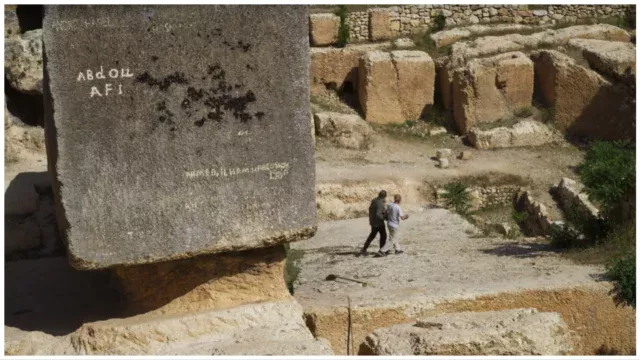
The film includes exquisitely shot imagery of the majestic temple ruins of Baalbek in Lebanon, dating back to AD 60, Kossakovsky cites this as an example of genuinely “sustainable” architecture – beautiful buildings made thousands of years ago that still stand today. “And we pretend that we are making sustainable architecture for the next 40 years. Then we destroy it again – and we build it again…we destroy mountains and we create mountains from garbage, from ruins of buildings.”
In stark contrast to the director’s earlier film Gunda (2020), which also screened in Berlin and focused on farmyard animals, Architecton has very few animals. A dog is briefly seen late on in the Italian architect’s stone garden, birds are heard on the soundtrack but the main emphasis here is on rocks and rubble.
“We still continue torturing each other in prison and killing each other…we still agree to kill each other. My question is why we are doing it,” Kossakovsky makes a familiar point. He still sounds pessimistic about human nature. “We are killers. This is what we do.” He lists the millions of pigs, chicken and fish, cattle and sheep slaughtered every day for food. He believes that as long as humans keep on killing animals, they will also carry on killing each other. “We have to stop doing it – and then we will not make war. Then we will respect nature and then we will see that even stone is alive, even mountains are alive.”
Architecton is Kossakovsky in monumental groove. Put it to him that it is a very long way removed from his more intimate work like, for example 2003’s Tishe! which he filmed from a window looking out on a single street and he answers in enigmatic fashion.
“Wait for my next movie…my next two films will be totally opposite in form, seriously different in topic,” he says. What are they about? “It’s going to be a very nice surprise,” is all he will say, but all the hints are that his next films will see him back in more playful and intimate mood.