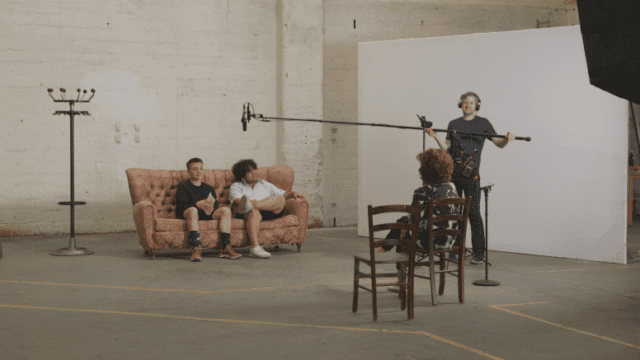
The sofa was there anyway, in the abandoned factory in Vienna. It had just the right look for Ruth Beckermann’s feature doc Mutzenbacher (screening in Visions du Réel Latitudes following its world premiere in Berlin Encounters). It was pink, a little bit frayed and seedy, “an erotic sofa” as one interviewee puts it.
It was on this sofa that Beckermann’s subjects would be sitting as they read extracts from the notorious 1906 pornographic novel ‘Josefine Mutzenbacher, or the Life Story of a Viennese Whore.’ It was sitting here that the subjects, men aged between 16 and 99, would share some of their thoughts not just about the anonymously [and illegally] published book from more than a century ago, but about their sex lives too.
“The story of the sofa? The story of the physical sofa or the story of the symbolic sofa?” The director responds when asked about that very striking piece of furniture in her documentary.
When the novel was first published, Sigmund Freud had recently written his ‘Three Essays on the Theory of Sexuality.’ “It was actually the first time that sexuality became openly a scientific topic and was discussed quite a lot, especially in Vienna,” says Beckermann.
This was also the city in which Arthur Schnitzler had written and published his 1897 play ‘La Ronde,’ which looked in forensic and satirical fashion at sex and class. Vienna in this period was turning into a huge industrial metropolis. It was a period when there were an estimated 30,000 prostitutes in the city.
The men in Beckermann’s film were recruited by advertising in the Austrian press. 150 Austrian men replied – and around 75 were eventually invited to take their place on that pink couch. The director didn’t speak to them beforehand but was pleasantly surprised by their openness. Popular cliché has it that men don’t like to talk about sex or intimacy, but Beckermann’s documentary suggests the opposite.
On camera the men seemed incredibly relaxed. They appeared to be enjoying themselves. “They were, especially when they were all together for these choirs…When they were on the couch, of course, people were very different. Some were a little embarrassed. Some were surprised. Some knew the book. Some were like characters out of the book! There were one or two men who were so Viennese in their language and way of speaking that [it seemed] they came from another time.”
Why make the documentary now? Beckermannn admits to some prosaic reasons. Another film she had intended to make had been derailed by the pandemic. She was sitting at home “playing cards and doing puzzles.” A deep dive into the murky world of Viennese sex and masculinity would at least be a good way of passing the time. It certainly beat solitaire.
“But somehow sexuality is the topic [now] but in a completely different way. Of course, [Harvey] Weinstein and [Jeffrey] Epstein are horrible. There is no doubt about that. But I am more concerned and astonished about this new kind of censorship and debate which is going between different groups like LGBTQIA+…it is a very dividing time,” the director reflects on contemporary identity politics.
“I made the film also as a kind of test. How will people – the public and society – react to it? Where do we stand today? Is it possible today to show such a film or will there be wokeness against it?…Maybe it will be horrible. I am not really prepared, but I try to be prepared!”
Beckermannn herself first encountered the Mutzenbacher novel when she was a kid, searching on her parents’ bookshelves and trying to find out more about “things that you shouldn’t know.”
The surprising element was how well written the book was. Many speculated that Felix Salten, famous as the author of ‘Bambi,’ might have written it but evidence on this is inconclusive.
Puritans are bound to grumble about the documentary. They will feel that Beckermann is giving publicity and a platform to a book that is deeply misogynistic.
“One has a choice,” the director defends herself in advance. “This book exists, texts like this exist. Either you close your eyes and don’t want to be confronted by them or you take a closer look…and I am always interested in the ‘other.’ There is a tendency in filmmaking today for people to stay in their own bubble I am very much against that. I think everybody should look at everything. I also think women should take a close look at men. Men for so many centuries created that most incredible and wonderful images of women in every art form…it’s time that women create male personalities.”
The director also points out that at least some female readers have contacted her to underline the positive elements in the Mutzenbacher book. “Of course, it was a man who wrote it. But some women read it when they were quite young and they think of it as empowerment for women because it is also a book about women’s lust. Women in this book are very active in the fantasy of the man who wrote it,” the director reflects.
A version of this article was first published during Berlinale 2022.