“Was it a photograph? I think it might’ve been a photograph,” Berlin-based Irish filmmaker Feargal Ward recalls how he first discovered the “urban combat facility” used to train British soldiers to combat IRA operatives during the period referred to as The Troubles.
The thing is, this facility – which was designed to resemble a Northern Ireland village complete with a bar, a bank, a corner shop and telephone boxes – was located within a remote forest area of north-west Germany. What’s more, its inhabitants were mannequins, giving the place a dystopian, even uncanny, air.
In his Tin City, selected for Berlinale Forum Expanded 2025, director Ward uses German archive footage of the fake town from the late 1970s, showing the place in all of its strange isolation. Crowds of soldiers from a neighbouring barracks are bussed in to throw stones, and live ammunition is deployed, albeit against an inanimate enemy of shop-front dummies.
“There’s obviously a fair amount of stage craft and artistry,” Ward says of the active props department that worked there in situ. “They were like technicians on a film set.” Disembodied, bullet-hole plastic ridden heads revolve on a turntable, while 2D snipers aim their weapons from windows. Meanwhile, mannequins meet and stand motionless in the town’s local shops and bars. “It’s odd on all levels,” the director concedes.
“I think the crucial thing for me was the idea of a war taking place between two entities (the IRA and the British army), but all taking place on a third site, not in Britain, not in Ireland, but transplanted to north-west Germany,” adds Ward, whose The Lonely Battle of Thomas Reid (2017) won Best Documentary awards at both the Irish Film and Television Awards and the Irish Film Festival London.
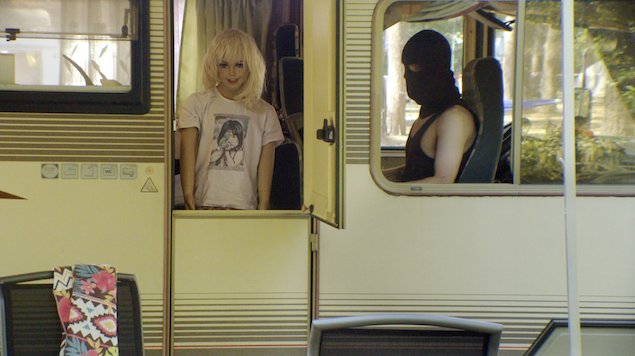
Tin City is, even now, used as a NATO facility for combat training, especially with war raging in Ukraine, which is why Ward was unable to enter the site to film there himself. However, this denial of access inspired him to create contemporary tableaus whereby the mannequins, now representing a happy nuclear family, are taken away from the facility on a kind of “holiday into the forest,” away from any conflict. The father still wears an ominous paramilitary balaclava, and a mother wears a fixed smile, but in this tableau there are kids, a demographic that is strikingly absent in the older Tin City footage, Ward notes.
“There were no child mannequins even though, when you see the old archive, you can imagine every one of those front gardens and streets being full of children,” he points out. “But [the British army] removed all children, which is kind of weird. So we decided to place a child into our versioning of it.”
This decision had a particular poignancy for Ward. “As we were making this film, the whole Israeli/Palestine conflict was raging with absolute colossal losses. Just two months ago, the UN came out with a report saying that the [highest rate] of casualties in the Gaza Strip has been among five to nine-year-olds. In the last 12 months, more five to nine-year-olds have been killed in Gaza than all the fatalities in the entire Northern Ireland conflict. This scale of difference, I was really struck by that.”
A third element within the film is the part-spoken transcript of an interview conducted in 1989 by a German journalist with an IRA operative after a German woman, the wife of a British soldier, was murdered in Germany whie driving her husband’s car. Just as the British army were active on mainland Europe in honing their military response to the IRA, so the Republican paramilitaries (the Overseas Department) were equally active in terms of targeting British soldiers posted there.
In the film, we hear the interviewer’s questions but we must read the Republican responses, which is reminiscent of how, in the 1990s, the voices of Sinn Fein leaders (the political arm of the IRA) were dubbed on British news media by actors in an attempt to neuter the effectiveness of their advocacy for the Irish cause.
In Tin City, the German interviewer quizzes the paramilitary representative on the justification of further locating the Irish conflict on mainland Europe. “This merciless Northern Ireland conflict, in the context of a unifying Europe, becomes less and less understandable. Are you not clinging onto an antiquated notion of nationalism?”
“It was not our intention to kill a soldier’s wife,” is the reply. “It does not serve our cause to be in conflict with the Germans, or the Dutch or the Belgians, but we have no other choice. To be clear…we have decided to attack the Brits wherever they may be…The Brits deliberately factor in civilian casualties in their war plan. With us, it is an accident.”
Tin City also serves to remind us how political terrorism was so endemic across Europe in the second half of the 20th Century, as conducted by the likes of the IRA (Ireland), Baader-Meinhof (Germany), the Red Brigade (Italy) and ETA (Basque region). “It’s strange to see it in that context now. Not to say that it was a normal aspect of European society or the European experience, but it is definitely way different to what it’s like now,” says Ward.
Thankfully, the Troubles are (by and large) no more, and Ward points to a “sliding doors moment” in the 1990s when the Ireland situation was resolved, just as the conflict in the Middle East intensified. “Northern Ireland and Israel/Palestine were in similar positions with the IRA and the PLO. It looked like both were moving towards some kind of resolution but the assassination of Yitzhak Rabin (Israel PM, 1995) was a catalyst and [the Middle East] just descended to the gates of hell. The other one, Northern Ireland, for all its problems became, after the Good Friday Agreement (1998), almost a poster child for reconciliation.”