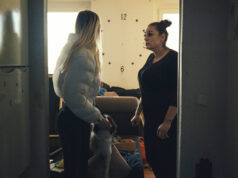
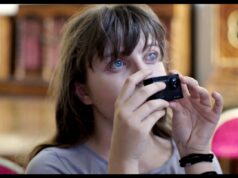
Our Body (Notre Corps), a world premiere in the Berlinale Forum, was shot over a period of around six weeks in a gynaecological clinic in a hospital in Paris. Director Claire Simon was also the cinematographer.
The documentary deals with everything from IVF to birth, from cancer treatment to gender transition. Simon had been approached to make the film by producer Kristina Larsen, who told her about her experiences over two years fighting a rare disease. In the hospital, Larsen had encountered a “mostly female world” – and this is the world that Simon wanted to investigate.
“It was really extraordinary that all these things about women’s bodies were in one place,” the director says of all that happened within this single clinic. “What was incredible [was] how it was mixed and everyone was treated equally.”
Women of every colour, class, income and nationality passed through the clinic as patients. The film features consultations as well as close up sequences of births and operations. Simon painstakingly approached the doctors and the patients for permission to film them.
“A lot of people didn’t agree. It was very funny. Sometimes, I would ask a woman when she was with her husband and her husband would say ‘no’. I said ‘but it is not you I am asking, it is your wife.’ I realised that so many men, they think their wife’s body is their own property.”
The documentary was made during the Covid period. In hindsight, Simon believes this was to her benefit. Wearing masks made her subjects less self-conscious about being filmed. “Also, the expression of the eyes are very strong.”
Simon was showing women’s bodies in a very different way to the “sexy, seductive side” that is generally portrayed in the mainstream media. “I filmed when they were naked; I filmed the examinations from the doctors and everything…my idea was to film women’s bodies as well as I could, with a lot of gentleness. Women are on posters to sell underwear [but] this is another way to talk about women’s bodies.”
Although the focus is on women’s bodies, the documentary includes men who “wanted to transition to women” as well as “trans guys who were girls before.”
The director was using a “very big camera” and wasn’t hiding in the corner of the room. Nonetheless, the patients never seem distracted by her presence. They were so preoccupied with what the doctors were telling them that they hardly noticed the presence of the film crew.
During the consultations, Simon was trying to film “between” the doctors and the patients.
“And not only their faces but their bodies. A lot of doctors talk and explain on their own bodies the surgery, or what is going on…There is a scene, quite incredible I think, between the professor and the girl who’s Spanish. They talk in Spanish and he explains on his body the surgery they will do.”
Simon paid close attention not just to her subjects’ faces but to their gestures. She was also fascinated by the way the doctors shared their knowledge.
“In surgery, it is like anatomy classes. They [the doctors] are always explaining what is what. We all learn natural science at school but we can’t recognise anything inside the body,” Simon observes.
The film is just under three hours long. Simon never considered making it as, say, an episodic TV series. “My idea was from Kierkegaard, the steps of life,” she grandly proclaims. “My idea was to begin with youth and to end with death. It was very clear for me…making a series would be completely inappropriate. It had to be a big arc, from youth to death.”
Simon is an admirer of documentaries like Fred Wiseman’s Hospital (1970). She makes it very clear, though, that she was coming at her subject matter in a very different way to Wiseman. Her interest was in the people (the women patients in particular) and not the institution. She doesn’t reveal precisely where she is filming.
After two days of shooting, Simon said to herself: “the thing is the body, the women’s bodies, and I started to film the bodies. That was my rule.” She suggests that outsiders don’t always appreciate the careful “mise-en-scène” that goes into documentaries as well as into fiction films. There may be no script but she is very careful in terms “of what you look at and what you are telling by the way you frame and the way you edit. But first you have to frame it in the proper way what you want the film to be.”
Many moments in the documentary are very emotional. Patients are dealing with seismic moments in their lives. Simon acknowledges that she and her sound recordist were often in tears at what they were witnessing.
Alongside her documentaries, Simon has also made fiction. “I love it too but I am quite a nervous person, very impatient and I want to shoot all the time. I am not OK to wait for years to have the budget.”
Once Simon agreed to make Our Body, she quickly started filming it. She had complete confidence that her producer Kristina Larsen would soon sort out the budget. “She is very good at it. She convinced them [funders] quickly. She is such a good producer that I could begin shooting it without any money.”
Distribution of the documentary in France will be handled by Dulac Distribution. After Berlin, the film is also being presented in the MoMA Non/Fiction Fortnight and has been chosen for True/False Film Fest in the US in March.