

French director Vincent Dieutre’s This Is The End (premiering in Berlin’s Forum & Forum Expanded) is another of the director’s works in which he blurs the lines between documentary and fiction and in which he invokes the spirit of the avant-garde filmmakers who have inspired him.
“Creative documentary is the place where you’ve got the maximum possibility of really thinking about the language of cinema, the form,” Dieutre reflects. “I always wanted to involve in the film all my love of Michael Snow, Chantal Akerman, all this kind of more contemplative cinema…”
In the film, a European filmmaker [Dieutre himself] visits Los Angeles. He drives around the city in a Ford Mustang and spends time with “Dean,” a lover from years ago. There are also many sequences showing poets performing at a local club.
The director’s quizzical voice-over is heard on the soundtrack.
“It’s kind of a very personal process. Through the film, I have in mind the story and also the poems that I am going to use. I do the filming without thinking that much about what is going be said,” the director explains how he combines the voice-over with the images. During editing, he “will find angles to make the voice enter with a slight relation with the image.” He talks about making “little bridges” between the words on the soundtrack and the images. He encourages his viewers to “enter the film in that slight space between what is said and what is seen.”
The voice-over is never simply illustrative. Sometimes, Dieutre will talk about an image that was on the screen ten minutes before.
Dieutre didn’t know LA at all before embarking on the film. He had never even visited the city. “I was not knowing California at all but I realised that Hollywood and Los Angeles [have] got such a big space in the culture and imagination of French artists. For me, it was rather a bad reputation. I wasn’t attracted by Los Angeles. I had to find this pretext to go there.”
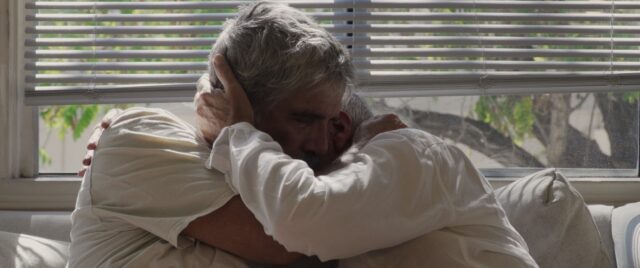
The reason he found for his visit is a reunion with an old lover. There are very tender moments between the two men whose paths haven’t crossed for decades.
“[But] this is a kind of a fiction,” Dieutre explains. When he saw Dean’s face on Facebook, he was reminded of a lover he had had 40 years before. The lover, like Dean (whose real name is Dino Koutsolioutsos), was originally Greek. They looked uncannily alike. The real lover had died of AIDS in the 80s.
Much of the film is shot from within a car but the director freely admits he “hates driving.” He decided, though, that if the city “was going to be beautiful, it had to be seen from a car.”
“In fact, I went to Los Angeles only with my phone,” the director says of that first visit to meet up with Dino and to film some initial material.
“I wouldn’t say we fell in love but we had a very good time…he was driving so I had only to go around with him. I really liked it.”
Then came the pandemic. The project was shunted off course. Dieutre didn’t know when he was going to be able to travel to the West Coast again. His producer Stéphane Jourdain told him “don’t worry, we will find a way.” Eventually, he got his visa and returned to LA to make the doc.
In hindsight, the director thinks the “Covid ambience” may have “nourished” the film. “I always think the conditions in which you do the film are also designing the film,” he adds.
Dino, who isn’t an actor, agreed to appear on camera and to share stores about his own background and how he came to America. “I was very moved by the way he accepted to play the game…it was a very strong adventure. Also, he knew the city very well. He would tell me his story, arriving there from Greece with the idea that it wasn’t good to be gay so he tried different therapies. And as he said in the film, he came out gayer than ever and has stayed in LA all his life.”
LA has its hellish side. To remind us of the fact, Dieutre includes shots of snakes in swimming pools or slithering across the tiles. “This also is a kind of poetic image in the film…[but] this is also real fact, during these huge fires they had three or four years ago round LA, many animals went back to the [city]. They were in town. Snakes would come in the pools because it’s fresher. Coyotes, eagles entered the city.”
The snakes, the director adds, are also intended as a reference to Jim Morrison, the poet and rock singer. “In one of his poems, a woman is in love with a snake.”
Some of the film was shot in Paris, doubling for LA. “In reality, all of what I call the Poetry Lounge doesn’t exist. We invented it in Paris, in the Belgian Cultural Centre. That was [in] lockdown,” the director says of the cabaret-style scenes in which various poets declaim their verse. “It was a performance that we did for three days. I tried to reach all the Americans in Paris that I know, actors or friends.”
Dieutre also did some filming in a near derelict old theatre in the Mexican part of Hollywood. He made frequent use of split screen to heighten the intensity of the poetry scenes.
“That was something I realised during the film, that poetry is the last free art, not completely occupied by the market. Literature, cinema, visual arts, they’re completely now in the [market] system but poetry has another relation to beauty, to art, that is very precious.”
Contributors to the film include Eva Truffaut, daughter of François Truffaut, French movie star Jean-Marc Barr (who Dieutre met at a festival) and Paris-based US actress Kate Moran. “I would link them to a character. Kate Moran is more or less Nico [from the Velvet Underground].”
Now in his early 60s, Dieutre has been making films for four decades, Several have screened in the Berlinale. This Is The End was made through La Huit Production in Paris.





