

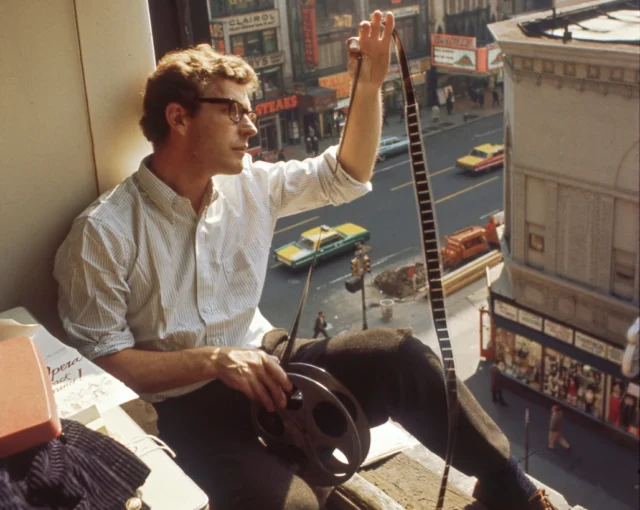
Bo Widerberg isn’t exactly Swedish cinema’s forgotten man. US outfit Criterion has released sumptuous editions of his work on DVD. French distributor Malavida has also championed him. Nonetheless, nearly three decades after his death aged 66 in 1997, the director who once had a reputation almost matching that of his rival Ingmar Bergman, has receded from view. Even hardened young cinephiles are unlikely to know many of his movies beyond Elvira Madigan – for the simple reason that so much of his work has been unavailable.
It looks, though, as if Widerberg is on the verge of rediscovery and reappraisal. That is certainly the hope of renowned Swedish film critic Jon Asp and industry veteran Mattias Nohrborg (founder of arthouse distributor TriArt Film). They have pooled resources to co-direct new feature doc Being Bo Widerberg (which received its world premiere in Cannes Classics).
The two fervent Widerberg admirers already have a close connection. Asp runs a film magazine, Point Of View, which Nohrborg helps finance. “We came together three years ago. Since then, we have been exploring the archives,” Asp explains.
When they started work on the project, Nohrborg and Asp carefully looked through the movies again. “The relevance of the films today is fascinating,” says Nohrborg. He talks of the “extremely modern” portrayal of women in Widerberg’s first feature, The Baby Carriage, the story of the independent minded Britt (Inger Taube) as she struggles to cope with an unplanned pregnancy.
“It could have been today. It is the same kind of issues we discuss when it comes to the difference between sexes, rights and so forth…his films seems so new and fresh and modern.” Nohrborg tells how screened some of Widerberg’s films for his 23-year-old daughter and she too was struck by how urgent and modern they seemed.
The documentary makers enthuse about the way Widerberg portrayed his home city, Malmö. His style, they suggest, was “elevated social realism.”
It was strangely fitting that Being Bo Widerberg premiered in Cannes on the same weekend as Richard Linklater’s Nouvelle Vague, a drama about the making of Jean-Luc Godard’s French New Wave classic, Breathless. Widerberg was from exactly the same fiery tradition as Godard, Truffaut and the other young rebels from Cahiers Du Cinema.
The documentary includes some very evocative footage of Widerberg in Cannes alongside the French directors (who famously brought the festival to a standstill in 1968). It also acknowledges that Widerberg was directly inspired by movies like Truffaut’s The 400 Blows and Godard’s Breathless.
Asp jokes that Being Bo Widerberg and Nouvelle Vague should show as a double bill. This could conceivably happen if TriArt manages to acquire Swedish rights for Linklater’s movie. (At the time of the interview with Business Doc Europe, Nohrborg was in negotiations to make the acquisition but faced competition from other Nordic buyers).
While Widerberg was championing the New Wave, he was also being waspishly critical about Ingmar Bergman and the undue influence The Seventh Seal director held over perceptions of Swedish cinema at home and abroad.
“He wanted conflict…sometimes he created his own conflict,” Nohrborg says of the long-simmering tensions between Widerberg and Bergman. “Bergman made vertical films, Widerberg thought, and he wanted to make horizontal films, that had more contact with society,” Asp chimes in.
Nohrborg knew both men. “I met Bergman more because he always booked up films that I was distributing. He had his own cinema.” What the TriArt boss remembers most vividly about Widerberg was that he was always in a hurry. “He had so much energy. He was always running. That is my memory. He was always doing something.”
If Widerberg was in Cannes and didn’t have a film in official selection, he would head off to horse races in Nice. In any social situations, he always wanted to be the centre of attention. “He was also extremely interested in football. He’d go off and watch football…he was full of energy. Of course, that is not so easy to cope with.”
It’s a sign of the regard in which Widerberg is held that so many leading filmmakers were prepared to give interviews for the documentary, among them Olivier Assayas, Mia Hansen-Love and Ruben Östlund.
Asp and Nohrborg began the documentary with a set of questions to which they wanted to find answers. One was exactly what happened to Widerberg in the early 1970s when, at the height of his fame, he seemed to go off the radar. “He didn’t disappear totally…in the 60s, he made almost one film a year. Suddenly, he didn’t…”
There were problems with financing and a lack of support. “But he was also quite a difficult person to collaborate with because the demands were so high,” Asp notes.
Ask the documentary makers about their favourite Widerberg film and they’re both in accord. Asp is a huge admirer of his first feature, The Baby Carriage. “It’s very vibrant and also a very strong portrayal of a young character trying to be independent.”
“That is one of best debut film ever made,” Nohrborg, an admirer of all of Widerberg’s films from the 1960s, agrees. He also expresses huge admiration for one of the director’s least seen movies, Joe Hill, which he shot in the US for Paramount before quitting and completing it in Sweden. “The whole production process was just unbelievable.”
Despite the chaos behind the scenes, Widerberg made a “gorgeous, beautiful film” with a strong political edge. “And I think Thommy Berggren – it’s one of the best male performances in Swedish film ever. I think he is just fantastic.”
The Swedish release of Being Bo Widerberg is set for October through TriArt. It will go out on around 50 screens – an ambitious attempt at getting Widerberg back into mainstream Swedish consciousness. “My team at the distribution company can naturally be very close to the whole process,” Nohrborg says. “They know the film. They love the film also…for us it is going to be a major release.”
There will be also limited theatrical releases of some of Widerberg’s movies. Viewers will also be able to buy DVDs and stream most of the films. (Malavida will release the film in France.)
Three years ago, Bo Widerberg’s work was almost impossible to find in Sweden. That has already changed. “I think the most important thing is the availability,” Nohrborg says of the quest to get Widerberg’s movies back in front of audiences.
“Our documentary will be the motive for international festivals and cinematheques to run retrospectives of Bo Widerberg films,” Asp suggests.
“It will be an excuse for cinema owners, an excuse for digital platforms, to re-release his old films,” his co-director concurs.





