The ‘self-conscious re-enactment’ subgenre of documentary is the gift that keeps on giving. Tunisian director Kaouther Ben Hania’s Cannes Competition title Four Daughters joins the ranks of masterpieces, such as Joshua Oppenheimer’s The Act of Killing (2012) and Kitty Green’s Casting JonBenet (2017), in which the act of re-enactment itself, and the reflection on its means and meaning, becomes the way in which the truth reveals itself to its participants.
These three films – and many like them – are very different, because the precise interaction of the different layers of storytelling depends on each specific story. Which is exactly why this is such a rich approach – Four Daughters proves, once again, that there is no reason to think this vein of documentary storytelling will run dry any time soon.
Of course, this all sounds very meta – and it is – but just like the other two titles I mentioned, Four Daughters is eminently accessible. Indeed, it is a characteristic of the re-enactment subgenre that it can deconstruct and analyse complicated relations between people in ways that are clear, understandable and often immensely emotional. Perhaps, I believe, because in our new and social media age we have all become so attuned to the ideas of performing for the camera, pretending to be somebody else, and the selective, subjective approach to truth in filmmaking.
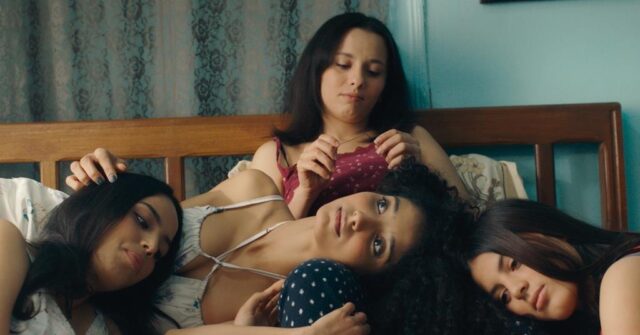
So what is it about? Ben Hania’s film is about a mother of four daughters re-enacting the family history up to the point where the two eldest left home, never to return. So while the two youngest play their own younger selves, the two older daughters are interpreted by actors. The mother, who otherwise plays herself, is also replaced by an actor for those scenes she finds too painful to relive. And then there is a single male actor who plays all male supporting roles – a clever solution which not only reduces the number of actors on this intimate film set, but also subtly combines all male characters into Man, men in general, aka the patriarchy, which has played an important and destructive role in these women’s lives.
If this were a standard re-enactment, that would have been all the introduction you’d need and we’d now move on to the stories depicted in the film. But in this subgenre of what I call ‘self-conscious re-enactments’, the set-up becomes much more complex. Because most of Four Daughters does not consist of re-enacted scenes, but of the discussions about these scenes, before, during (scenes are frequently interrupted by comments, tears and laughter), and after.
Imagine this. Instead of sitting the mother, Olfa Hamrouni, on a couch and asking her questions in the traditional talking head fashion, we place her in front of an actor – in this case, well-known Tunisian-Egyptian Hend Sabri – who is going to play her in a film and wants to hear everything she needs to know to interpret her as best she can. Which means she will ask her not only the basic questions a traditional interviewer would (what happened where and when, what did you think, how did you feel?), but far more specific ones: what did you wear, how did you enter the room, who spoke first, how should I move my arms, should I use swear words – the list is endless. Now imagine the mother looking on as the actor plays her in a fight with one of her real daughters, telling her afterwards what she did right and wrong. And then imagine the daughter giving her reactions. And the actor, as herself, emotionally reacting to how this mother treated her child.
This is what happens in Four Daughters. And much, much more: the two remaining daughters dressing up the two actors playing their lost sisters to resemble them as much as possible, doing their hair, clothing, nails, laughing and crying in equal measure (one sister tearfully admitting she hadn’t even spoken her lost sisters’ names since their disappearance); the mother playing her own sister, to show Hend Sabri, who is playing her in this scene, how she was scolded on her wedding night and pressured to have sex with her husband – which she refused, instead kicking him into a corner (which Sabri re-enacts with abandon); the actor playing lost sister Rahma arguing with such irresistible force, using religious arguments we know the actor herself doesn’t subscribe to, that the mother, for the first time in the documentary, falls silent, staring at her – at that moment indeed seeing, I believe, her lost daughter before her.
All of these situations are enormously layered, with many different interpersonal relationships, real and re-enacted, happening at the same time. And all of these situations are also instantly gripping and engaging and – apart from those brief moments when we cut to another scene and are not immediately sure if we are watching the actor or their character – easy to follow and understand.
Complex relationships and accessible presentation: it’s by translating private, interpersonal relationships with their often repressed regrets and reproaches into publicly discussed and much more easily understood relationships between director, actor, part and role, that these ‘self-conscious re-enactments’ manage to bring buried histories out into the open. And not just for the viewers, but also for the participants themselves. Indeed, more than one family member refers to the hoped-for therapeutic benefits of making this film.
Ultimately, of course, it all depends on the personalities of the family members portrayed and their willingness to bare their hearts and souls. On that level, Four Daughters is a revelation. The mother and her two daughters all have winning personalities, combining great honesty in how they look at themselves and their relationships with a loving kindness towards each other even when discussing extremely painful events. Simply put, I laughed, I cried, I learned.
And without wanting to spoil the experience too much for other viewers – because letting the whole picture slowly emerge, layer by layer, is the greatest strength of this documentary – the key insight is how the patriarchy is being enforced by women on women, from one generation to the next, not as a form of obedience, agreement or belief, but, counter-intuitively, as a form of resistance. It’s an insight which ultimately made me care deeply about this mother, who, it cannot be denied – and it isn’t denied in the film – did terrible things to her daughters.
But she did it because she believed she was protecting their daughters. And did it even though she herself, as a younger woman, would never have stood for it. And slowly I realised her behaviour wasn’t so much contradictory as warped by the patriarchy, because everything she did (from fighting her own husband to trying to beat her daughters into submission) was consistently driven by a fear of losing female autonomy. Hers, and her daughters’. Seeing her coming to the realisation she had been wrong, that she had done to her daughters what her own mother had done to her (sitting next to her younger daughters who, after many struggles, have come out of this ordeal guns blazing, fully autonomous in their own way and no one else’s, and clearly still loving their mother nonetheless), is as soul-shattering as it is enlightening.
France/Tunisia/Germany/Saudi Arabia, 2023, 107 minutes
Director Kaouther Ben Hania
Production Tanit Films
Producers Nadim Cheikhrouha, Habib Attia
International sales The Party Film Sales
Script Kaouther Ben Hania
Cinematography Farouk Laaridh
Editing Kaouther Ben Hania, Qutaiba Barhamji, Jean-Christophe Hym
Sound Amal Attia, Manuel Laval, Henry Uhl, Maxim Romasevich
Music Amine Bouhafa
With Olfa Hamrouni, Eya Chikhaoui, Tayssir Chikhaoui, Hend Sabri, Nour Karoui, Ichraq Matar, Majd Mastoura