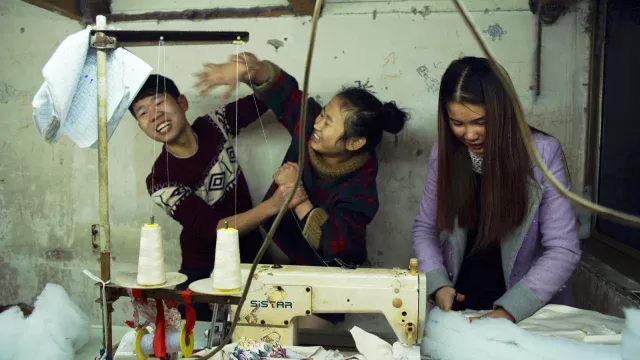
Two things stand out in Wang Bing’s Cannes competition title Youth (Spring). The first concerns the subject, young textile workers in the Chinese manufacturing province of Zhili, and the second its style, which achieves an extraordinary sense of ‘presence.’
The first thing that grabs the attention in Wang Bing’s Cannes Competition title Youth (Spring) is the lively vitality of these young people we see working in the small textile workshops of Zhili, 150 km from Shanghai, where some 300,000 seasonal Chinese migrant workers produce clothes, mostly for the domestic market (and where Wang also shot his 2016 documentary Bitter Money).
They laugh, flirt, sing and argue, with little apparent supervision. But one would be wrong to assume this means they’re slacking off: the repetitive tasks, behind sowing machines or cutting cloth with large scissors, are performed at breakneck speed. So fast, in fact, that at times it seemed the film itself had been sped up.
It is mesmerising to watch. In a way, it seems to be almost literally ‘mindless’ work – as if these young people do not need to use their thinking minds at all to carry out this work, seeing how they chat, joke and tease without slowing down for a second. As if their minds and bodies were actually separated.
If one would not look at the image, but only listen to the conversations, which are accompanied by the drowning noise of machinery and the loud pop music that is often playing at these workshops, one might imagine a couple of young friends chatting and hanging out during their break. Not these lightning-fast workers in the middle of their fifteen-hour shifts.
As far as I could tell, most protagonists are between 16 and their mid-20s. They are there for the money, no doubt, and a text at the end of the film informs us that they are often thousands of miles from home. And although this work is clearly not going to make them rich, and offers little in the way of career opportunities, Wang’s film also conveys a sense of freedom, the freedom of only lightly supervised dorm life, where these young people are flirting, having sex and falling in love. That said, there is one moment, when a somewhat older co-worker phones home to talk to their child, which tugs at the heartstrings, making you wonder how far apart they are and how often they get to see each other.
As in many of his films, Wang Bing ignores the three-act, two-hour running time format and instead builds up his world slowly and deliberately, following the beats and rhythms of these young people’s lives. The film was shot between 2014 and 2019, and the running time Wang ended up with – four hours – clearly followed from the story he wanted to tell, rather than, as is usual in cinema, the other way around. Indeed, four hours is quite short for Wang, who made his name with the nine-hour Tie Xi Qu: West of the Tracks (2002) and later released the self-descriptive 15 Hours (2017) – although this same Cannes festival is also screening his one-hour project Man in Black, proving that for Wang, length isn’t a given, but follows function.
Just as how Youth (Spring)’s cinematography, shot in a Direct Cinema style without interviews or voice-over, follows its protagonists. In fact, the camera (or cameras, as Wang shot with three cameras at a time) behaves as if it is one of the co-workers itself, sitting at the same tables, living in the same communal housing and lying on the same beds. Always at eye level, keeping the same distance as these young workers do with each other; perhaps a little more shy, slightly more distant. More like the regular visitor that director Wang was than an actual employee of these shops (many of which are located on a street called ‘Happiness Road’, which feels like something dreamed up by a local PR company).
This consistent sense of ‘hanging out’ with them in their communal spaces, which is supported by the three-camera cinematography and the longer running time, is the main explanation I can give for the second thing that struck me most about Youth (Spring): how extraordinarily present I felt throughout the documentary. But I have to admit that these seemingly straightforward stylistic choices do not feel like sufficient explanation for this exceptional ‘sense of presence’, to borrow a phrase popular in the world of VR.
In fact, many scenes felt very close to VR. Especially the ones inside the work spaces – if I close my eyes now, I can immediately imagine myself in those rooms. I see the bland walls, with writing on them here and there, electric cables, stickers, posters; I see the piles of fabric and cut cloth waiting to be made into trousers, skirts and jackets; the heaps of finished garments waiting to be taken downstairs to be counted and inspected; I see the lived-in mix of order and chaos, the half-cleaned, functional mess; I see the tables, the chairs, tattered and worn; the threads running from the central spools to the individual sowing machines; the young workers behind their tables, passing by, fooling around, et cetera, et cetera.
Another crucial factor might be what co-producer Denis Vaslin previously told Business Doc Europe: that Wang insisted on a sound that was “rough, as realistic as possible.” The sound in Youth (Spring) is indeed loud, present, upfront. Voices are clear and distinct, also when they are talking and shouting at the same time. The immersive qualities of good sound design are harder for most people to judge than visual style, and are therefore often ignored, also by film critics like myself. But given the overall effect of immersive presence (I really haven’t felt so convincingly and physically present in a film so often in the past) and the ease with which I can recall the soundscape almost as well as the images, this sound design was indeed exceptional.
I have to mention that the film loses some steam around the three-hour mark – quite deliberately, as for the first time we see workers trudging along in silence, without talking or fooling around. So, instead of first focussing on the drudgery of the work and then on the liveliness of the individuals, Wang has reversed the logic. These workers are not lively despite the work, the work is numbing despite their liveliness. It’s a subtle but important distinction.
Another thing is that one might expect a film like this to make one reflect upon wider issues of economics and politics. And one can, of course, but Youth (Spring) itself doesn’t really go there.
It’s possible that the announced trilogy on the subject, with an estimated combined running time of nine hours and forty minutes, will have a different effect, but for now, and for me, this film is really about the people you see, not about something bigger, not about something else. And I find that a refreshing and, in a way, ethical approach. They might be used by the system and their bosses, but not by this documentary. Here, they can be themselves.
France, Luxembourg, the Netherlands, 2023, 212 minutes
Director Wang Bing
Production Gladys Glover, House on Fire, CS Production
Producers Vincent Wang, Sonia Buchman, Nicolas R. de La Mothe, Mao Hui
International sales Pyramide International
Cinematography Maeda Yoshitaka, Shan Xiaohui, Song Yang, Liu Xianhui, Ding Bihan, Wang Bing
Editing Dominique Auvray
Sound Ranko Pauković