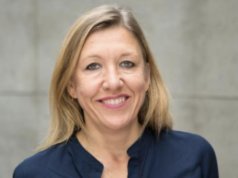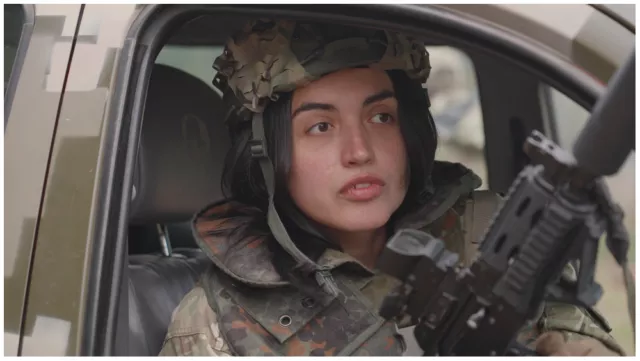
Cuba is dark-haired and olive-skinned while Alaska is pale and blond, but when producer Olha Beskhmelnytsina asked the latter if it was because of her hair colour and complexion that she chose such an Arctic nickname, Alaska joked instead that she was “distant and frozen.”
The logline of the Ukraine/France/Belgium feature doc co-pro Cuba&Alaska reads how two female paramedics choose go to war, on the way encountering friendship, love, and acceptance, but also pain, sorrow, and death.
The film is directed by Yegor Troyanovsky whose first full-length documentary Demon (2020) received the Fipresci award for Best Film at the Odessa International Film Festival, and is also a co-creator of the critically acclaimed historical documentary series Collapse. How Ukrainians Destroyed the Evil Empire.
At times the film follows the characters in civilian life. We see the rehabilitation of Alaska after she is injured following a kamikaze drone attack. We observe how she rediscovers her love of drawing, and animated sequences in the film bring some her drawings to life.
During breaks from military service, Cuba is a fashion designer whom we follow to a show in Paris in Spring 2023. That said, for the past three years, Cuba has spent most of her time on the frontline, producer Beskhmelnytsina points out.
Male and female paramedics do everything together while on duty. There is no specific allowance made for either gender. “You are serving all together but sometimes of course when you are female…it’s not easy. It’s also part of the film that we explain how difficult is this choice for them and how strong they are. To be strong enough to stay all the time in this not really comfortable condition of living,” says Beskhmelnytsina.
And they are accorded 50:50 equal status, the producer underlines. “They have the same contract as the male soldiers and paramedics, but there is one difference. Women are not obliged to serve in the army. So for them it’s their own choice. They could resign if they want, but men cannot resign. But they [Cuba and Alaska] are staying all this time and saving lives. So that’s why it’s for us really important to tell their story, because they’re choosing this job every day.”
Another core part of the film concerns Cuba’s love for and engagement to a soldier and their impending marriage in 2023. “But in June he was killed by the Russians,” says the producer of film that does not shy away from inevitable death and grieving during war.
Cuba&Alaska is at late production/early post-production stage and Beskhmelnytsina predicts delivery in November 2024. 70% of the finance is in place and co-producers are Christian Popp (TAG film, France) and Hanne Phlypo (Clin d’Oeil Films, Belgium).
“In our team we have another very important person. It’s our editor, Joelle Alexis who is Belgian,” the producer tells BDE. “For us it is very important to have somebody in the team who doesn’t have experience of war but is building the film. All the time this gives us the possibility to reflect…with an editor who lives in a different part of the world in safety, if she feels the film and the war the same way and if it’s understandable for viewers. So this kind of collaboration gives us possibilities all the time to check with ourselves if the story which we try to tell works, if it’s understandable for international audiences.”
Inevitably, every film that comes out of Ukraine right now is either about, or deeply coloured by, the war. “You cannot just close the eyes and say ‘no, we will film some other kind of story and we’ll ignore the war’. I really want that one day we’ll do films that will not be affected by war, but for now it doesn’t feel real or possible.”
And is international interest as strong as it was at the beginning of the conflict, or is it waining? “Yes, interest has changed. Sometimes people call this the ‘tiredness of the war.’ People don’t really want to see the story or to hear the story because painful, it’s somehow hidden. So that’s why I think their interest is less,” observes Beskhmelnytsina.
“But we understand that it’s also our goal to make films from different angles to make them not only films about the war, but about other experiences affected by war or different experiences of life during the war. And so it is in our film. We are trying to focus on the unique lives of our protagonists. What does it mean to live like this? And make films that show not only the tough part of this life, but also the good and very proud part of this life.”