La belle de Gaza (or The Belle From Gaza) has to be the most unfortunate title of this year’s Cannes selection. Because the film isn’t about Gaza – it’s set in Tel Aviv, Israel’s freest and most progressive city when it comes to trans rights. And it’s not even really about anyone from Gaza – although a whispered-about ‘belle from Gaza’ was rumoured to have walked all the way from there to Tel Aviv, which formed the starting point for French director Yolande Zauberman’s investigation into the lives of trans women in the Israeli city.
At this festival however, anyone who sees that title will inevitably think of the horrors currently unfolding in Gaza. And even if you accept that a film can be ‘about’ Gaza, however indirectly, without having to be set there, one should at least acknowledge that any film about the relative freedoms Israel offers Palestinian Arabs in certain respects, will now be seen through a painfully different lens.
To be fair, this project began before the recent escalation in the region. In the press notes Zauberman says: “I wouldn’t have made The Belle From Gaza if the October 7 attack had already happened.” But in that case, why not change the title now that it has?
There are other moral conundrums that arise when reviewing Zauberman’s film, mostly concerning the trans women’s privacy. Zauberman asks very basic, direct questions about their transition, often focusing on their bodies – on surgery, genitals and sex – or asking whether they regret it. The kinds of questions that many cisgender people typically ask transgender people, over and over again, and are generally seen as rude and stigmatising. This film is about trans people, but it is clearly made by and for cis people.
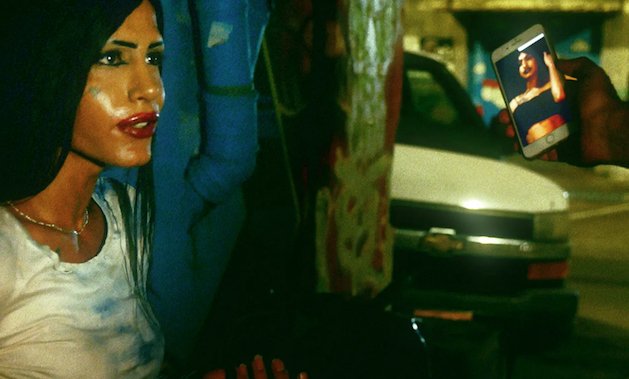
Zauberman also approaches trans women on the street, showing them an image of the ‘belle from Gaza’ she shot four years earlier, and asking if they know her, what her name is and where she can be found – almost like a detective. Or a police officer. Seemingly ignoring, at least for the moment, that they might have good reasons, both personal and political, to keep their identities and whereabouts a secret. Likewise, the number plates of their clients are never blurred.
One trans woman is even deadnamed on camera (i.e. addressed by the name she was known by before coming out as trans), just about the biggest social sin you can commit against a trans person.
By approaching trans women with such clichéd questions, the film sets the wrong example, especially for viewers unfamiliar with the subject. Those might come away with the idea that deadnaming a trans person is okay – and it isn’t, unless the trans person themselves says so. Leaving this moment out of the film would not have weakened the story and would have prevented misunderstandings – it’s as regrettable as keeping the title. As the poem that trans sex worker Danielle had tattooed on her body says: “All know my name, none my story. Some speak of me, but is it me? If you join me on my path, don’t stumble on the first step.”
And yet, and yet. I was still mesmerised by the women Zauberman got before her camera. Which must have had something to do with the way she relates to them and the way she films them – Zauberman is her own cinematographer. Mesmerising even though – or perhaps because – that camerawork often seems to be all over the place. La belle de Gaza is the third part of what Zauberman calls her ‘Night Trilogy’, after Would You Have Sex with an Arab? (2011) and M (2018), and the recurring images of trans sex workers working the streets at night, with orange lighting, slow-moving vehicles, graffiti in dank alleys and deep dark shadows, really do create a sense of presence, of temporarily inhabiting that world.
Then there are the trans women themselves. If they don’t object to this style of interviewing, which they generally don’t seem to, who am I to question them? Someone like Arab-Israeli model Talleen Abu Hanna, who can be considered the star of the documentary, is obviously capable of standing up for herself. She won the first Miss Trans Israel in 2016 and later also competed in Miss Israel. For the sex workers, however, more concern for their privacy seems justified. Because life on the streets of Tel Aviv is dangerous – even if it is the most accepting city for trans rights in Israel. So the fact that one of them wears a veil which does little to hide her face on camera, seems troubling.
It’s interesting to see how all the trans women portrayed find strength and solace in religion, be it Christianity or Islam. “If God made me like this, he made me like this for a reason,” one of them states. And another angrily mocks those who would kill trans relatives to protect the family’s reputation – as if murder is good for your reputation!
Scene after scene, it’s the trans women themselves who keep me glued to the screen. And within the relationship Zauberman has created with them, the way they are approached and portrayed may have been a joint decision, or at least acceptable to them. Indeed, in the scene in which Talleen gets deadnamed, it’s by her best friend while she’s sitting right next to him, listening without any apparent discomfort. It is thanks to this documentary’s unapologetic directness, which is both its weakness and its strength, that we get to be present at such moments.
France, 2024, 76 minutes
Director Yolande Zauberman
Production Unité, Phobics, Arte France Cinéma
Producers Bruno Nahon, Yolande Zauberman
International sales Pyramide International
Script Yolande Zauberman
Cinematography Yolande Zauberman
Editing Léo Richard, Rafael Torres Calderon
Sound Selim Nassib
With Talleen Abu Hanna, Israela, Nadine, Danielle, Nathalie