

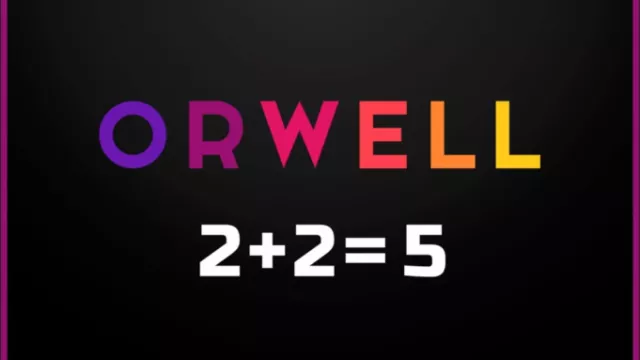
When Raoul Peck was offered access to “everything by George Orwell,” not only the novels but also the diaries and letters of the English author of 1984 and Animal Farm, he couldn’t say no.
“But then it is my job to find what is my angle, what is my organic approach to the subject and come up with something different as well,’ he says of his scorching new feature documentary Orwell: 2+2=5 which launched in the Cannes Premiere section earlier this week. (Sold by Goodfellas, it will be released in North America by Neon).
Don’t expect the usual biographical portrait of a “great” writer. Peck’s approach is far more subversive and outspoken than that. He uses Orwell’s 1984 as a prism through which to view authoritarianism in today’s world. He has everybody from Trump to Putin, from Mark Zuckerberg to Victor Orban, in his sights. The film also touches on tragedy and destruction in Myanmar in Mariupol, in Gaza and Lebanon.
“I don’t like when they say ‘visionary.’ It’s not about the vision. It’s about an experience he went through in putting his body, his mind, in a situation that rarely writers, especially British writers, would find themselves,” Peck reflects on how Orwell eventually found his identity as an artist. He was an old Etonian – part of the elite – but when he went to Burma at the age of 18 as an “imperial soldier,” everything changed. Once there, he realised that what he was being asked to do was (as Peck puts it) “not human; it was repression; it was disrespect to people who were older than him – the punishment, the imprisonment, the brutality – and witnessing that changed him.”
The transformation in Orwell’s thinking during his Burmese days made it far easier for the Haitian-born Peck to identify with him. “I could recognise myself in him. It was not about theory. It was somebody who went through a process, a real exchange with human beings and wrote about it in a very sincere, unambiguous and honest way.”
The director cites Orwell’s essay Why I Write, published in 1946, as “a classic that opened the door of the whole film.”
“Desire to push the world in a certain direction, to alter other people’s idea of the kind of society that they should strive after,” Orwell summed up one of the strongest motivations behind his choice of career in that essay.
Peck’s documentary focuses on the period late in Orwell’s life when the writer was beginning to work on 1984 on the remote Scottish island of Jura. By then, he was very sick, in and out of TB sanatoriums, but this was the moment that he was trying to finish the book now regarded as his masterpiece.
“I tell the story of a man who is a character – he has emotion, he has conflict, he has visions but also he is going through life. At the moment he is working on the novel that will make him famous, he is at his most fragile.”
Peck’s challenge was to find his own storyline “and to arrive at a description of today’s world which is the very reason to make this film; to make people see reality as it is and stop hiding behind excuses when the destruction is very clear.”
The director is referring to the erosion of democracy and decency in many countries across the world – and the failure of the politicians, the media and the legal system to do anything about it.
“It’s like in the 30s in Europe. [People said] ‘oh Hitler won’t do this.’ But not only is he doing it. He told you he was going to do it. What are you waiting for? You want to wait until your head is under the guillotine?”
Over 70 years ago, Orwell was already warning anyone who would listen that British was not protected against authoritarianism. Nor was the US or France. Orwell set 1984 in Britain precisely because he wanted to show that fascist leaders could seize power there too.
The Orwell doc is produced by prolific US filmmaker Alex Gibney. “Well, Alex is a good friend first of all. We have known and exchanged [ideas] about our projects for many years,” Peck sums up the collaboration.
When Gibney was offered access to the Orwell estate by Universal, he called Peck. They immediately agreed to work together. “That was decided in three minutes…I knew what it means to have access to all the work of a great artist, a great writer.”
Many of Peck’s writer friends still feel ambivalently about Orwell. Peck believes that their scepticism comes because they don’t have the full picture of the author. “For me, I have zero difficulty to understand Orwell. He’s a man who went to Burma when he was 18, realised he was in a colonial army and decided that was not who he is, and decided to write about it a very candid way. That’s my companion, that’s somebody I respect.”
The director believes that 1984 itself is still misunderstood. The book was never intended as a critique just of Stalinism. Its frame was far wider than that.
Peck also credits Orwell for continually “putting his body on the line,” fighting in the Spanish Civil War.” Few writers today, he points out, are prepared to do the same.
As a proud Haitian, the director knows dictatorship at first hand. “When I was growing up, my father was arrested. Who was supporting the dictator who arrested my father? It was the United States. They were supporting the dictatorship of Baby Doc [Duvalier] because he was a bulwark against communism, against Cuba and the rest.”
“I always had to deconstruct the reality I was presented with, with images or words of Hollywood films,” Peck continues. “When you come from the other side of the world, you have to deconstruct everything – history, sociology, art, cinema, books etc.”
We are now in a world of doublespeak and thought-crimes uncannily close to the one Orwell describes in 1984. The film is also very up to date. The last piece of footage Peck inserted was Elon Musk’s Nazi-style salute at the start of this year.
There is a strong contrast in the documentary between the frenetic world of war and politics and the quiet beauty of Jura. Peck spent time on the island and regards it as one of the places that “defined” Orwell.
“It’s a beautiful space, very deserted,” he reflects. “We shot inside the [Orwell] house. The nature, the air, everything, is incredible. I can understand why he went there because when you are writing something so violent, so radical, you need the peace to elevate from the chaos!”
Damian Lewis voices Orwell. “I need an actor who could be Orwell,” Peck explains the choice of the British star. ‘He’s an incredible theatre actor as well…he knows how to build a character.”
Now, Peck is wasting for the release of a movie that some distributors are already comparing to Michael Moore’s Fahrenheit 9/11 In its potential to foster explosive debate.
“I was privileged from the start to have a big distributor like Neon to back the film up, great partners who gave me total freedom to do the film I wanted. They financed the film on one page I wrote – so that’s a lot of trust, The idea is to create something that will be in the middle of the discussion,” Peck says of a movie set to cause huge soul searching and controversy when it is released later in the year.





