For two years after Russia’s full-scale invasion in February 2022, director Sergei Loznitsa filmed life across Ukraine. A companion piece to his remarkable 2014 documentary Maidan, about Ukraine’s civil uprising against political alignment with Russia, The Invasion shows the Ukrainian people to be just as stoic and resilient in times of war.
As far as I can tell, we see no Russian soldiers in The Invasion, Sergei Loznitsa’s documentary about Ukraine, shot over two years after Russia’s full-scale invasion, which began on 24 February 2022. This simple fact can itself be seen as an act of resistance: imagine a film made in France after the Nazi occupation, in which all German soldiers are kept out of the frame. As if to say: invasion? What invasion? This is Ukraine, and the only people you see here – who belong here – are its citizens.
In Loznitsa’s The Invasion, the clearest reminders of the ongoing Russian onslaught are the air raid sirens. Their ghostly wailing, announcing as yet unseen enemies, is met by Ukrainian civilians with striking composure. “Sorry, I have to close the bookshop and everyone must go to a shelter,” a shopkeeper tells their customers, who calmly make their way to the exit, one of them stopping at the cash register to buy one last book before leaving – as if the shopkeeper had simply announced closing time. In a primary school, a middle-aged woman unhurriedly walks from class to class announcing an air raid alert as if she’s telling the children their break has just started. Afterwards, we see classes continuing in a bunker-like setting, the pupils seemingly less scared than excited by the change in surroundings.
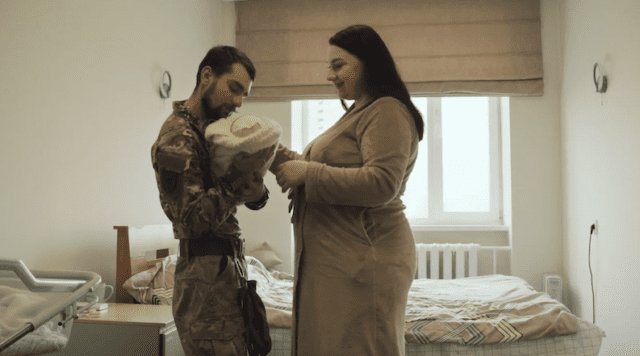
Two years after the beginning of the full-scale invasion, and more than ten years after Russia’s first attacks, these alarms and the war they represent have become part of Ukrainians’ daily routines. It is these routines that Loznitsa mostly focuses on, the “circle of life shrouded by the breath of death,” as he describes it in the press notes. Including the religious, social and political rituals – funerals, births, weddings and commemorative events – which represent Ukraine’s shared values and traditions, and which, by the very fact of taking place, also function as acts of resistance against an aggressor shamelessly denying Ukraine’s historic right to exist.
The Invasion can be seen as a sombre sequel to Loznitsa’s 2014 documentary Maidan, in which he silently portrayed the popular uprising taking place around Kyiv’s titular main square against then-president Yanukovych’s decision to rescind an agreement with the European Union and instead strengthen ties with Russia. But whereas that film had a heroic and victorious feel, as seen in the demos against the tides of autocracy, The Invasion shows the extent to which that democratic resolve has since been tested.
To be clear, the people – both civilian and military – portrayed in The Invasion show no signs of defeatism, instead behaving overwhelmingly according to the famous British Second World War Two dictum ‘Keep Calm and Carry On’. But the documentary does begin and end with funerals and memorials for lost loved ones, stressing just how massive the toll has been. And when you consider that Ukrainian forces are currently outnumbered and outgunned on the front lines, the film cannot help but leave you with a heavy heart.
Like in Maidan, Loznitsa films not so much individuals as the Ukrainian people. The Soldier, the Priest, the Teacher. And just as in Maidan, he uses static framing to create a sense of contemplation and historicisation. But unlike Maidan, where Loznitsa and his camera crew managed to capture the vast masses of demonstrators in group portraits reminiscent of classical paintings, the effect in the episodically structured The Invasion is more hit and miss.
The awkward framing and editing of the opening sequence of an Orthodox funeral service, for example, never manages to elevate what is essentially a news report into cinema. And while such a communal gathering does lend itself in principle to a more generalising depiction (emphasising that this is but one of hundreds of similar events), in a later wedding sequence, Loznitsa’s static and often distant approach clashes with the individuality of the bride and groom which inevitably shines through – she radiant; he clumsy and nervous. At moments like these, you wish the camera crew had been free to roam around and let the individuals being portrayed dictate what and how to shoot, rather than obey a stylistic concept.
There is one moment in the documentary where the camera is let loose, during a search for survivors in a recently bombed building. I assume the intention here was to create a shock between the solid, static framing of the relative peace of everyday life, and the handheld and chaotic war imagery of destruction and a frantic rescue effort. It works, insofar as the contrasting static wide shot of the building afterwards, after everybody has left the site, reminds the viewer, who has by now probably grown accustomed to news footage of bombed-out Ukrainian buildings, that each and every single one of these ruins harbours the ghosts of such horrific events.
But the lively and empathically responsive shots of these rescue workers – who are just as representative of the Ukrainian people as any other group portrayed in the film – only underline how awkwardly detached individuals and situations are approached in other scenes.
To be fair, church services and weddings take place under time pressure and one can imagine a camera crew struggling to find the perfect static shot at every dramatically important and, one assumes, unrepeatable moment. Loznitsa’s approach works better in more controlled circumstances. For example, in the bookstore where Russian books are collected, bound together and disposed of. This scene also contains the funniest line in the film, when a woman enters with a cardboard box full of books and asks: “Where should I put Russian culture?” The film provides the answer as we see countless Russian books ending up as compacted waste.
It’s a scene which recalls the debate at international film festivals over whether, as the Ukrainian Film Academy demanded, all Russian entries should be rejected for the duration of the occupation – even those by outspoken critics of Putin’s regime. Loznitsa, who had previously resigned from the European Film Academy for what he saw as its timid response to Russia’s full-scale invasion, was himself expelled from the Ukrainian Film Academy for arguing that festivals should judge Russian films and filmmakers on a case-by-case basis. In The Invasion, however, we see Russian literature treated with no such nuance: they all end up as garbage, Lenin and Stalin as well as Dostoevsky and Pushkin.
However, the scene in The Invasion where style and content come together best is in a revalidation centre, where people who have lost one or both of their legs learn to walk again using prosthetic limbs. Here, superior framing and thoughtful editing manage to balance the film’s stylistic reserve with the individuality of the rehabilitating patients, using subtle close-ups, moments of black humour, and the cinematic beauty of the mise-en-scène. These scenes encapsulate the message of The Invasion, showing the everyday resilience with which the Ukrainian patients, their doctors and their loved ones strive to surmount the heavy losses they have suffered, and the shared humanity with which they continue to endure and confront the Russian aggressors.
The Netherlands/France/United States, 2024, 145 minutes
Director Sergei Loznitsa
Production Atoms & Void
Producers Sergei Loznitsa, Maria Choustova
International sales Atoms & Void
Script Sergei Loznitsa
Cinematography Evgeny Adamenko, Piotr Pawlus
Editing Danielius Kokanauskis, Sergei Loznitsa
Sound design Vladimir Golovnitski