

Picture yourself in the middle of the playground in an inner-city Paris school full of kids from immigrant families. According to the right-wing French press, such institutions are hot beds of deprivation, noise, chaos and violence.
This is not at all what Claire Simon found when she visited the Makarenko public elementary school in Ivry in the city’s suburbs. Her closely observed new documentary Elementary (a special screening in the Cannes Festival and sold by Films Boutique) offers a very positive portrait both of the young school children and their teachers.
“I had been scouting for schools for quite a time in Paris and in the suburbs. I wanted a school where the children were quite mixed,” Simon explains what led her to the Makarenko school. Her 2018 film Young Solitude had been shot nearby and so she already knew the district.
“Makarenko was well known as being in a bad neighbourhood,” Simon remembers.
As a documentary maker, Simon welcomed the chance to portray the education system in a much richer, more nuanced way than it is generally portrayed in mainstream media.
“I was so amazed the first time I went into the classroom of the professor…he talked in a very low tone and said there is too much noise here. Suddenly, all the children lowered their voices. That was just the contrary of what they [the media] say about schools with sons of immigrants, that they were shouting all the time.”
She thought the school yard was “wonderful…very, very open.” The director “loved” the fact that the school colours were orange and yellow in “a neighbourhood where everything is grey.”
When she first arrived, Simon planned to shoot only in the playground but, encouraged by the head teacher, she eventually decided to film in the classrooms as well.
“This is a normal school, an elementary school, as there are thousands [of others] in France. The fact is that the buildings around it are mainly inhabited by immigrants or children and grandchildren of immigrants,” the director notes.
Violence in the playground turned out to be practically non-existent (although there were incidents of bullying, some of which Simon caught on camera).
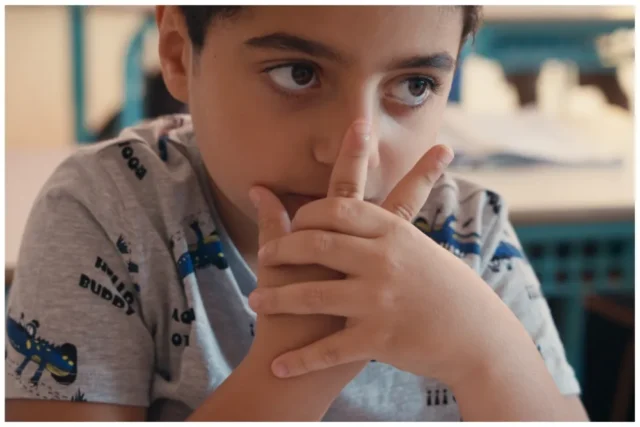
Elementary is shot from the children’s point of view. These pupils, aged between 6 and 12, are remarkably unconcerned about being followed by a movie crew. Simon realised that they were concentrating far too hard on their school work to worry about the camera being pressed close to their faces. “It is more important to give a good answer than to be filmed. This is a sort of law in documentary – you have to find a place where it is more important for the people you are filming what they are living [and doing] than the fact of narcissistic attitudes toward being filmed. And that was the case [in the film].”
Simon talks of wanting to be “a child among the children.” When she first arrived in the playground, the school kids crowded around her, clowning and asking her to film selfies and material of them they could post on Tik Tok. She told them, “I am sorry but you look so stupid when you do that. Give it up.” They soon followed her advice. Generally, they would leave her to film what she wanted. Sometimes, though, they’d come up to her and ask her to film them playing football. (“We’re so good at football,” they’d tell her). She was immediately struck, though, by how keen they were to learn. They took their lessons very seriously.
“It’s not ideological, my point of view. It’s real. You can see the children feel so bad when they are wrong,” Simon observes. “It’s not that the teachers know everything but they open the doors of the world with their language.”
Making the film reminded the director of her own school days. She grew up in a village in the south of France, the daughter of an immigrant (“she was English.”) There was only a single classroom. Everybody mixed in together.
“I loved school… we were with gypsies, Italians, children of the village. School has this wonderful quality – it makes everyone equal. This is so important. It’s true that I felt like when I was at school [while making the documentary].”
In Elementary, Simon is trying to show “the power of the school, the power of the Republican idea of the school.” All the children, wherever they come from, are being taught how to become good citizens, “how to learn and how to talk with the rest of the society.”
In one scene in the documentary, we see the kids discussing an extract from Jules Verne’s novel ‘Around The World In 80 Days.’ In some ways, it seems a surprising choice of reading matter, a book from the 19th Century which expresses sometimes antiquated social attitudes. That, Simon says, is the point. “It’s a special exercise that lots of schools do. It is called cultural mediation. The teacher reads a part of the story and then there are questions to see if the children have correctly understood the text. Then, they have to have a point of view about some questions…the idea is to teach the children how to have a point of view and to defend it.”
Some viewers may think that Elementary is a naive or idealistic film but that’s not how the director regards it. “I showed it to the teachers and they said it’s completely real…this is the school how it is. You have hard things also…”The director freely admits, though, that she loves filming kids. “You see in their faces the feelings they have so clearly. It’s so beautiful. I am completely overwhelmed by that. I really adore the faces of those children because they don’t hide anything!”





