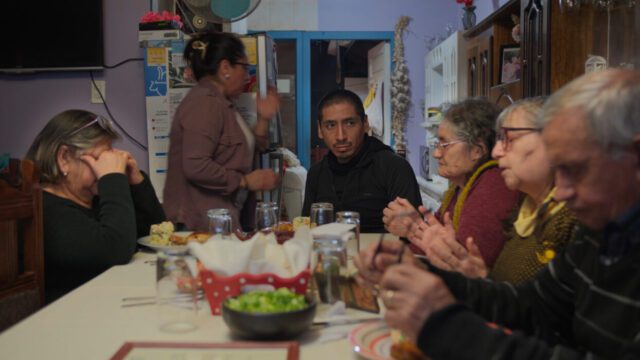
“What is a land, if not a force that forges bodies?” asks director René Ballesteros (Chile-France) within his new film Landless Children (Les Films d’Ici, La Madre, La Ballesta Films), and which world premieres in competition at Cinéma du Réel 2026.
The documentary film follows the stories of two Mapuche [the largest indigenous group in Chile, residing primarily in the Araucania region] children who were taken from their homeland and adopted by European families in dubious circumstances. Juan and Daniel’s stories are just two out of the estimated 20,000 children who were taken from hospitals and children’s homes in Chile in the 1970s and 80s.
In the film, strong themes emerge, of how familial ties are unbreakable and in some ways mystical, even when the two children had no knowledge of what happened to them until adulthood. These ties manifest themselves through dreams, feelings of displacement and unexplained rage. Juan and Daniel, now men, feel the pull of their homeland in different ways, but both with a mix of anger, longing and curiosity.
René Ballesteros was himself a Chilean emigré who washed up on the shores of France. The story of Landless Children, he tells BDE, came to him in a seemingly typical Mapuche way – by chance – or perhaps by fate.
“I was living in Lille when one evening I saw a Mapuche face in the metro. I come from this region, and I’m very familiar with Mapuche faces. It was so strange, I wanted to talk with this woman, but I didn’t want to be intrusive,” he tells BDE.
“So I was working on my first movie by then [The Burn, 2010,] and also working in a restaurant. The chef, a Chilean, told me that there are a lot of Mapuche here in northern France. It was like finding, I don’t know, people from Alaska living in Australia. I learned that a lot of Mapuche were adopted, and that was the first time I heard about this phenomenon.”
At the same time Ballesteros’ own personal life echoed the experiences of the adopted Mapuche. He was contacted by two of his siblings, a brother and sister who had been given up for adoption by his mother after she fled Chile for Venezuela.
Through his research, and with the help of an NGO working with Mapuche people, Ballesteros uncovered the stories of Juan and Daniel, now in their 40s, who had discovered they were adopted, and who were part of the Mapuche diaspora.
Both men had experienced a feeling of displacement growing up, even though they didn’t know they were adopted. We learn that Juan’s adoptive family were ‘bad people,’ and that Daniel was declared dead at birth, then spirited away to be adopted in Sweden.
What comes across loud and clear is their hurt, anger and longing for their birth mothers, even all these years later. Their feelings of rage against what happened to them are visceral. In Juan’s case, he desperately searches for a mother who he hopes had no choice but to give him away, who had perhaps searched for him, and in Daniel’s case, we see him rage against the world for making him grow up in the wrong life. His anger and hurt was so overwhelming, we are told, that he smashed his apartment up, to avoid doing it to himself.
We witness Juan meeting and interviewing his birth mother’s extended family. ‘How much was I worth?’ he says accusingly to a gathering of them in Chile. ‘Look, your mother loved and searched for you, never doubt that,’ replies a family member in tears. We watch as Daniel visits the orphanage he was adopted from. ‘It’s like a horror story,’ he says. We also see Juan bond with his half-sister, and meet cousins who still live in their ancient homeland. “You were ripped away from your ancestral lands, but your heart belongs here,’ they tell him.
We don’t see Daniel meet his Mapuche family, because that hasn’t worked out, but we do see how the knowledge that he was pronounced dead and taken from his mother affects him in relation to his birth half-brothers. ‘I had to die for them to be born,’ he says bitterly to camera, and later, ‘it’s a parasite that consumes me, I feel like an immigrant… I am looking for Daniel the Chilean at [the age of] 42.’
The almost mythical figure of the mother is very prevalent in Latin American culture, Ballesteros tells us. “I don’t know for you in England, but we were raised in this very Catholic and Christian image of Maria. No matter if your mother beat you or abandoned you, the mother is everywhere. It’s a quite heavy load on your shoulders – for me too,” he says.
In all these scenes, there is a genuine sense of these life unfolding before our eyes. How did Ballesteros achieve this?
“It’s something I learned here in France – being open and listening,” he responds. “Also maybe because I had another job – I was a psychologist before. Once I met Albert Maysles, the historical director from cinéma direct, and he told me that the link between being a psychologist and making documentaries is listening. And I guess that’s the most important thing. With both Juan and Daniel there was a connection because I was trying to listen to myself, too. You don’t know exactly what moves you when you meet someone, but there’s something… you have an intuition,” he tells BDE.
There’s a thread of intuition running through the documentary, as well. Juan has unexplained dreams in France that he only makes sense of when he meets his Chilean family, as if his mother had reached out to him at death. For Daniel, it’s a chance meeting in the Chilean cemetery, where he believes his mother may have been searching for him, believing he might have been buried in one of the ‘angelito’ tombs for dead babies. There, we meet a man who tells us just how many children and babies died so young in Chile, which leads Daniel’s girlfriend to talk about a stillborn baby she still grieves for. In empathising with others, and understanding the precarious lives people must have lived in the decades of his taking, Daniel seems to begin to find some peace.
As with many documentaries following people in real time, the stories only really began to emerge in the edit, Ballesteros explains. “I have to say it’s not just my presence and listening that makes the movie, of course, it’s the choices made in the editing. I have been lucky to work with a marvellous team and the editor, Romina del Rosario, was great – and it was a year in the edit.”
As well as being a director, Ballesteros also works as a screenwriter for other projects, and this informs his own work, he explains. “I’m passionate about stories, about narrative and dramatic construction in documentaries and fiction,” he enthuses.
For the world premiere at Cinéma du Réel, Ballesteros wants to send an invitation to audiences to listen, to unearth, to be open to the ‘other.’
“What happened in this movie we didn’t know would happen…but I felt it. I come from the Mapuche region (though I’m not Mapuche), and knowing the culture – there is a lot about dreaming, and I knew Juan’s dream would lead to something. I didn’t know what, but I knew there was a reason for him to have this dream. So this is an invitation to listen to the experience of people, and to the particularity of every story.”