

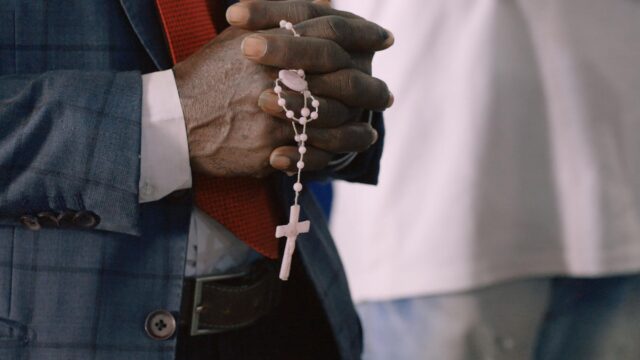
Flemish Panenka’s new six-part series The Vatican promises to lift the lid on the highly secretive workings within the higher echelons of the Catholic Church, and to observe at first-hand the business of controlling a vast and unwieldy juggernaut that governs the lives of more than 1.4 billion faithful followers.
In development for four years, the series examines an institution very much at a crossroads. After decades of scandals, The Catholic Church is mistrusted by many and its power is steadily diminishing, but it is nevertheless headed by a reformist Pope who is battling to inject a bit of 21st Century enlightenment into the 2000-year-old, highly conservative establishment.
The project was first mooted during a conversation in the Panenka offices between the company’s founder and creative director Tom Lenaerts and Rik Torfs, a professor of canon law (also co-writer on the series), and soon joined by co-writer Jo Badisco. What started as a run-of-the-mill chat about ecclesiastical matters soon turned into a full-blown conversation on The Vatican and its hitherto questionable representation in media. There were, they realized, more creative lines to follow, different approaches to be made and wider topics to be covered, such as “women in the church” and “its real power structure,” says Badisco of the project.
“Let’s see if we can get up high in the Vatican hierarchy. Let’s see if we can discuss these topics with those people that we never hear of,” Badisco recalls of the trio’s deliberations on how to isolate and cross-examine the mandarins in Rome. What’s more, they knew their idea would work perfectly as a six-part series. “People wanted to see something new on the Vatican, but more elaborate, more encompassing.”
They also realized that they would have to dial down on their cynicism. “Despite our skeptical attitude, we knew that if we wanted to hear the voices of high-ranking clerics then we needed to adopt an open yet firm attitude, otherwise they would never talk,” Badisco adds. The institution would still remain “impenetrable.”
Badisco also remembers how it took over a year for the team to get a foot in the Vatican door, but when they did, the first “encounter” with the institution’s communications department was encouraging. The department head explained that he wanted a “different narrative,” such were the storms of negative media the Church had suffered, or brought upon itself, in recent years. The Vatican department also acknowledged that this would be an independent production on which all creative and editorial decisions would be taken by Panenka.
So the ground rules were set. The comms department understood the seriousness of the endeavor and they co-operated well with the filmmakers, despite their obvious tendency towards self-protection. After the first cardinal agreed to interview, the ball started to roll. “They knew that our approach was respectful. They were, like, ‘we can trust them even though they have this skeptical attitude, but we know we cannot run away from that.’ They helped us, but always with respect for our independence. They knew that they could not control the final outcome of our documentary.”
“You have to work with them, obviously not compromise your values, but work with them nevertheless to progress,” Badisco adds. “Otherwise, for a project like ours, you’d never get into the city walls.”
The series is directed by Kat Steppe. “She is one of Belgium’s most talented docu-directors and a master at opening up on-screen a closed-off world,” producer Kristoffel Mertens tells Business Doc Europe. “It proved an added value to have – thanks to Kat – a female voice in the series, in the male world of the Vatican.” (Steppe has worked extensively with Panenka on many past projects, including Taboo, which is one of VRT’s most watched and highly lauded series, for which she won an International Emmy nomination. She is also in pre-production on her first fiction feature film [working title, Mist], also to be made with Panenka.)
On The Vatican, the team conducted scores of interviews with clerics from a dozen countries and across all strata, right up to the Church’s second-in-command, the Secretary of State. Did they go for the big prize of the Pope himself?
“What do you think?” Badisco answers witheringly. “We tried for a long time. It went from personal letters from me being the head writer. At one stage I moved to Rome with my family. We lived for a couple of months close by the Vatican, just to do the research in a different way to get to know people a little bit better…Every now and then you got a feeling, that we’re getting closer.”
But it was never to be. Pope Francis would never agree to an interview that would be edited and blended into a free-flowing creative documentary series, Badisco points out. If the Pontiff gives an interview he will see the questions in advance and insist that it is run chronologically and in its entirety. “We hoped that it would be different this time, but no, finally they didn’t concede an interview,” Badisco regrets.
Nevertheless, the series promises to present a reforming pope looking to effect meaningful change in a deeply conservative institution that continues to be beset by scandal, Badisco underlines. “How important is this figure, the personality of this Pope, in the whole process? Is he really enabling change for a long-term future, or will his attempt only fail?” Badisco further wonders.
Presenting the series at the recent CONNEXT showcase of new Flemish audiovisual output, Panenka producer Mertens observed how, “we never made a documentary series that generated so much response. Literally, everyone who already saw the episodes feels the need to express their opinion, and that’s why we make productions – to create impact and to open up discussions.”
The series is in post-production with an aim to complete all episodes by the end of the year for broadcast in early 2024. Mertens has sales company Federation Studios on board, which has been at Mipcom this week “starting up the first conversation with potential and interested parties.” The Panenka producer confirmed that that all archive material and unique footage has been cleared for worldwide use.
“How nice it [is] to have a documentary series like this that impacts so many people and that opens up this discussion to as many screens as possible?” Mertens signed off in Antwerp. “So from now on, we welcome all distributors, broadcasters, and festivals with open arms.”





