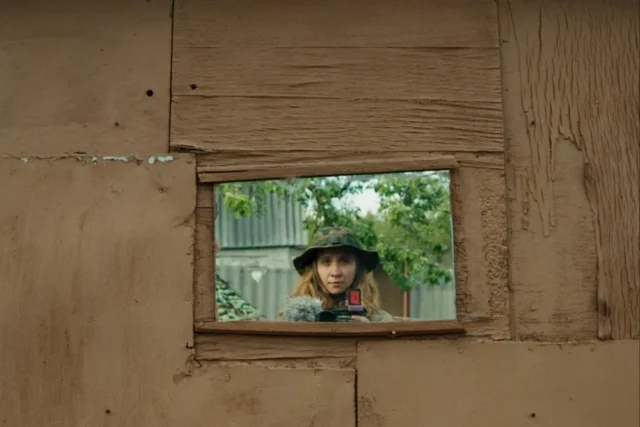
After Putin ordered the full-scale of her country in February 2022, Alisa Kovalenko enlisted into the Ukrainian army as a volunteer. She was fulfilling a promise she had made to herself in 2014 that she would take up arms to defend her country if the war were to escalate.
“Some might think I am crazy – a mother going to war – but after everything I had endured and witnessed, I never doubted my decision,” the director explains in her film notes. “I had a sense of what was to come since 2014, when I filmed in Donbas, shortly after Crimea was annexed by Russia. At the time, I was grappling with the question of who I was as a filmmaker in the midst of those events. That’s when I made a promise to myself.”
“Yes, emotionally, it was a tough decision [to go to the frontline]…but at the same time, I knew I had to do this as a citizen of my country. This decision was about honouring my promise and staying true to my belief in fighting for our freedom….There was also this feeling that we, as parents, are responsible for our children’s future, so that in the years to come, they would not have to go to the frontline instead of us. We were certain that we had to stop it now.”
In her 98-minute film, Kovalenko films herself and her comrades, most of whom are men (and fellow volunteers), as they hide out in the woods, operate surveillance drones, peel vegetables, joke, eat together, lie in silence during mortar attacks, advance on the enemy, and suffer the loss of their colleagues. When they can, the soldiers phone home via Starlink. As does Kovalenko, at times joyfully, at other times close to tears, as she chronicles her life for Théo, the seriousness of her messages increasing as she and her troop advance towards the frontline.
We also get to see the messages back from Théo. “I am very proud you are protecting Ukraine,” he says at one point. All the time the tension is palpable, not least when they return to the school which had been their camp just a few days before, but which is now in ruins, the target of a concerted mortar attack.
Kovalenko’s film also includes a very moving coda sequence which honours the soldiers with whom she served and who later died in combat, not least the inspirational commander Bars whom she had first encountered in Donbas in 2014.
Usually it is sons writing home from the war zone to mothers. This film is the opposite. “I also had this feeling that a woman as a mother is also kind of invisible on the frontline,” Kovalenko reflects on the time she served, although at the time, “when I was writing letters I didn’t think this so much. I just felt that I’m like all other soldiers. I didn’t so much think about myself as a woman. I started to reflect on this fact much later.” She also points out that today’s Ukrainian army has the largest number of women of any force in Europe.
Kovalenko also talks of a sense of guilt that she feels, even after having served her country both as a decorated soldier, as a filmmaker chronicling the war and as a cultural ambassador at myriad festivals and events across the world.
“I think these responsible people, they all feel that they don’t do enough even when they go beyond their limits,” she says. “Every day there’s a feeling that we are not doing enough because of the war still going on, because there’s still people dying and you cannot get rid of this feeling.”
“I always want to be in Ukraine more than ever…I think many of my friends, colleagues, they want to be at home more than ever. Sometimes you’re even more afraid about what’s happening in your country when you are far away.”
But at the same time, Kovalenko recognises her duties as a filmmaker, even if there has been a considerable widening of her responsibilities of late. “It’s not anymore art for art, it’s something more important,” she says. “But it’s motivating to go to festivals to talk because sometimes you can be a voice of people who cannot speak out – you can make the voices of these people louder.”
The feeling of guilt nevertheless remains, alongside a sense of powerlessness. “I feel that in a way it’s easier to be on the frontline to be a soldier and to fight because it’s something very clear, very black and white and it’s easy for the brain. But when you are running around here in Europe or in the US and you’re talking and participating in a conference…it’s not like nothing has changed, but you see that it’s still not still going how you want it to be…We see a lot of talks about peace but everybody forgets about justice and maybe justice will be sacrificed for the peace.”
For Kovalenko, what constitutes ‘normal’ these days is far removed from any sense of normality she knew before the Russian invasion of her country. “It’s super intensive,” she says. “We are combining so many roles – you can be mother, you can be soldier, you can be survivor of captivity, of violence, of torture. You are also documenting other survivors, documenting war crimes. You are a character, and you are somebody who is documenting this unique experience of what we are going through, trying to capture this reality from inside this reality.”
What she truly misses is the freedom simply to enjoy small things “without this very bitter background,” just to be happy for its own sake.
“It’s like now we always have this burden that we have to carry and even when we are trying to be happy, you are not happy fully, you cannot live through this moment,” she says. “It was Saint Patrick’s Day in New York [she was recently at the UN representing women survivors of sexual violence in war] and I was curious how Irish people were celebrating. I was looking at all these people dancing and they were happy – I don’t know, drunk but still very nice and there in this moment, fully enjoying themselves. And suddenly I felt so fucking sad and I just wanted to cry because I felt that I don’t know when we can have again this moment of joy or happiness or lightness of life.”
“It’ll be very hard way for us to find new normality with all our wounded souls, with all our traumas. We have to find something, our own normality that we will feel so we can leave all this behind,” Kovalenko ends.