In Swiss filmmaker Ian Purnell’s feature documentary, selected for main competition at CPH:DOX, a cable-laying vessel traverses the high seas en route to one of the remote Aleutian Islands that separate the Bering Sea from the Pacific Ocean. The crew’s mission is to delivery fibre optic connectivity to the Arctic islanders, hitherto denied to them because of their sheer remoteness.
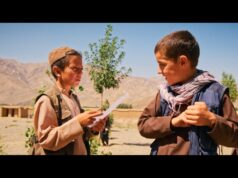
As the boat approaches, islanders and crew members alike reflect on what they believe the worldwide web represents. In a classroom, schoolkids liken the internet to a venomous snake, or an endless void. One particularly articulate pupil compares it to a queen ant who is fed by us, the workers, in the form of our personal info.
Another islander sees the internet as a “sentient being” that will deliver the social connectivity and dating opportunities that he craves, and therefore he can’t wait for the ship to arrive.
With serious decline in fishing yields, a fisherman awaits the arrival with curiosity. “Maybe the internet is the saviour from the ocean,” he says. “Or maybe it’s the beast.”
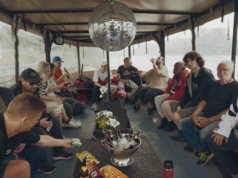
On the ship, meanwhile, connectivity is virtually non-existent, other than for strict operational purposes. This doesn’t seem to be of huge concern to the crew of Filipino workers, however, who play pool and air hockey, laugh, joke and play live music, with no online distractions to spoil the collective fun.
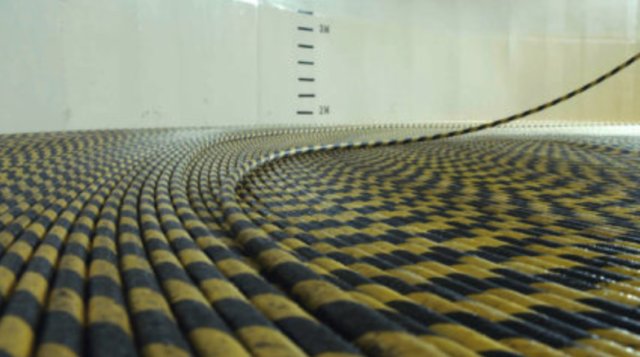
All the time, the film shows us the processes of the cable-laying operation via submersibles, which must, at times, descend to a depth lower than the height of Everest, we are told. On deck, we see the cable unspool slowly and satisfyingly, like a yellow cobra, and we observe technicians splicing the cable ends, revealing just how delicate the electrical wiring is inside its casing. On the island, channels have to be dug to accommodate the new cable before eventual delivery of the service.
In his film notes, Purnell describes his initial spur to make the film. “When I first discovered a map of the world’s submarine cables, the internet suddenly took on a physical shape. I felt a strong urge to trace these hidden routes – to see how the network disappears beneath the sea and to meet the people who build these connections,” he says.
“I wanted to understand this infrastructure that usually remains unseen, and I knew I could only approach it emotionally rather than purely technologically. In the form of the cable, the internet became a kind of protagonist for me: uncanny yet vulnerable, a snake-like being infiltrating remote landscapes, underwater territories, and human minds. Cinema felt like the right medium to give this entity a life of its own.”
He adds to BDE how he grew up with the internet, “it was already part of me, so then having seen a very simple visualisation of it [in the form of the cable map], and the possibility to actually travel to it, this just made me want to go on this journey and research these ships that bring the internet across the oceans.”
One hurdle he had to overcome was gaining permission to board the boat with a camera. “There are only a handful of companies worldwide operating cable-laying vessels and there is very little reason – and often very little desire – to allow an external film crew into that environment,” he says. “Building a trustful connection with these companies took years. Logistically, we also had to remain extremely flexible in this process, as setting out to sea – often from very remote areas – depended not on us, but on the constantly shifting operating schedules.”
Also, there was the problem of seasickness, he tells BDE. “Especially in that region around the Aleutian Islands, it can get very stormy. And for me – I’m a cinematographer – it was a new experience to be on sea for such a long time. So I had to be prepared with medicine against seasickness…and that made me even more sick. I couldn’t see properly anymore, which was not a very good thing for shooting a film. I could only see blurry, like through a blurry lens.”
When the high-speed fibre optic arrives it is, of course, life-changing. One woman Purnell met had preciously told how him how she always wanted to bring her kids up on the island “in the present,” enabling them to experience all that nature had to offer. Now with high quality internet so easily accessible, the kids are reluctant to gambol on the beach, preferring instead to play online.
For one older Filipino guy, who readily admits to having been left behind by technology, the new online reality now enables him to look up old photographs of friends who were part of the Filipino diaspora. It is an experience from which he derives much pleasure.
Purnell highlights for BDE a further benefit of the island’s newfound web access. “Especially with those remote communities, the internet is extremely important, maybe even more important than in cities in Europe, for instance, because they’re so dependent, because there’s so little infrastructure there…So it’s also important for the survival of those places,” he says, citing the medical and school systems which now rely upon greater connectivity. “And at the same time, because there is so little [to do] there, so little other distraction, it can really have an even bigger impact, since these communities are also more vulnerable to addiction.”
In his film notes, he riffs more on his relationship with the web, which he describes as a very personal one. “I grew up alongside the internet. My first experiences of real connection beyond my immediate surroundings happened there. I found people who thought like me, who felt like me. It gave me a sense of belonging, of understanding, of discovering my place in the world. For me, the internet is tied to core memories of love, connection, and recognition.”
“The internet is not separate from the world we live in. It is part of it. It shapes our present-day reality. So the question is no longer whether we want the internet. The more urgent question is: how can we shape it differently? How can we resist the dominance of a few corporations and have more agency? How can we make the internet more human again?”
Arctic Link is sold by Filmotor, and is one of six European documentaries selected for the EUROPE! Docs programme, devised by EFP and CPH:DOX.