Given the recent rise in international tensions, it’s the perfect moment to be looking back at a time when world leaders were actually trying to reduce the risk of war. Especially now that Cold War mindsets seem to have resurfaced in both Moscow and Washington.
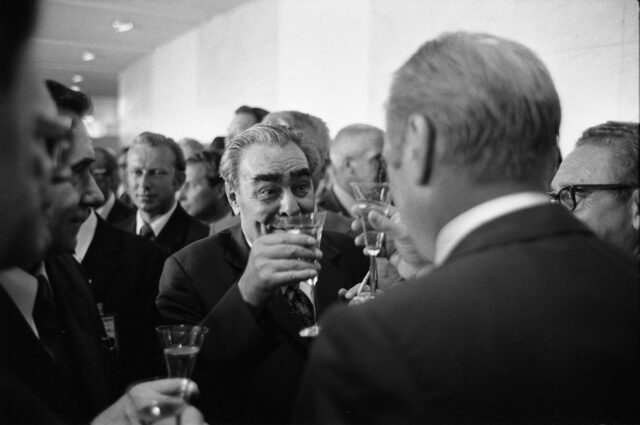
The policy of disarmament and confidence-building in the 1970s was called détente and culminated in the 1975 Conference on Security and Cooperation in Europe (the forerunner of the OSCE) in Helsinki. Eight socialist and twenty-seven capitalist leaders, including Ford, Brezhnev, Schmidt, Honecker, Ceaușescu, Trudeau, Palme, Wilson and Tito, came together for what one French TV newsreader described as “the conference of the century, unprecedented in world history.”
It was, explains Finnish director Arthur Franck, who guides us through the archival material with a personal, often ironic and sometimes even sarcastic voice-over, the brainchild of Soviet Secretary General Brezhnev, who considered it part of his political legacy.
The Americans didn’t really see the need to reaffirm the European borders as they had been established after the Second World War, which is what the Russians wanted, but acquiesced because the Europeans insisted.
With Moscow wanting to reaffirm European territorial integrity and Washington following the political wishes of their European allies, The Helsinki Effect is full of historical echoes, contrasts and funhouse mirror images of our current political realities.
Franck treats all this with a light-hearted touch, mixing television footage of the conference with remarks made at other high-level political meetings of the era (many, as the documentary notes, only recently declassified) and more general period imagery – from John Wayne praising America to cartoons illustrating life behind the Iron Curtain. Plus the running gag of footage of TV news anchors struggling with empty, upside-down or misaligned blue-screen backgrounds.
To more easily integrate written transcripts of meetings into his film, Franck uses AI-generated voices for Henry Kissinger and Leonid Brezhnev – his two main protagonists. Franck is open about this from the start, and AI voices do not require training on copyrighted material, so I see no problems here. And even if, as Franck notes, Brezhnev in reality did not speak English, as he does here, the approach certainly helps to make these dossiers more accessible. It works.
Franck’s pretending to call Kissinger and Brezhnev directly (for which a few unimportant phrases had to be AI-generated without being sourced from the historical record) is a bit silly, and would have made more sense if the whole film had used this conceit of ‘live’ reporting from the year 1975. Still, it doesn’t really do the film any harm.
What does bother me, however, is Franck’s insistence, right off the bat and repeated throughout, that such conferences are “boring,” even “extremely boring,” and that it is therefore up to him to “make it interesting” for us. First of all, I do not believe that this is Franck’s true opinion – you do not make a feature-length documentary about something you find inherently uninteresting.
And secondly, if Franck believes he has to convince viewers who think this is boring – well, of course he doesn’t! No one in their right mind is going to watch an archival documentary about a political conference in the 1970s unless that’s exactly the sort of thing they’re interested in. And I am – so to be constantly reminded that, of course, everybody knows this is boring, is frankly patronising. In fact, Franck’s repeated insistence that these political proceedings are boring (after an hour he says: “If you’ve not fallen asleep by now, you might as well stay with me until the end”), becomes itself the most boring aspect of his documentary.
The same can be said of the irony, which is largely based on the same assumption of a shared disinterest in international diplomacy.
It undermines – only partly, but still – the very essence of what is so relevant and interesting about looking at this conference through a 2025 lens. The stakes are so high, the alternative (which we seem to be heading towards right now) is so unthinkable, and the intricacies of diplomacy are so complicated (the documentary shows how the conflict between Turkey and Cyprus threatens to derail the conference), that there is absolutely no need to talk down to an audience by assuming they are bored. “Boring” – really? What could be more fascinating than this? For a superb example of what I mean, see Johan Grimonprez’s exhilarating Soundtrack to a Coup d’État (2024), which presents international politics, including meetings and conferences, with thriller-like intensity without needing a wink or a watering down for an audience presumed to be a priori uninterested.
Maybe the most important point made by The Helsinki Effect – and the one that gives it its title – is the unpredictability of the impact of such a large-scale, high-level international forum. Looking back, we can see how the conference inspired peace movements in both the East (including Charter 77 and Solidarność) and the West (including Helsinki Watch, a precursor to Human Rights Watch).
The documentary traces this back to the so-called ‘Basket 3’ of the three-tiered negotiations. The first two baskets being what the Soviets wanted (recognition of borders; economic and scientific cooperation), the third being what they had to compromise on to get it.
I wish the documentary would have delved deeper into the legal and diplomatic nitty-gritty here, as I only got a rough idea of what was finally agreed. The first time the documentary refers to Basket 3, it is described as “co-operation in humanitarian and other fields”, which does not sound very controversial. Later, it is summed up as “freer movement of peoples across borders, to allow existing family reunifications, to facilitate the freer and wider dissemination of information of all kinds, meaning access to newspapers, books and television, and better working conditions for journalists from other countries.” Which makes more sense if it is to be regarded as “interference in internal affairs,” which was the Soviet Union’s first response. Whatever the precise articles, this third part of the Helsinki Agreement signed at the end of the conference, contained enough specifics to motivate peace activists all over Europe to use the document to hold their governments accountable. Which Franck directly links to the fall of the Berlin Wall, only fourteen years later.
The Helsinki Effect is fascinating, relevant and exciting – and could have been even more so, if its inherent fascination, relevance and excitement had been fully embraced by its makers.
No risk of boredom; no need for irony.
Finland/Germany/Norway, 2025, 87 minutes
Director Arthur Franck
Production Polygraf
Producers Sandra Enkvist, Arthur Franck, Oskar Forstén
International sales Rise and Shine World Sales
Script Arthur Franck
Editing Markus Leppälä, Arthur Franck
Sound design Yngve Leidulv Saetre, Thomas Angell Endresen
Sound Daniel Rognes
Music Uno Helmersson, Patrik Andrén
With Henry Kissinger, Leonard Brezhnev, Urho Kekkonen