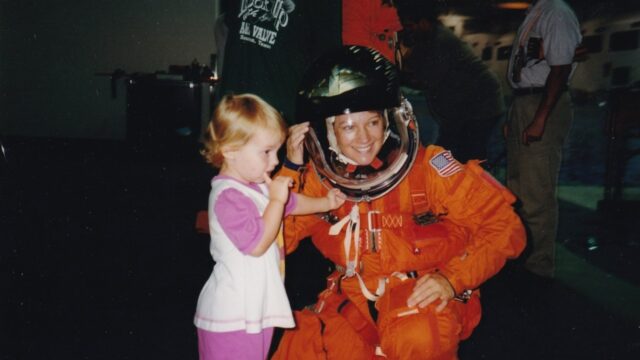
The remarkable insights from the ever-measured and thoughtful Eileen Collins, the first woman to pilot and command a NASA Space Shuttle, help make Hannah Berryman’s documentary Spacewoman a highly watchable film. As well- balanced as its subject – Collins’s own daughter says that her mother is “serious and procedural” – it beautifully explores the dangers of her chosen profession as well as the pressures it had on her family life.
The scene is set right at the opening of the film. “So Eileen,” says the director. “What makes a good astronaut?” It is an appropriate question, and with a slight turn of the head and a hint of a smile Collins replies: “A person who is not prone to panicking. A person who does not fear problems, but sees problems as challenges…and something that is, frankly, exciting.”
Berryman – blending archival family footage, NASA material and a series of new (and news) interviews – goes on to paint the portrait of an extraordinary person. We follow her journey from a troubled working-class childhood (where she admits to be being painfully shy but determined to fly), through her military career, and onto her time with NASA and her pioneering 1995 mission that saw her pilot the Space Shuttle Discovery in the first rendezvous with the Russian space station Mir.
The chronological structure of the film feels appropriate, allowing her to explain how at 19 she worked several jobs to raise the money for flying lessons; how joining the airforce came at the point when the military wanted to ascertain if women could fly high intensity aircraft and how she was part of the first group of women to take part in advanced pilot training.
Setting her sights on the NASA space mission (she rather engagingly admits that she wanted to be Captain Kirk from Star Trek) she knew that to be a mission commander she had to come in as a pilot. She aimed to get into test pilot school – which is where Shuttle pilots tended to be drawn from – and admits to a journalist (in archive) that you had to be seen to be better than men even to be considered an equal.
The underlying sexism of the military and NASA is prominent throughout the film, especially when she marries a fellow pilot. The film’s examination of how her career and family life worked is at the core of the film – her husband is cheerful and endlessly supportive, but it was never so easy for her daughter Bridget, born shortly after her first Shuttle mission, to have a mum engaged in such dangerous heroics. In a fascinating series of interviews the now-adult Bridget comments how she never saw her mother show, nor display, any fear. Collins herself admits having a baby changed her a lot, but she recalls explaining the Challenger disaster to a young Bridget. Despite her assurances that NASA had learned from the tragedy, the subsequent Columbia disaster two weeks later merely emphasised the very real dangers of the missions. Her son Luke, though younger and less directly affected by his mother’s missions, is seen chatting with his sister about his memories of her and her NASA time.
As the film cheerfully stresses, Eileen Collins certainly had the ‘right stuff’, always presenting herself with calm and ordered confidence. Astutely the film celebrates the glory of space travel while also being very clear about the dangers, never getting caught up in jargon or minutiae but allowing the human side of the missions to shine through.
The film comes to a rather delightful end with footage of Collins at a signing for her book Through the Glass Ceiling to the Stars: The Story of the First American Woman to Command a Space Mission, as she chats to a smiling and awe-struck young girl sporting her own junior flight suit, telling her to “reach for the stars”. The film is a powerful and moving tribute to a remarkable woman.
UK, 2024, 95mins
Dir: Hannah Berryman
Production: Haviland Digital, TigerLily Films
Producers: Keith Haviland, Natasha Dack Ojumu
Cinematography: Ian Salvage
Editor: James Gold
Music: Marcelo Zarvos