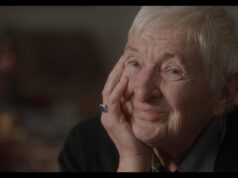
A beautiful delve into life, love and the ups-and-downs of a long relationship are gently and thoughtfully examined in the wonderfully titled Two Strangers Trying Not to Kill Each Other. The film ends up being movingly profound in its simplicity as it tells the story of Maggie and Joel, aged 75 and 84, both very much aware they are in the twilight of their lives but still battling for their love, as well their different needs within their relationship.
Thirty years after a chance encounter, internationally-acclaimed Bronx-born photographer Joel Meyerowitz and British-born artist and writer Maggie Barrett still relish each other and their relationship. But as directors Jacob Perlmutter and Manon Ouimet movingly reveal, there is still an element of unease between them, which is further challenged when Maggie falls and breaks her leg, forcing Joel to become her caregiver for a while.
The film opens in Italy where Maggie is in hospital right after her accident. Holding hands, they talk in whispers about their wedding, kiss gently and say how much they still love each other, with Joel adding: “We have to dance again.” Back in their Tuscan home there begins a lengthy rehabilitation process, but even as she is first brought back to their bedroom and starts to explain what she needs from Joel, there are hints at frustration as he takes a phone call. “Just say no,” she angrily says.
Joel is exhausted, he tells his friend Gianni, while Maggie expresses how her spirits are low, her injury making her ruminate on mortality. “It is coming closer,” she adds. “Close to end! It fucking pisses me off.” Their delightfully amusing and warm doctor Rossana distracts Maggie when she takes stitches out, commenting that there are “no doctors like this in America,” but this acts as a precursor to the couple making a decision to leave Italy and return to New York. “I don’t want life in Tuscany to end,” says Joel, “but with Maggie’s leg and her osteoporosis, this place is too challenging for us.”
They play sitting-down table-tennis together, she plays the piano and they sway and gently dance next to her walking frame, but when it is time to pack she points out that there is far more of his stuff to take back than hers, adding “I feel overwhelmed by you”. Hints of deeper issues are revealed when she expresses her worries. “We have to leave Tuscany – that is obvious. Our other home is New York and for me that is stepping back into a place of pain and isolation and rejection.”
Back in New York and Joel busily prepares for an upcoming Tate exhibition of his work, but Maggie becomes increasingly tense and frustrated. She is filmed tearing up her journals. “Fifty or 60 books of pain,” she comments. “Utter angst, and I hung into them. Hung onto them as thought they would be an archive when I became an important writer.” Joel attempts to be supportive, but he is clearly frustrating her, leading to a spellbinding sequence where he angrily explains her feelings, how much she hates the New York apartment (he had a life there with a previous wife) and how he doesn’t really listen to what she is saying and is just caught up in his responses.
After selling their New York place the couple re-settle to Cornwall in the UK, where Maggie is from. With her painting the rugged coastlines and Joel taking photographs they appear – as the film comes to a close with charming footage of them dancing at the top of a cliff – to have found balance and peace to go alongside their deep-rooted love. They talk in bed about how they want to be remembered and where ashes are to be scattered. They still have very different opinions, but as they hold each other there is also a mutual understanding. This is a film of openness and ultimately compassion. There are hard truths to be faced in all relationships, but in the shadow of mortality, finding understanding and balance seems all the more important.
While co-directors Jacob Perlmutter and Manon Ouimet are with this couple at moments of love, pain and conflict, they have also unobtrusively managed to craft a warm-hearted and deeply moving film about living and loving – one that faces up to tough questions and which elegantly (and beautifully, thanks to Perlmutter’s cinematography) stresses that life is never easy as one strives for peace.
UK-Denmark-US, 2024, 100mins
Dirs: Jacob Perlmutter, Manon Ouimet
Production: Manon et Jacob, Final Cut For Real, Undeniable, Louverture Films
International sales: Cinetic Media
Producers: Manon Ouimet, Signe Byrge Sørensen, Jacob Perlmutter
Cinematography: Jacob Perlmutter
Editors: Estephan Wagner, Josh Mallalieu
Music: Diogo Strausz