We’ve all seen One Flew Over The Cuckoo’s Nest. Those scenes of cold-hearted psychiatrists and sadistic health workers persecuting the mental ill are familiar from many other plays and novels too. As Norwegian filmmaker Ellen Ugelstad shows in her new feature documentary The Recovery Channelthat this cruelty continues today. Coercion remains a troubling part of mental health care.
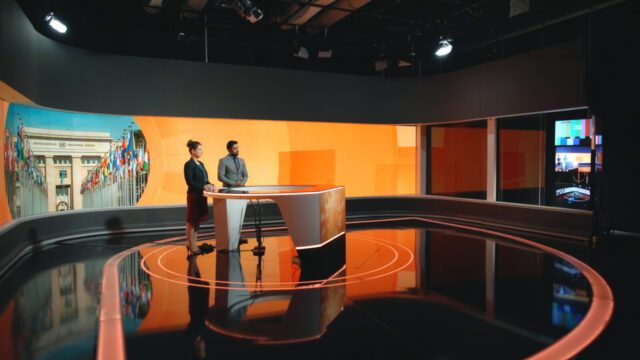
The film takes an unusual stylistic approach. Rather than use verité filmmaking, the director tells her story as if she is making a report for a CNN-like TV news channel.
“I thought of it as a very heavy and complicated topic to go into. There is also so little knowledge about it. I thought how can I convey it not in a more entertaining but a different way and get a different perspective on it,” Ugelstad explains why she thought up the ‘Recovery Channel’ conceit. “I was thinking about a TV channel as a place to tell stories from.”
The Recovery Channel shows reporters with microphones talking directly to camera as if they’re providing bulletins for a daily news show. These were shot in a rented space in studios in Oslo.
The documentary has a very personal resonance for its director. Her father, who died in 1996, was a psychiatrist. Her mother was a social worker. Her brother Torstein, who has been living with schizophrenia for many years, has been in and out of psychiatric wards since he was a teenager. “I have seen how he has been hurt by the system and hurt by people who were supposed to help him.” (Torstein was the subject of the director’s debut film Indian Summer in 2011).
Ugelstad laments the “fragmented” approach to mental health care in Norway and the “lack of continuity” in relationships between patients and their carers.
“My brother is a very dark story. It is not like that for everyone. But a lot of people don’t get the help they need and the system is in itself oppressive, I think.”
As the documentary reveals, patients are still often restrained physically and put under intense pressure to take medication. This doesn’t only happen when they’re in a state of distress or when they’re putting themselves or others at risk. It’s just the way some psychiatrists go about their work. Psychiatric wards are still too often akin to jails.
“When all you have is a hammer, then everything looks like a nail. It’s like they don’t have enough alternative methods to de-escalate or deal with the situation,” the director suggests. She believes the “culture” is naturally conservative and that the medical experts are far too reluctant “to try something new.”
Earlier this week, the filmmakers hosted a pre-premiere impact screening event for The Recovery Channel in Geneva. This was intended to “bring attention to the intersection of storytelling, mental health and human rights in the framework of the UN Human Rights Council sessions…to reach policy makers, journalists and academics and “to ignite a collective call for a more compassionate approach to mental health care.”
Ugelstad describes the film as a labour of love, born from her experiences with her brother, and by “a deep desire for change in how we perceive and treat mental health issues. I hope The Recovery Channel not only resonates with the audience, but also inspires politicians to advocate for a more humane approach to mental health implementing the recommendations from WHO.”
She draws attention to the plight of those who are mentally ill. To admit to their condition is to risk institutionalisation. “If people really felt they were getting help, then they would contact [medical experts] for help. [But] sometimes when you contact early on, they’ll tell you [that] you are not sick enough to be admitted to the hospital and that you have to wait until either you’re hurting yourself or you’re hurting somebody else…it’s like a downward spiral in a way.”
How does mental health care in Norway compare to that elsewhere in the Nordic countries or in Europe? “I don’t have all of the numbers but I know that Norway uses a lot of coercion.”
“I really want to raise awareness and put it on the agenda. I want the whole society to discuss this. Also, I want people to know what is going on behind closed doors,” Ugelstad continues. She is calling for recovery-oriented treatments for the mentally ill that don’t demonise them.
The director believes her attitudes chime with those of her father and other enlightened psychiatrists who were “always very humane and concerned about the patients and their families.”
Distribution collective Jack Film Agency is handling the Norwegian release of the film. On the 4th April, the film will be released theatrically on 80 screens around the country.
“We structure it like a band going on tour. We don’t release it in the whole country at the same time. We do one city at a time, a very tailored tour,” Ugelstad talks about the freewheeling distribution strategy.
Ugelstan founded the independent production company Twenty One Pictures. “In 2019 I expanded and took in other directors. I found that it is important for women to run their own companies and to set the agenda, not having to knock on the door always at the producer’s office to have your project approved – because in Norway we have to have a producer also to apply for the money,” she says of the company. “I thought that as there is a shortage of producers, I will just do it myself!”
Now, as well as making her own movies, she helps other filmmakers’ projects to come alive, working with fellow directors like Line Berg and Thomas Østbye. She is currently developing a new feature of her own, The Best Country In The World (working title), a multi-character comedy drama with various interconnected stories. This has received development support from The Norwegian Film Institute.
“For me, film is film,” she says about the ease with which she skips between drama and documentary. She likes to bring fiction into documentary and vice versa. “It’s just a way of working. I like playing in both formats…”