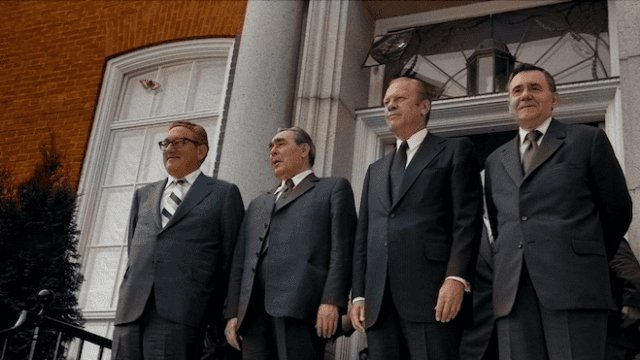
How could watching a bunch of grey-haired men, not a woman amongst them, gathering for two days and many of them in the early stages of dementia, be in any way interesting? The Helsinki Effect is a film about speech-making and international diplomacy during the final leg of the Conference for Security and Co-operation in Europe, held in Finland in the summer of 1975. What could possibly be sexy about that?
As it happens, quite a lot. And it can also be hilarious too when you parachute in a wry and ironical commentary, and engage in fictionalised conversations with the world leaders of the time (using authentic transcripts of what they actually said). It is also an entirely serious film, especially when viewed through the prism of 2025 when US diplomacy requires the public humiliation of a fellow president who has led his country through an unjust war and illegal war.
In The Helsinki Effect, sold by Rise and Shine, world leaders talk and joke in private, in-between bouts of rhetoric reserved for the global media. These leaders (eight from Socialist states, 27 from capitalist, we are told) are more alike than one would have ever supposed. They actually got on. But that’s because they actually took the time to sit down and get to know one another, the film shows.
“The sense of diplomacy and those personal connections are built over time, they actually are crucial to maintaining [stability],” Finnish director Arthur Franck tells BDE. “That kind of humoristic friendship that is actually pivotal to any deep relationship can actually then also benefit the world. On the surface, everybody has to play hard and make big speeches and make the political stance very clear. But then when you’re in the room, you still have to get along, and that might sometimes then save the situation.”
Not that the world was one great cosy place back in the 1970s. Watergate had ousted an incumbent president. Europe had its internecine and radical home-grown terrorism (in the form of the Red Brigade, the IRA, Baader-Meinhof etc), Turkey and Greece were at loggerheads over Cyprus, and the Cold War was still chilling. Nevertheless, the political temperature in Helsinki were very warm.
The underlying premise of The Helsinki Effect is that Brezhnev walked away from the conference with a smile, thinking he had signed an accord pact that he could happily present back to the Politburo in Moscow. But he had unwittingly opened the door for legitimate dissident activity within the Soviet satellites, most famously Poland and Solidarity, which ultimately marked the beginning of the end for the Soviet Empire.
In many ways, the core characters are just how we remember them. Ford looks a bit lost. Brezhnev is jovial but with ice in his veins, and Kissinger is a player. “He was a superstar,” Franck tells BDE of Kissinger, the real spider within the conference web. “Maybe actually a really bad guy, but he’s still very fascinating, very magnetic in a way. I feel very attracted to his behaviour and his charm, even 50 years removed.”
But what differentiates Kissinger from his latter-day counterparts, Franck underlines, is the loyalty he showed to his allies, despite his well-attested-to war-mongering tendencies elsewhere. “Now, President Trump’s foreign policy of reshaping the world order around the spheres of interest of the super-powers, whilst selling out allies and undoing decades of diplomacy in the process, places the smaller western nations in existential peril,” Franck writes in his notes for the film.
The Finnish director freely admits that he doesn’t like filming very much, and that the opportunity to instead gather archive in an edit suite was infinitely preferable. It was even a lot fun, at least until all the money was raised and they had only a year left to deliver the film in time for the 50th anniversary of the Conference.
“I set out to make a film that wouldn’t have a single day of shooting…not getting out a lot was actually the whole point of my process,” he confirms. “So I started looking around for subjects that kind of related to Finland and this thing [the Conference] kept coming up in my mind…I didn’t know that much about it. I just knew that it was supposedly a big thing here in Finland. This seems interesting. And then I read a book, and then I was like, okay, this actually might be a good story to tell.”
The film takes four distinct editorial/cinematic approaches to the story. First there is the archive (whose pleasing graininess and colour saturation adds more authority to proceedings, even after 50 years) and the transcripts of leader statements and pronouncements. As many of these are translated into English, Franck deploys an AI voice recognition tool that brings the transcripts to life, with appropriate dialects and accents. Then he added his very funny commentary, as well as a fourth element, a series of imagined phone calls to world leaders, all of whom treat the director with comic derision before opining on the given topic, their words culled from the transcripts.
“We could combine these allegorical connections and then just the find the rhythm and then everything came together,” says Franck. “It was just so freaking hectic that it’s really hard to describe it as fun. But yes, having said that, I wouldn’t change it for the world – for anything – and I’m really happy with the end result.”
Franck is further delighted when I suggest his film is comparable to Johan Grimonprez’s Soundtrack to a Coup d’Etat, which was recently nominated for an Oscar. “I saw it exactly a year ago,’ he says. “I was blown away. I don’t know how it actually inspired me. I think seeing a film like Soundtrack is liberating in terms of how one can approach historic filmmaking. I think I maybe had that sensibility within me anyways. But I think it was reinforcing that there is actually a more interesting way to do it, to kind of lean into the creative part, to the entertainment part. The fact that it has serious issues and themes doesn’t mean you can’t be playful.”
The Finnish director intends to stick with archive for his next film, whatever that may be. “I’ve come to this conclusion that I have one sustainable, good idea a year. And I don’t know if this year’s idea has come yet. I haven’t had space for it in my head, but history it will probably be, that’s for sure.”
One day, Trump era diplomacy will be ripe for full-on (and satirical) documentary analysis, but not yet, at least for Franck. “I think [the past] is where I’m most comfortable. Maybe because present day has too much anxiety, I’d rather stay in the warm, safe bosom of the past where we know what happened.”
The Helsinki Effect is selected for the European Film Promotion (EFP) and CPH:DOX EUROPE! On Demand initiative designed to boost the visibility of European documentaries in the North American market.