When Czech filmmaker Greta Stocklassa, now 29, was eight years old, she was off school for two weeks with pneumonia and missed being able to share her birthday with her friends as a result. “It sucked!” she tells BDE. But she remembers watching TV on her sick bed at home when normal coverage was interrupted because of the September 11 attacks on The World Trade Centre in New York…
“I remember that I got scared and I asked mum what is happening. I saw she was a little worried but said ‘it’s nothing baby. It’s probably just some floods.’ And then we saw the second plane crash [into the Towers]. A lot of people, even small children, have this distinct memory of what they were doing [at that time].”
Two years later, the US was to invade Iraq, claiming that the country, then still under the dictatorship of Saddam Hussein, was hiding weapons of mass destruction. Those weapons were never found. The cycle of events starting with 9/11 and leading to the Iraq invasion set the world on a disastrous path from which it is arguably yet to recover.
Could it all have been avoided? That’s the unspoken question at the heart of Stocklassa’s new documentary Blix Not Bombs, a world premiere at CPH:DOX (and sold internationally by Syndicado).
The film profiles Hans Blix, the Swedish politician who was head of the United Nations Monitoring, Verification and Inspection Commission. Blix was the mandarin who went to Iraq to see if Saddam was indeed hiding nukes. He didn’t find any – but he didn’t discount the possibility that these weapons may have existed.
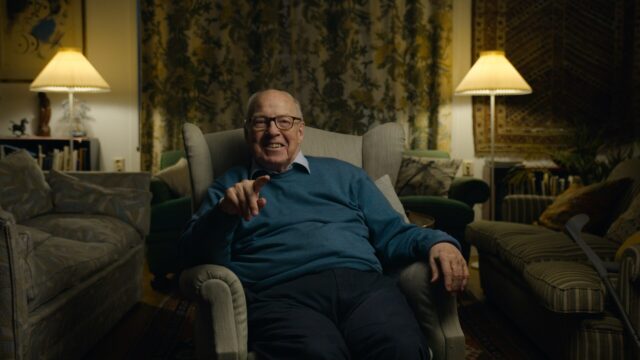
Blix is now in his 90s. He’s still intellectually sharp and very articulate.
“When I approached Hans, the idea was to make a film about him. One thing a Finnish tutor at a workshop once said was that you should turn your weaknesses into your strengths. That really helped me,” the director explains why she came at her material from such a personal perspective. She knew she wasn’t some heavyweight documentary maker like Errol Morris. Nor was she an expert historian or political theorist. She was a young female filmmaker who wanted to understand what made Blix tick and to ask if he could have behaved differently.
“I realised that the dialogue with Hans was at its best when we were interacting in this more civil way, me almost as a grandchild and he explaining patiently to me,” Stocklassa notes.
Blix proved to be a “sincere and open” interviewee. When Stocklassa first approached him, he responded by inviting her for a cup tea at his home. At the time, she was still a student at film school. When he asked what she wanted, she responded that she thought he was interesting and would like to make a film about him.
“He [Blix] was willing to talk to me…he was willing to open up his home and his life.”
The venerable politician was also happy that Stocklassa seemed so interested in his work at the UN. “Sometimes I felt really bad because I felt we were exhausting him,” the director says of the shooting period. “He really needs to think about his time, and so the fact that he is giving us so much of his time is [precious].”
According to his critics, Blix flunked it. If his report on WMD had been more strongly worded and less equivocal, it would have been far harder for President Bush to justify his invasion.
“To me, it felt like he was hiding behind doing his job. I feel that is always dangerous because you have to take personal responsibility. But that was also what made it interesting to make the film about him. He saw himself as this civil servant,” the director reflects.
Blix is very sure of his own position. The more Stocklassa talked to him, the more sympathetic she became toward his actions. He felt a strong loyalty to the UN. His job was to give the facts and to avoid bias. If he had spoken out against the idea of the US invasion, he would have been stepping well beyond his remit as a UN inspector.
There is something very Swedish about Blix. He’s a measured and calm figure. “That was a reason I wanted to make this,” the director acknowledges. “For a long time, I’ve been interested in Swedish neutrality and this history of diplomacy. For a small country, there have been pretty many big, famous international diplomats [from Sweden].”
Blix has seen the documentary and generally liked it. (“He is overall content,” says the director) He had one or two issues with the film’s chronology. Stocklassa pointed out to him, however, that this is a documentary, not an exhaustive historical study.
The director hopes her film will reach an audience which doesn’t always engage with this type of political documentary.
“This topic tends to be appealing to people who lived through that period and to…men. I am a young girl. Hopefully, that may make it more interesting for millennials and women, this perspective. I don’t think women are not interested in politics,” she uses a double negative. “I think everyone is [interested]. I just think it [the film] needs to be made in an approachable way.”
Blix Not Bombs was produced through Czech production outfit Pink. It shows in the festival’s F:act Award competition.