Rob Moore is the kind of figure you might expect to find in an Eric Ambler or Graham Greene novel. He’s a well-spoken, middle-aged Englishman who seems convincing enough at first glance, but whose loyalties and motives become harder to understand the more time you spend in his presence.
He worked for several years as a corporate “spy” for K2, an intelligence agency that asked him to report on the activities of anti-asbestos campaigners. Perhaps ironically, Moore posed as a documentary maker to gain these activists’ trust. By his own account, he then switched sides and tried to help the activists by turning whistleblower – but they still ended up suing him.
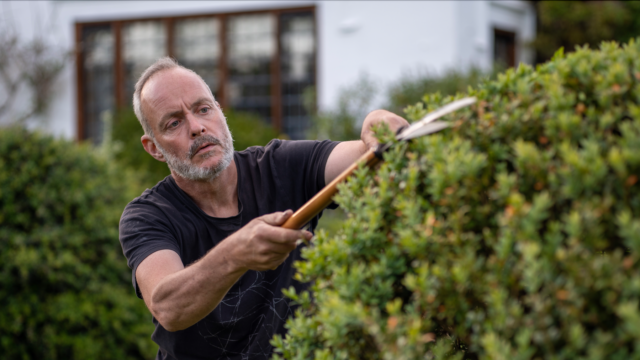
It’s a very twisted story. Trying to untangle all its threads is distinguished Norwegian director Håvard Bustnes in his new documentary, The Gardener, the Buddhist & the Spy (a world premiere in F:ACT AWARD at CPH DOX and sold by Syndicado). The title refers to Moore himself. After his divorce and the implosion of his once successful career as a TV comedy producer, he began to work as a gardener and to study Buddhism.
To add to the layers of complexity, two top investigative journalists are working on the same story. Ceri Thomas and Alexi Mostrous are making a podcast on Moore for Tortoise Studios. They could easily have been rivals to the filmmaker but instead became his allies.
The Norwegian was fascinated by his subject’s green fingers. “I really liked that he was a gardener. It is exactly this contrast between the gardening and the investigation industry. That was very fascinating for me,” Bustnes says.
Relations between the director and his subject sometimes became fraught. At one stage, Moore is shown on camera calling Bustnes a “parasite” and accusing him of staying voyeuristically on the sidelines.
“He [Moore] is obviously very friendly and clever,” Bustnes conceded. “All the time, he used very friendly words to me like ‘pal’. It is very difficult for a filmmaker, because obviously you need a professional distance all the time because you are trying to make something balanced…he did test me.”
Through his own background working on cult UK comedy shows like Brass Eye, Moore knew all the tricks of filmmaking. “And he knew very much how to push my buttons!”
Working with Moore made the Norwegian Bustnes reflect on his own approach to storytelling. “For us [as documentary makers], conflict is great. We want conflict – but conflict can be very hurtful to people…”
Another insight provided by an interviewee in the film is that the best whistleblowers are also often “narcissists.” The question of whether they are good or nice people isn’t relevant when it comes to the information they unearth.
“That’s also something Rob was very eager to say. From his side, he felt very often that when you try to blow the whistle on somebody, they always attack you as a person, try to make you less credible. I think that’s correct. Whistleblowers are not perfect….[but] they can still come up with something important.”
Throughout the film, Bustnes tries hard to be honest about his own role. He features on camera and is shown at moments of confusion and vulnerability. He wanted to show viewers that he wasn’t just this “leading journalist asking brilliant questions all the time” but was prey to his own doubts and sometimes lost his way.
When the story about Moore’s court case broke in the UK press, the local journalists picked up immediately on the fact that Moore’s sister, Charlotte Moore, is a very senior executive in the UK media, currently Chief Content Officer at the BBC and soon to become CEO of Left Bank Pictures.
This was one aspect of the story that Bustnes ignored completely. “It is not important for our story. Rob is responsible for his actions. It is not about his sister,” the director says.
Nor is there a huge amount of information about Moore’s past or family background save from a few minutes detailing his TV comedy career working on celebrated satire, Brass Eye. “It’s also a film about oligarchs and corruption. There were a lot of things we wanted to have in the film. We had to get to the main theme…to the core of the story as soon as possible.”
This might be a difficult story to tell but it was an easy film to sell. In advance of its Copenhagen premiere, it has been acquired by many broadcasters.
“It’s a rare insight into the corporate investigation industry which is very secretive,” its director speculates as to why it has attracted such attention.
Bustnes himself was shocked at the idea that someone could pose as a filmmaker and elicit information that way.
The director has been working on the film since 2018. He still doesn’t know what he thinks about Moore. “I have been going through all the different stages. At one stage, I was absolutely sure everything he said was correct. Then I am going to the other side and thinking he is a liar and then it is back again. I think that’s fascinating, this theme about lies. When you don’t tell the whole truth, what is a lie?”
After Moore started collaborating on the podcast with the other investigative journalists. Bustnes feared he would have to abandon the film.
“He suddenly said he was going to make this podcast. That was very shocking to me. I thought these years of working would be lost.”
Instead, the podcast ended up becoming a vital strand of the film. Bustnes needed someone to “scrutinise Rob.” Early on, Moore was introducing him to his friends and supporters, all of whom had nothing but positive things to say about him. “But that became very boring. As soon as the podcast journalists started to work with him, it became much more interesting,”
These journalists questioned Moore’s account and scrutinised the information he provided. This created tensions – and drama.
“I am very happy about working with Ceri and Alexi. I really respect them as journalists and had a lot to learn from them,” Bustnes says of his collaborators. “As journalists, we are used to talking to other people and we have the power – but suddenly they gave me the power to film them. That could be very scary. They had no clue how I would portray them…I am very grateful for that.”
This was one of the trickiest films to edit in the director’s career. “It was extremely difficult because there are so many layers and so many ways of telling [the story]…the fact that I am part of the film came very late. First, we made a film without me. That was my goal…but we saw that we needed my presence – to show that I am the filmmaker.”
Bustnes emphasises that this is not a “film podcast.” It’s a proper piece of cinema with all the trimmings. At times, he is critical of the podcasters – and he is critical of himself too.
One striking element of the film is that Bustnes and Moore resemble one another. Their working methods are similar too. Both use deception or withhold information from contacts and sources.
“I think all journalists do it. It was important for me to show that. I didn’t want to make a film that was very critical of Rob and what he did, and that portrayed ourselves as perfect…I wanted to go deeper.”
As a Norwegian working in the UK, the director didn’t always pick up on the nuances of the British class system. “I don’t know the British society and I don’t know the British language.”
When he screens the film for English spectators, they immediately recognise that Moore is from a privileged background. That, though, wasn’t obvious to him.
Whatever the occasional friction between them, Bustnes insists that he finds Moore very good company. He also hopes that the documentary is “extremely balanced…we have spent a lot of time to investigate his side of the story. I think he comes [out of it] pretty well. I also have to say that I really like Rob.”
Ask the director about his relationship with Moore today and he acknowledges it is ‘complicated’. “Understandably, this is a very difficult story for Rob,” Bustnes signs off.