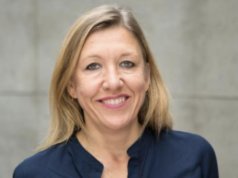
Filmmakers Betsy Hershey and Emma Wall (whose feature Just Look Up premieres this week in CPH:DOX F:ACT Competition) met in unlikely circumstances – at a silent meditation retreat. The event was organised by mindfulness meditation guru, Jon Kabat-Zinn.
“We found ourselves there in these very deeply reflective spaces,” remembers Wall. At the time, she was still working as a child psychiatrist but felt she “needed a different outlet.” Hershey was also “pondering her path.” In breaks between the silence, the duo discussed working together on a documentary project.
“It led us on this path,” Wall explains their route into directing together. She eventually quit the child psychiatry world. They now run production company Guest House Productions together with producer Natja Rosner (a former sales exec at TrustNordisk and LevelK).
The world of Just Look Up is a long way removed from silent meditation. The film follows the charismatic (if slightly neurotic) US climate activist and stand-up comedian, Michael Greenberg. He is the founder of Climate Defiance, a group which stages imaginative and very noisy protests at public events involving companies and individuals with links to fossil fuels. They target everybody from Brian Moynihan, President and CEO of Bank of America, to a certain Bill Gates. Their interventions take a lot of courage and planning. They are up against rich, powerful people who tend to be heavily protected by police and security guards. These bankers and captains of industry don’t like being caught out by climate protesters and will sometimes react very aggressively against them.
Ask the directors about their experiences filming the protests and they acknowledge this was sometimes very hair-raising work. “It is definitely filled with all of the emotions – nerves, excitement and fear,” suggests Hershey.
The two directors worked very closely with a First Amendment rights lawyer to make sure they had legal protection. At each disruption they attended with their cameras, they had her number written on their arms so they could call her quickly if the need arose. What’s more, they dressed “quite conservatively” so they would fit in with the business executives attending the various seminars and debates. “We usually wouldn’t get thrown out,” Hershey says their disguises seemed to work.
“We live in this day and age where everyone pulls out a phone so we could kind of blend in as observers which is what we were. We were not participating in any of the actions,” Wall adds. “You could adopt this shocked witness position…it was very scary when we were filming…but I think it is scarier now. We would never have believed our lives were on the line in these scenarios.”
The film was largely shot before the beginning of the second Trump administration. Since Trump returned to the White House, the risks involved in climate protests have heightened.
Even before his re-election, though, tensions were rising. Activists had planned to disrupt Joe Biden’s headquarters but Hershey recalls how this action was stopped in its tracks before it began “because of the amount of security” following the Trump assassination attempt.
Over the course of production, the directors filmed “dozens of actions.” Early on, they tended to use cellphones and very small cameras, while placing some inexpensive and unobtrusive sound recording equipment on the activists. Sometimes, the activists were arrested – but the filmmakers would still try to get the recordings back.
“As they [the activists] developed more and more notoriety, they were having a harder time. When they would buy tickets, we would buy tickets. But their tickets would suddenly be cancelled…”
The activists reacted by finding different ways to access the events. Sometimes, all they needed to do was walk through a back door. “At those points, we could have much larger cameras and just walk in with them,” Wall remembers. “But the key was having lots of different types of cameras, small, medium and large – and having many cameras. You never knew when the police were going to take them [the activists] out, or which activist would get to the stage, or which camera person would be pulled out of the room.”
Not all the documentary is about the protests. The filmmakers also show Greenberg performing stand-up, giving interviews while trying to eat his lunch, and sometimes rather forlornly discussing his love life.
“We have deep respect for Michael and the work that he does. He is a complicated and fascinating character,” Wall states. Hershey adds that when they first met him, they knew within a few minutes that they wanted to make a film about him. “How sure are you?” he asked them. “We’re sure,” they instantly replied in unison.
They filmed ”almost weekly” with Greenberg and Climate Defiance over a period of around a year. They were “always there” and the activists soon began to trust them and to stop worrying about the cameras. Greenberg understood the power of storytelling and realised that “letting the filmmakers in” would enable them to tell a much more compelling story about their activities.
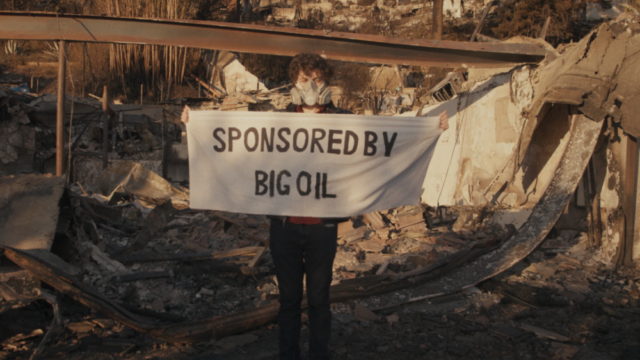
Just Look Up has a sombre coda. A masked Greenberg is shown walking through Los Angeles after the early 2025 wildfires. We see homes and businesses reduced to ashes – and even an image of the still smouldering wreck of a Bank of America branch. This reveals the apocalyptic results of climate change (“the real-world consequences” as Wall puts it) in very direct and graphic fashion.
The project had some illustrious supporters, among them writer, filmmaker and comedian Adam McKay, (director of climate change satire Don’t Look Up, Oscar-nominated producer Signe Byrge Sørensen from Final Cut For Real, and director Joshua Oppenheimer (The Act Of Killing). The doc was never intended as a “recruitment video” for Climate Defiance. It’s an independent film about them. Nonetheless, the documentary will show audiences just what non-violent civil disobedience can achieve – and how it is possible to confront climate problems without giving way to despair.
“Our goal is to help people, young people especially, feeling climate anxiety,” says Wall. “For us, it was always about helping them feel a sense of agency and possibility so they can take a role, whatever it is.”
Now, having Greenberg aboard will obviously help with the North American roll-out. “We are so lucky to have Michael because he is ready to take the film to every college campus in the US,” Hershey observes. “There will definitely be a giant impact campaign and a lot of the other activists as well will be willing to join.”