Yance Ford remembers vividly an early personal encounter with the cops.
“It was when they were sitting on the couch at my home explaining to my parents why the man who killed my brother wasn’t going to be charged for the crime…”
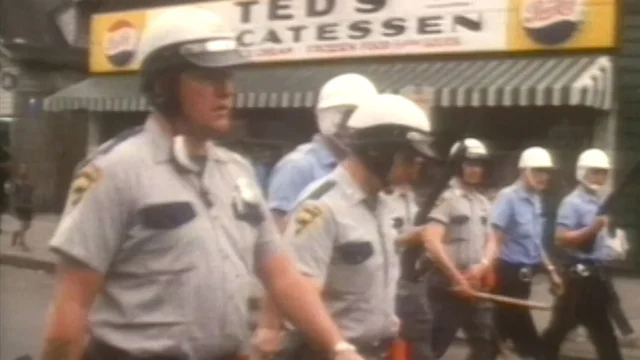
Ford’s new feature doc Power (which has its final CPH:DOX screening March 23 and is soon to launch on Netflix) looks at the origins of police power in the US and asks why American citizens have allowed the cops to hold so much sway over their lives. It explores how the police treated indigenous Americans and the slave population – and how police power has almost always been wielded in favour of a white privileged elite.
The director takes a very deliberate and sober approach to his material, avoiding sensationalism. The documentary features interviews with many leading academics who detail with chilling clarity the reasons behind 200 years of American police bias and brutality. This, as Ford puts it, is a system with “violence, coercion and control’ at its core.
“Like most other Black Americans, over the course of my lifetime, I’ve had varying experiences of the police, being pulled over for tailgating, being followed for over five or ten miles, or being made to walk down a specific side of a staircase when the other side was empty…”
Ford talks of a “kind of policing that is less incident-based and more ambient.” This is about persistent low-level harassment of targeted communities: bag searches on the subway, random arrests as part of a ‘stop and frisk’ policy that no-one believes has ever worked.
Police departments tend to police themselves.
“They’re not necessarily open to data they don’t generate,” Ford notes. The cops tend to ignore any evidence, whether anecdotal or scientific, that casts them in a bad light.
“What we wind up having is a cycle of reform efforts that look very familiar over time, that do not work and do not actually change anything.”
Since the murder of George Floyd by white police officer Derek Chauvin in Minneapolis in May 2020, Ford notes that “there was a lot of talk…but very little action.”
Four years on from Floyd’s death, after huge waves of protest and debate , there is little sense that the police has reformed itself or “re-imagined” its practices.
“I saw the George Floyd video and I watched the protest around the country and the world…there was something about the police protests that felt very different to me. The police violence in response to many of those protests felt unrestrained. It felt like they were happening in a space where the police officers felt there would be no repercussions for violating people’s right to protest,” Ford remembers the events that prompted him to make the film.
Ford was startled by this massive show of police power. The director points out, though, that the documentary is an indictment of the police as an institution, not of individual police officers.
“There are no villains in Power. There is history. If history feels villainous to people watching the film, that’s one thing and so be it.”
One figure who features prominently in the film is Black American police officer Charlie Adams, a stalwart of the Minneapolis Police Department with almost 40 years of experience. He comes across as a wise and decent man.
“He is an example of someone who has the best intentions in mind for the community where he grew up…but ultimately Inspector Adams is constrained by the priorities and the practices of the institution where he works.”
In today’s America, Ford notes, you’re far more likely to interact with a police officer than with an elected official. The police are everywhere.
“My intention going into Power was to make an essay film that looked at the history of policing over time,” the director continues. “I did not expect that we would go back to the removal of indigenous people from their land as the United States expanded west. That was part of the information I discovered as we were researching this film.”
Ford and editor Ian Olds worked hard to bring past and present together. The director’s own voice features prominently as that of the narrator/essayist.
Every country from the Nordics with their noir thrillers to the US with ‘The Wire’ has its own cop and detective shows on TV. These almost always portray the force in a sympathetic light. Why do audiences devour these stories when the actual institution they are celebrating has such a violent and problematic history?
“Part of that has to do with the fact that a lot of cultures like heroes. A lot of cultures need heroes. For some reason, the people who create television and film both in the UK and Denmark and the United States have landed on a very narrow band of people in society who can be portrayed as heroes. They’re usually police officers, fire fighters and doctors. It [the cop drama] is a lucrative genre. It’s a genre that works and is easy to replicate,” Ford suggests. “I don’t know how these programmes are researched. They seem more informed by mythology than by facts.”
In Power, the facts are always foregrounded.
“I am not interested in a debate coming out of Power. What I am interested in is a discussion where people actually ask themselves what is the role of policing in my life…,” Ford sums up the intentions behind the documentary.
The director wants audiences to reflect on the role of the police as part of a democracy. Where are the checks and balances?
“I think we need to have a conversation about what public safety means…ideally, the goal of Power is that we look forward together to building a policing apparatus that has a holistic definition of public safety at its core, and that works for all of us.”
Ford has one central question: what are the police for? The documentary reveals that the cops aren’t there primarily to prevent crime. Their work has been more about protecting privilege and property rights on behalf of a small sector of the population than looking after the rest of us.
“I am not so interested in people understanding what I think about police. I am interested in people understanding what the history of policing is in this country. Until we all have a common understanding of our history and the growth and evolution of police, I don’t think we can get to what comes next…the academics in the film don’t all arrive at the same conclusion but they don’t argue with the history because youcan’t argue with the history,” the director points out the facts in the documentary are simply beyond dispute.