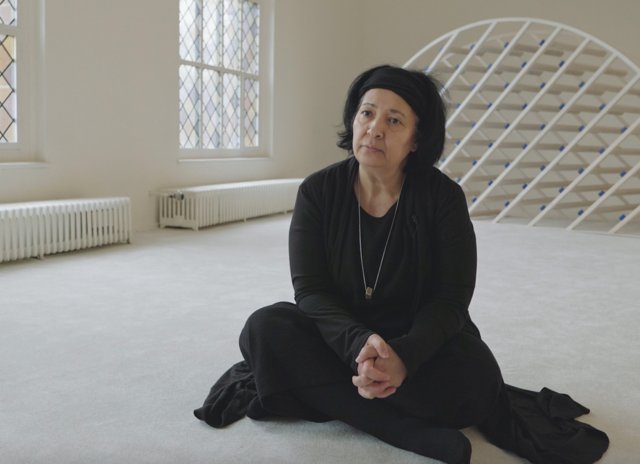
To describe Seyran Ateş as a force of nature would be to understate her velocity. The intrepid and tireless Turkish-German lawyer, author, feminist and social campaigner grew up in very humble circumstances, first in the slums of Istanbul and then as an immigrant in Berlin. She ran away from home as a teenager.
As a result of her stand against child marriage, she was shot and almost killed in her early 20s. Undaunted, Ateş has gone on to become a hugely influential lawyer, the founder and female imam of a mosque in Berlin, and an LGBTQ activist.
Now, Ateş is the subject of Nefise Özkal Lorentzen’s remarkable new film Seyran Ateş: Sex, Revolution & Islam. The Norwegian film is in the Nordic:Dox Award competition at CPH:DOX and in official selection at Hot Docs. It is produced by Jørgen Lorentzen. International sales are handled by Kim Christiansen at DR Sales. An eye-catching North American deal with Juno Films has already been secured.
The roots of the project lie a long way in the past. After 9/11, Lorentzen had decided to make a trilogy of films about Islam and gender. The first title was Gender Me (2008), about Islam and homosexuality.
“After 9/11, I was on the way to leaving my religion. I was not sure whether I belonged to this group or not,” the director remembers.
The second part of the trilogy was A Balloon For Allah (2011), about Islam and feminism, and the third part was Manislam (2014), for which she filmed in several different countries. She was, she says, searching for “feminist men” within Islam who were trying to make changes to their religion.
Having completed the trilogy, Lorentzen planned to continue making films in the same spirit and hatched an idea for a documentary about female imams. By chance, her mother gave her an article about Seyran Ateş.
“I read about all the things she had done and then I immediately travelled to Berlin,” the Oslo-based independent filmmaker remembers the impact that article made. Very soon after their first meeting, she shelved the idea for a doc about female imams in general and instead decided to make the documentary entirely about Ateş.
Her subject Ateş has had a fatwa issued against her. This means she needs to travel with bodyguards always in tow. “Yes, she is highly protected,” the director says with evident understatement. The first time Lorentzen met and filmed Ateş, she wasn’t allowed to lock the door and the police stayed with her.
No, the director didn’t worry about her own safety. She was too busy with the business of making her documentary. Her attitude was just “to say Inshallah, everything will be OK.”
As the film reveals, Ateş is subjected to continual abuse and threats on social media. She shrugs off all the hostile messages. “It’s very important to say that she has [also) been receiving lots and lots of positive emails and messages…the positives are also very, very strong,” the director notes.
Whenever she is accused of being anti-Islam, Ateş always makes a crucial distinction. She replies that this is not the case at all but that she is anti-patriarchy and pro-human rights.
“Sometimes people really misunderstand what she is doing. The left wing can’t understand. The right wing can’t understand. People are trying to put Seyran in a box – and that is impossible.”
Lorentzen observed admiringly how Ateş behaved in her daily interactions. “She is always very respectful and she never ever plays the queen. She is together with her bodyguards whom she calls the ‘angels.’ If they’re going to eat together or whatever, she always looks to see if they have been served or have what they need. She is very, very concerned with the people around her.”
The director made it very clear to Ateş that this was an independent documentary, not “an advertising film about her mosque.” Ateş was fine with that. “We respected each other’s spheres,” Lorentzen says.
Ask about her ambitions for the film and the director replies that she would relish the opportunity to screen the documentary to conservative audiences (“not only the Islamic milieu but other groups”), and then to have an open debate about the themes it raises.
“I’d love to screen the film to all the communities who are targeting the female body…it all starts with the woman’s body,” Lorentzen reflects. “If society can’t handle the woman’s body, it cannot handle homosexuality, [the men] cannot handle their sisters, their wives or partners. Everything starts with the body and this patriarchal gaze.”
Seyran Ateş: Sex, Revolution & Islam is one of the ten films selected for the Changing Face of Europe programme at Hot Docs, organised by European Film Promotion.