Kristoffer Hegnsvad is the chief editor of the film and television section at Dagbladet Politiken, the biggest newspaper in Denmark.
“That is at least a full-time job,” Hegnsvad laughs ruefully at the amount of work the job entails. He’s in charge of 12 journalists and has constant deadlines to meet. Nonetheless, this very busy newspaperman has recently completed a new feature documentary, Soviet Bus Stops, which premieres in Nordic:Dox at CPH:DOX.
Soviet Bus Stops follows Canadian photographer Christopher Herwig as he travels across the former Soviet Republics…taking pictures of bus stops.
“I met Herwig 20 years ago by coincidence on a ferry in Greece…we just bought the cheapest tickets on a ferry ride from Athens to Haifa in Israel,” Hegnsvad remembers his first encounter with the man who was to ‘star’ in his documentary two decades later. They talked and talked, establishing a lasting friendship.
Herwig’s work keeps him constantly on the road, taking photographs in crisis zones around the world. On a bike trip from London to St Petersburg, he stumbled on the bus stops and soon became obsessed by them. They were often highly unusual and beautiful structures. He was later to publish two books about them.
“He kept on inviting me just to go have a look for myself,” Hegnsvad remembers. Eventually, he took up the invitation – but not with any plan at that stage of making a full-scale feature documentary about the bus stops. He shot a short film for his newspaper. This was well received. Herwig’s books, meanwhile, became unlikely successes (“a bit of surprise for everyone,” Hegnsvad says).
The popularity of the books encouraged Herwig to venture back to eastern Europe in search of yet more bus stops. From around 2016 onward, Herwig knew he would make a proper film about his friend’s travels. They made a long trip across Russia together. Their next step was to search for the people who had designed the bus stops.
“We began to dig up names slowly…it was very difficult finding people.”
The bus stops themselves were fast disappearing. Herwig may have regarded them as architectural marvels but locals often saw them as eyesores from the bad old days and didn’t always want to preserve them.
Dotted throughout the documentary are lines from celebrated Russian poets including Osip Mandelstam and Anna Akhmatova. There is also a voice-over from Herwig himself.
“For me, it was important it was Herwig’s own voice. We worked a lot together on how to express our view of the bus stops,” the director explains the narration.
In many cases, no-one knew the exact story of the bus stops. Nonetheless, Hegnsvad was determined to pay tribute to spirit behind their creation. Even in a totalitarian society like the old Soviet bloc under Stalin where the creed of socialist realism ruled in the arts, people were still expressing themselves in verse…and by designing bus stops.
“On a deeper level, a feeling of resistance and poetry is what attracted me and kept me going,” Hegnsvad says of what drew him to make the documentary.
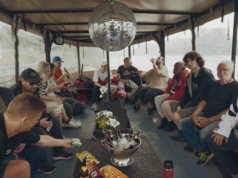
The project entailed travelling enormous distances. It also required painstaking detective work. Sometimes, the bus stops were in the most remote and unlikely places. There were brushes with the authorities along the way too, such as when they shot footage next to the Chernobyl reactor, Hegnsvad remembers.
There were, though, moments of respite and pleasure. Belarussian bus stop designer Armen Sardarov served them up some delicious Georgian wine, delighted to discover someone like Herwig who shared his passion for the designs.
The film includes music from 80’s electronic rock band Zodiak, formed by composers in Latvia in the late 70s. These renegade musicians loved disco, listened to “illegal” music from the west and built their synthesisers from old scrap metal.
“First of all, when you hunt for bus stops, you hunt in a car. You can’t hunt for bus stops in a bus…so you will listen to a lot of music. We tried to pick up music from the different regions. This [Zodiak] was a band very close to Herwig’s heart and so we listened to it a lot.”
Original Zodiak member Jānis Lūsēns and his son Jānis Lūsēns Jr produced the score – and there are now plans to release a vinyl record to accompany the movie.
How has the Russian invasion of Ukraine affected the project? “We came to the conclusion that we wanted to get it [the film] out as fast as possible and stand by it. I think this is more important than ever, to show that there are people who had different ideas back then and there can [still] be people who have different ideas…even when you can’t see any hope of a civil society at all, there might be small cracks which can bring about hope.”
The film’s journey begins in earnest at CPH:DOX. It will show afterwards at Docville and has other festival dates in the pipeline. Produced by Empty Chairs in Denmark and 291 in Canada, DR Sales handles international rights.
Filmmaking isn’t Hegnsvad ’s only extracurricular activity beyond his journalism. He’s also a writer, author of a study of German director Werner Herzog, and is currently working on a new book…a meditative Geoff Dyer-style volume about the Soviet bus stops experience.
Does he have a favourite among the bus stops?
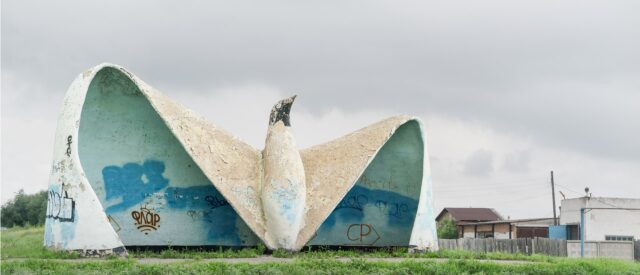
”I was initially very attracted by the Georgian splashy ones with the great mosaics,” Hegnsvad reflects, but quickly adds he is equally fascinated by some of the “wild, brutalist” ones, made with pre-fabricated concrete like the bird shaped construction in Omsk. He’s “very fond” of some of the bus stops in Ukraine, for instance the one in the shape of a pink castle-like tower. “For now, that is my favourite. In two months, it will probably be something else that will surprise me,” the director concludes.