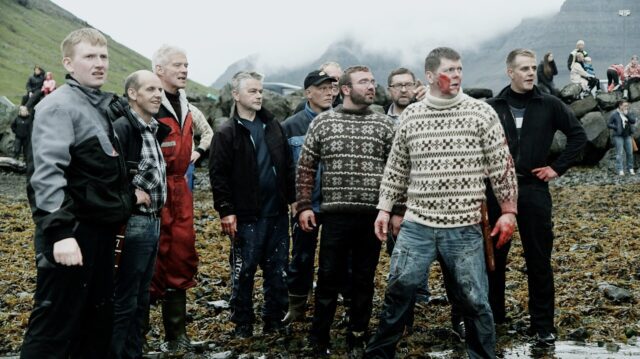
If you can’t stand blood or animal cruelty then be prepared to look away. A Taste of Whale, selected for F:act Award gives an honest and gory account of what happens every time a herd of pilot whales enters the waters of the Faroe Islands.
As soon as the mammals are detected, a large part of the population drops everything they’re doing to either jump on a boat or jetski to corral the whales, wait in the water with ‘animal-friendly’ hooks to grab the whales by their airholes, stand at the beach with a knife to slay the beasts or just simply watch the bloody ordeal.
The documentary lets the Faroe Islanders tell why they do it: the usual arguments of how generations of predominantly men have done it; it’s part of the national identity; it’s better to eat what you’ve killed yourself; it brings you closer to nature.
And then there’s a group of activists, entering the island from abroad, all kinds of nationalities gathered under the Sea Shepherds flag, including celebrity Pamela Anderson. They argue it is plain cruel, completely unnecessary and a danger to the already rapidly decreasing biodiversity. Their arguments include the sensitivities of generations to come. “I don’t want to have to tell my children, ‘I knew these species and you won’t.’ And I did nothing to prevent the massacre.”
The makers of the film don’t seem to favour any of the parties, though you can’t help but wonder how many more privileges the Faroese need when they live in this natural splendour, with meadowed mountains, massive fjords, spectacular lakes and waterfalls and the omnipresent sea – all of which is presented using the most beautiful cinematography. They do, however, allow one of the whale killers to ask, ‘why are whales more important than any other animals?’ whilst sharpening his spear, followed by him shooting a cormorant from a boat, laughing maniacally.
The makers bring nuance to the story, as personified by two locals: environmentalist Runi Nielsen and Pál Weihe, Head of the Faroes Board of Public Health. Nielsen believes in dialogue more than radical activism. “You can save a few whales now, but when you leave they will be killed some other time,” he points out. That’s why he organises a screening of David Attenborough’s documentary on the pilot whale. And the discussion afterwards does seem to trigger awareness, as younger generations of Faroe Islanders point out that whale meat is actually dangerous for your health.
That is also Weihe’s standpoint. As a former whale meat eater and supporter of the tradition he can no longer close his eyes to the scientific facts: the meat contains so much mercury it poisons your body and harms the brains of the Faroese children. It seems nature has its own way of getting back at us humans.
If you can see past the bloody scenes, which are quite extraordinary in their own right, the film is a beautiful portrait of the Faroe Islands, their inhabitants and their dyed-in-the-wool traditions, but also of a devoted group of idealistic activists. It doesn’t judge, giving ample space to all arguments, without being repetitive.
The end the movie spins a little out of control, throwing around random images of the total absurdity of the global food industry which relies on consumers looking the other way from what the activists describe as ‘violence inflicted by barbarian humans on animals’.
France, 2022, 89 mins
Director: Vincent Kelner
Producer: Rémi Grellety
Production: Warboys Films
Editor: Olivier Marzin
Cinematography: Vincent Kelner
Sound: Vincent Kelner
Sales: Films Boutique