Karlheinz Stockhausen (1928-2007) was a towering figure in contemporary music. The German composer was revered in the classical world but also known as “Papa Techno.” He was a genius but one with a headstrong and flawed personality.
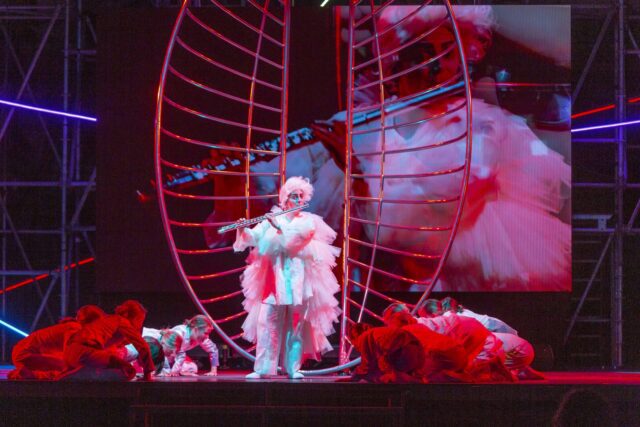
Dutch director Oeke Hoogendijk’s new documentary (screening at CPH:DOX Sound and Vision, having just won the Jury Prize at the 40th International Festival Of Films On Art) tells the story of the 2019 staging of Licht, the opera cycle which Stockhausen regarded as his magnum opus and which took him 26 years to complete. It was never staged in its entirety during his lifetime. However, the Holland Festival organised a performance lasting seven days and complete with the helicopters that Stockhausen included in the work. The production was overseen by celebrated French-Lebanese theatre director, Pierre Audi.
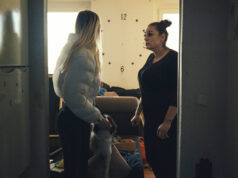
Hoogendijk’s documentary, produced by Witfilm, chronicles this monumental endeavour but also offers an intimate and revealing portrait of Stockhausen himself, from the point of view of his wives, former lovers, children and collaborators.
“Well, actually, I wasn’t so much into the music of Karlheinz Stockhausen,” Hoogendijk says of her relationship with her subject before she began work on Licht. She knew of him as a significant cultural figure – one of the faces on the cover of the Beatle’s Sgt Pepper album. When Dutch broadcaster NTR asked her if she would make a film about the staging of Licht she was very curious to find out more about its creator.
As for Stockhausen’s extraordinarily embroiled private life, that (the director says) was “part of her motivation” for agreeing to take on the assignment. “When they ask you for a film, you always think, well, why should I do it? Why shouldn’t someone else do it? [But] I do honestly say that I like it when it is complicated.”
Two of Stockhausen’s former partners, Suzanne Stephens and Kathinka Pasveer, work together to protect his legacy. (Both feature prominently in the documentary). His old home has been left untouched. “Everything is still there, his boots, his coat, his desk, his office…everything is still there. I was quite intrigued by this. And, of course, I knew that almost all his six children broke away from him. That intrigued me also because I was wondering what did he do that everyone was gone.”
Whatever his vexed relationship with his children, his wives and former lovers adore him and fight hard to protect his rich and varied legacy. “I had many reasons for being willing to work on it,” Hoogendijk explains her growing fascination with her subject’s work and life.
Ask the director how she feels about Stockhausen as an artist and personality now, having made the film, and she gives him a strong endorsement. “As an artist, I really got involved with his music much more than before I started. It’s not always that you can say ‘I like his music,’ but you can feel that there is such a large spirit behind it,” she reflects. “I am a nervous person and when I put it on, I couldn’t stand it sometimes because it made me more nervous!”
Hoogendijk adds that Stockhausen isn’t best listened to at home anyway. You’ll appreciate it more when it is performed in public, as a huge event like the festival staging of Licht. “Then, you are drawn into it and it becomes really something mythical.”
The director was won over by her subject as a human being too. Preparing the documentary, she watched a lot of archive material of him. “I saw the charm he had. It’s incredible.” She could understand very easily why all those women “adored” him.
When Hoogendijk spoke to the composer’s first wife Doris, who is now almost 100, she couldn’t help but notice how a “big smile” appeared on Doris’ face at the very mention of his name.
As the film makes clear, Stockhausen had a desperate desire to be loved. He came out of the Second World War as an orphan and was always looking for someone to fill the emotional void left by the loss of his parents.
Early in the documentary, Hoogendijk asks various interviewees what they feel Licht is actually about. They struggle to give convincing answers. Put the same question to her and she replies: “It’s the most difficult question you could ask. Actually, I don’t know! I think the story is about everything – birth, death, life , war, love…it’s so difficult to say [that it’s just about) one theme.”
There were 400 rehearsals for the production. It was “incredibly difficult” for the director to work out how to shoot the process. “I can imagine you’re lost. We’re lost as well,” the assistants working on the production used to tell her.
However, once she met his children and former wives, the director realised that their stories were the catalyst she needed. As a child of divorced parents herself, she understood the children’s perspective about their illustrious father. “I started really to dive into those personal stories and that’s where I got my connection again with the film.”
And, no, Hoogendijk wasn’t in the helicopter filming the violinists. That was done by webcam. ”I am not a person for heights,” she explains.
The Stockhausen documentary isn’t the only Hoogendijk film screening at CPH:DOX. The festival is also screening her 2021 documentary The Treasures Of Crimea as part of its sidebar, Ukraine: A Sovereign State. The film, made before war broke out, tells the story of how a Dutch museum became involved in a bitter dispute over historical art works between Russia and Ukraine. “I’ve noticed there is more interest in the film than there was before,” the director says of how Putin’s invasion of Ukraine has boosted its profile.
Hoogendijk is widely for her art documentaries, among them My Rembrandt and The New Rijksmuseum – The Film. She is currently working on her film about the restoration of Rembrandt’s The Night Watch, a project expected to take several years.