Discussions about nuclear energy are often dizzying. The powers unleashed, the timescales involved and the costs required defy comprehension by what in Germany is called the Normalburger – the ordinary citizen.
This problem comes up during the preparations for a public conference by the Bundesgesellschaft für Endlagerung, the German agency tasked with finding a final resting place for nuclear waste. On the one hand, one participant says, we should describe our processes in such a way that laypeople can follow what we are talking about; on the other hand, another warns, we should not oversimplify the hugely complex operations and calculations involved.
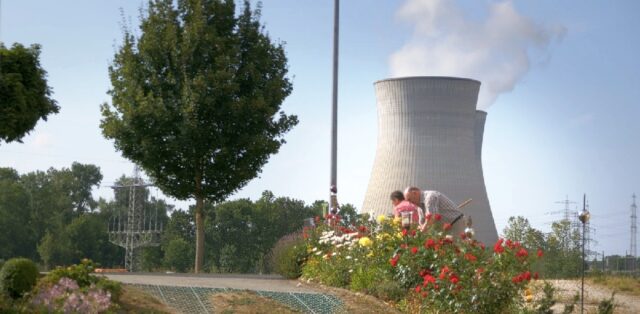
In his tightly structured Nuclear Forever (Atomkraft Forever), director Carsten Rau skilfully treads the middle path between these two positions. The informative documentary is certainly not dumbed-down and a lot of figures are mentioned or appear on screen. But Rau doesn’t lose himself in data for data’s sake and always returns to the people involved, from those at the top down to those who found their jobs at a nuclear reactor, got used to the imposing concrete presence next door and, now that Germany has decided to close down all of them, feel as if a part of their home is being taken away.
Numbers. The German nuclear reactor in Greifswald, former GDR, was designated for closure in 1990, after having been active for 16 years, and is still being decommissioned at a cost of more than 5 billion euros. The last of the 600,000 tons of nuclear waste, after having been sorted, cleaned and packaged in enormous new halls built especially for this purpose, will reach its temporary storage place around 2080. There, they will wait until their final destination has been determined. A destination which, according to official regulations, will have to be safe for a million years. There are ten projected ice ages to be taken into account, we hear discussed at a meeting – after which the question arises as to whether the calculations must take into account future glaciers which might migrate further across German soil than the historical record may indicate?
These numbers are too big to fathom for the human mind, which already has difficulty with the abstract-sounding level of processes, procedures and logistics, which somehow feel as if they obscure the real forces and dangers involved. So it is a wise Rau who feeds us this information carefully. Indeed, this is why film is the perfect medium here. Information, pause, information, pause. You couldn’t really do it during a lecture, in front of a crowd. To just pause and let the information sink in before you go on. In a documentary, you can. Rau lets his camera linger in German landscapes – with a side trip to nuclear superpower France – and through the always impressive industrial sites, while the restrained score alternatesbetween a curious, slightly distrustful tone and more explicitly threatening passages with ticking sounds reminiscent of a Geiger counter.
This musical score betrays the position of the filmmakers, who in the accompanying materials repeatedly write about the ‘nuclear nightmare’. But they also write how they want to give viewers a chance to form their own opinions and, although the documentary is skewed against nuclear energy, Rau does mention the arguments in favour and provides a reasonably balanced view. The pro-argument is not that the dangers don’t exist – they obviously do. It’s that the alternative is even worse. The world is not ready yet – assuming it ever will be – to fully switch to renewable energy, which means that any move away from nuclear energy means a move towards fossil fuel, in some way or other. And the pollution produced by burning fossil fuels not only costs tens of thousands lives yearly, , as one French proponent of nuclear energy reminds us, but the CO2 unleashed also fuels the climate crisis, a problem at least as unfathomable as that of nuclear waste.
Rau doesn’t try to quantify the two evils to give the viewer more grounds for comparison. And to be fair, going in-depth into the climate crisis as well would have been too much to ask for a single documentary. Nuclear Forever isn’t neutral and emphasises the core-melting powers and mind-melting absurdities of nuclear energy and waste. Still, Rau presents the pros and cons in such a commendable way that no one after having seen this documentary could ever believe there is an easy answer.
Germany, 2020, 94 minutes
Director Carsten Rau
Production PIER 53 Filmproduktion
Producer Hauke Wendler
International sales Magnetfilm
Script Carsten Rau
Cinematography Andrzej Król
Editing Stephan Haase
Sound design Yannick Rehder
Sound Augusto Castellano
Music Ketan und Vivan Bhatti
With Jörg Meyer, Marlies Philipp, Steffen Kanitz, Joachim Vanzetta