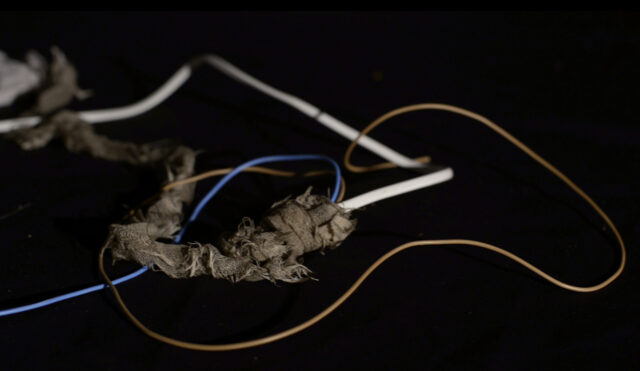
The prisoners are patiently using their hands, cutting paper or arranging threads of fabric and bed sheets in elaborate patterns. This isn’t some game. It’s a way of sending each other signals. “A 4G connection,” one jokes. They liken their elaborate string sculptures to “a mechanical intranet.” They call sheets of paper “faxes.”
This unlikely communication system is the subject of French director Julie Ramage’s new documentary short How To Order Online (which has been screening at Visions Du Réel and is due to go on to Sheffield Doc Fest).
Inmates’ access to telephone communication is both limited and monitored, Ramage explains in notes for the film. Nor is there any internet connection, which means a complete restriction on economic transactions. “They overcome this by designing their own exchange infrastructure, a mechanical network of handmade tools, called yo-yos, that allows for the circulation of goods and messages,” the filmmaker writes, adding how their mechanical intranet allows the prison population to ‘order online’, thereby emphasizing “the human need for exchange.”
Ramage doesn’t show any of the prisoners’ faces. Viewers can hear their conversations and watch their fingers as they cut and shape material into hidden codes.
“I’ve been working in French prisons for eight years,” Ramage explains how she ended up in a penal institution not far from Paris, working with long-term inmates on creative audiovisual projects.
“I could have shot their faces. The only thing then is that you would have had to get into a three year battle to get the images out,” the director explains why she focused only on the prisoners’ hands. Otherwise, it would have been a logistical nightmare both to make the film and to secure permission to show it outside the prison.
The director “is not really allowed” to give specifics of just why the prisoners have been locked up. However, given the severity of their sentences (20 years or more), it’s reasonable to assume they were convicted of serious crimes.
“This is why it was interesting to work with them. They have been in a lot of prisons. They have a lot of experience,” Ramage says of the group.
The director has established a strong creative rapport with her subjects. It was a matter of principle for her to treat them as close to equals as possible. “I know them very well,” she says. “I am working with them at every step of the process. Basically, I come in. They give me the idea. We debate…we talk and talk and work in a workshop situation for months. Then we write a movie. Then we shoot. Sometimes, I even give the camera.”
The prisoners are consulted on the editing process and have a say in how the films they make together are distributed. Ramage also tries to share any profits from the work, often paying them in kind with legal advice from lawyers or food.
“I think everybody can end up in prison at some point. You don’t know what will happen in your life. You don’t know the circumstances that will lead you to commit a crime. I am not justifying, I am not excusing and I am not psychologising because that is not my role,” Ramage states. Her interest was in “the daily survival strategies” that the prisoners invented in their “closed environment.”
Ramage had been visiting the prisoners for seven years. “Then the pandemic hit. We had been shooting a new movie about the prison economy and we had to interrupt the shooting in March 2020.”
The director was allowed back in to visit once or twice last summer but “now the situation is really, really tough.” Visiting is forbidden. She has been writing the prisoners letters. Some of them have been allowed cell phones because of Covid – so she has been able occasionally to call them too.
“Now, they are more and more isolating themselves because they lose the habit of seeing outside people.”
These men may be convicted criminals but they have strong moral convictions. Once, they had a chance to show their work in a big museum as a part of an exhibition about post-colonialism.
“It was a bit tricky. It was comparing the situation of prisoners today and putting it in the context of the story of slavery,” the director remembers. It was a big opportunity for the prisoners to have their work seen in the outside world for the first time but they were concerned about the ethical side of the exhibition – and eventually refused to be a part of it.
“The next step is to pay everybody!” she says of her plans for their future films together.