Polish Prayers paints an amazing portrait of a homophobic Polish Catholic activist who changes both heart and mind to become an active member of the LGBTQIA+ community.
“I spent a year with them before I met Antek,” Polish director Hanka Nobis told Business Doc Europe at IDFA 2022 how she hung out with the radically homophobic Polish Catholic Brotherhood, gaining their trust – which wasn’t easy. But when she saw Antek, Nobis and her team soon realised he was different from the others. They thought he might be someone who could change his opinions. What happened next is the stuff of clickbait.
It’s an enormous gamble to base your documentary on the expected change of heart of your main character. Though to be fair, if Antek hadn’t changed, Polish Prayers could still have been an interesting portrait of a group of right-wing conservatives, whom documentary filmmakers don’t usually put centre stage. Throughout the film, Nobis eschews commentary and interviews and simply follows Antek and the Brotherhood, with calm camera movements and shallow focus providing a stylish cinematic touch.
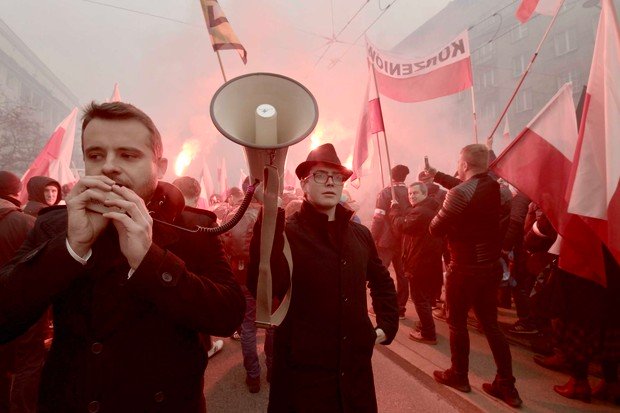
It seems like a fair portrayal and it’s easy to see what draws members to the Brotherhood. There is a sense of camaraderie and shared values. They go for walks in the woods, or swimming in a river. They eat, they drink, they sing. They have found companionship and a spiritual home.
But Polish Prayers should come with a content warning of homophobia. Because just as in other countries, Polish Catholic activism overly targets the LGBTQIA+ community. Somehow, it’s not hunger, war or poverty that spurs them into action, but people loving each other. When the Brotherhood organises a counter-demonstration during Pride, the contrast is abundantly clear. On the one side, there’s love, colours, music, happy faces. On the other side – and I don’t want to sound simplistic, but I find it difficult to describe it any other way – there’s hatred. There’s no positive message to their counter demo. They are focused on what they are against.
Now, if all they were doing was defending the conservative view of traditional marriage, even though I strongly disagree, I could still have some basic respect for it. I can understand how people might feel shaken and insecure about significant changes to such a long-standing tradition – I was raised a Catholic myself. And to be fair, the Brotherhood’s counter-demonstration is peaceful, at least in physical terms.
But their slogans are not. They repeat false claims linking homosexuality and paedophilia, together with other unscientific statistics. They warn parents that the LGBTQIA+ community is coming for their children, using sex ed in schools as a cover. They are lying, clearly and obviously, and they are demonising – putting the ‘demon’ back into demonstrating, so to say.
So it’s quite remarkable that, through it all, Antek somehow manages to remain a charming figure. There’s a smile that’s never far from appearing on his face, partly shy, partly ironic. Such large eyelashes he has, two women tease him, and he grins and blushes. Even when the Brotherhood is spouting their violent propaganda, it’s hard to truly see him as a bad person.
Which makes his incredible transition easier to believe and understand.
From the beginning, Antek seems sure of himself. Then, love happens. He finds a girlfriend, and life changes. You can’t be so close to someone without their values somehow rubbing off on you. Which leads to the moment when Antek tells a fellow Brotherhood member that his lover showed him you can be a good person and do beautiful and moral things, without believing in God. And, crucially, that he “had been doing things a bit automatically, without much reflection.”
Without reflecting on it, he felt sure about his role in the Brotherhood. But the moment he realises he never actually thought it through, he shifts gears with the same sense of purpose and confidence. He does not seem afraid to tell his fellow Brothers he no longer believes in God. The thing that does not change, and the reason he doesn’t suddenly come across as a different person, is that he retains the courage of his convictions. What changes is that he starts not simply believing, but thinking. And thinking inevitably means questioning.
Nobis is very – probably too – modest about the access she acquired to Antek’s Damascene conversion. To BDE she said, talking about Antek and his girlfriend: “It’s a generosity to allow the camera to be that close. It is not me being talented or smart. It is just them, they are generous.” The fact is, she recorded an impressive amount of material, enabling us to follow almost every step of Antek’s development. Although I would have liked to know a little bit more about his reflections on his own situation once he had become part of the queer community. Maybe stylistic consistency prevented Nobis from including an interview – even though it could have been filmed as a dialogue with someone else.
But generally speaking, putting the main focus on the Brotherhood was the right choice. Showing its appeal and showing how its members are, of course, individuals with different ideas and motivations – and how one member can cross over to the other side, becoming an even more powerful ally by doing so. And showing, crucially, that the answer to hatred is still love. Because it was love that changed his mind – by winning his heart.
Poland/Germany/Switzerland, 2022, 85 minutes
Director Hanka Nobis
Production First Hand Films
Producers Esther van Messel
International sales First Hand Films
Script Hana Nobis, Esther van Messel
Cinematography Miłosz Kasiura
Editing Bigna Tomschin, Olivia Frey
Sound design Oswald Schwander
Sound Ania Rok
Music Marcel Vaid
With Antoni Kaminski