

Poland is a bitterly divided society. “It breaks my heart,” young Polish director Hanka Nobis sighs as she contemplates the rift between the conservatives and the progressives. She is very much in the latter camp, attending rallies and demonstrations in favour of women’s rights and the LGBT community.
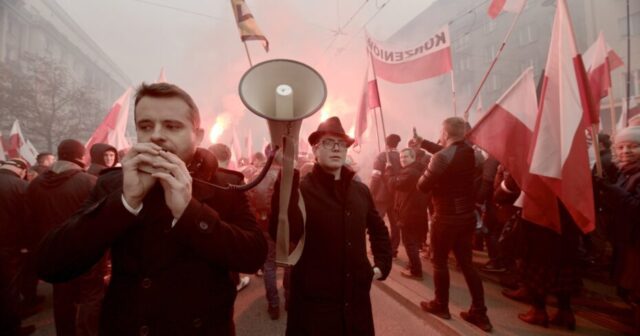
Antek, the main character in her documentary Polish Prayers, a world premiere in IDFA’s Luminous section, starts on the other side of the fence. He’s an earnest young Catholic with very traditional views, and who is part of the shadowy Brotherhood group. He and his fellow conservatives disapprove of gay marriage and are anti-abortion.
“I wondered who they are,” Nobis says of these young conservatives she would see beyond the barriers, protesting at Gay Pride marches. When she met the Brotherhood members, she was surprised discover that they were very well educated. She was keen to find out more about them.
“I spent a year with them before I met Antek,” the director recalls. And, no, it wasn’t easy to win their trust. “I didn’t think they were comfortable with me. We succeeded as a film crew to find some kind of a connection…it was kind of a slalom, up and down, never stable. It was kind of like standing on sand,” she says of their relationship. They were as curious about her as she was about them. They were also very suspicious. “It’s a crowd of individuals. Each of them has different opinions.”
Some members welcomed the director. Others worried that they wouldn’t like the documentary and worried that she would mis-represent them.
The project has had a lengthy gestation. Nobis began work on it during her time at the Doc Pro course at the Andrzej Wajda Master School. Early on during production, she met Hanka Kastelicová, the HBO exec who has backed many of the best recent eastern European documentaries, including Alexander Nanau’s Oscar-nominated Collective. She told Kastelicová about Antek and suggested he was one of the young conservatives who might change his opinions. “These are risky promises. Good luck with that,” Kastelicová said to her.
Two years into filming, Nobis met Esther van Messel, the formidable Swiss producer, sales agent and boss of First Hand Films, at a workshop for producers at the Warsaw Festival. At that stage, Nobis didn’t have a producer. Van Messel was impressed by the early footage and congratulated her on it. These were among the first compliments the director had received. Van Messel became her producer.
As for Antek, Nobis was worried that he would become like “a tree without roots” if he renounced his conservative views. “Also, I didn’t want to cause any conflict in his family.” Nonetheless, he was re-thinking his philosophy. Her DOP who filmed the Brotherhood members at a survival camp in the forests had told her: “he is not like the others. He is not ashamed of the camera.”
What really changed Antek was that he had fallen in love. Nobis heard that he was having difficulties in his private life. He now was the one seeking out her for advice. “Sometimes, I felt a bit overwhelmed. They don’t have that much contact with females.”
Antek and his first girlfriend allowed Nobis to film them in intimate circumstances. “It’s a generosity to allow the camera to be that close. It is not me being talented or smart. It is just them, they are generous,” the director says of how she secured the footage of them smoking together and of Antek braiding the girlfriends hair.
By now, HBO was keen to back the film. Kastelicová could see how much work Nobis had already done.
Antek is now 25 and he is engaged. He was 21 when Nobis first met him. “Forever,” the director asks if she will stay in touch with him. “He is a bit like a brother.” However, Nobis also acknowledges the ethical dilemmas making the film posed for her. “You are going with dirty shoes into somebody’s private life.”
Docs Against Gravity is interested in distributing Polish Prayers in Poland, says Nobis. The idea is to have premieres in eight different cities with talks afterwards, possibly next April. Having spent “five years of my life” on Polish Prayers, the director is now looking toward her next project, Songs Of Sisterhood, about three young lesbians living in a queer collective and fighting against harassment and police violence. The new film, then, is on “the exact opposite side” to its predecessor. Again produced by First Hand’s van Messel, the project was presented earlier this year at CPH:Forum at CPH:DOX 2022.
“You just have to hang around with good people…and be in the right place,” Nobis says of what she still sees as the secret of the best documentary making.





