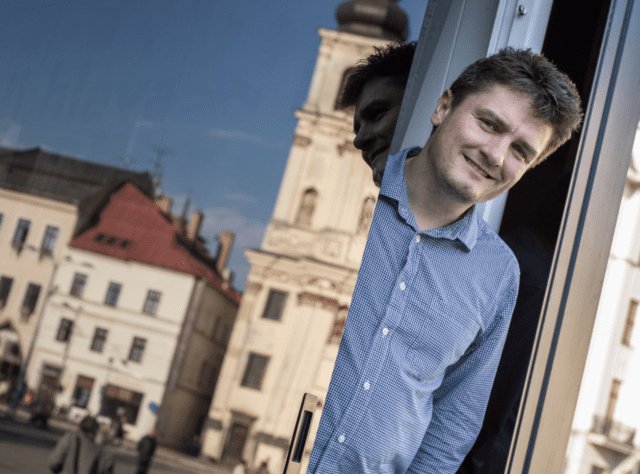
Ji.hlava IDFF director Marek Hovorka
Ji.hlava IDFF director Marek Hovorka talks to Business Doc Europe about the decision to go online in 2020, the need to showcase African documentary and the ongoing essential role played by experimental film, as underlined within the festival programme.
Marek Hovorka points out that for him and his festival, going online to present new documentaries is nothing new, having co-founded the virtual documentary portal www.dafilms.com in 2005, the same year that YouTube was launched. Nevertheless he acknowledges that an exclusively online Ji.hlava fest this year is a sub-prime option.
“Online is a challenge. Because we don’t want just to put films on that. This is not an online festival. At Ji.hlava it was always crucial to have this spirit and atmosphere around, this spirit of meetings with people you don’t know, being ready for discoveries and surprises, meeting directors whom you never have a chance to meet and to have very intense moments at the festival.”
Yet he remains philosophical, pointing out that online offers even access wider audiences to audiences both across the Czech Republic and to international audiences for whom 80+ titles from the festival’s main competitions will be accessible.
“In terms of the festival it is a big change but, since the Spring, festivals in general have moved to a state of solely online or hybridity. It means that from now, all festivals will be both offline and online.”
As for the future, he is equally reflective, especially on the ongoing importance of festivals in guaranteeing highest quality, entertaining, instructive and thought-provoking films to cineastes. This is something, he argues, that the dollar-oriented exhibition sector doesn’t see as a priority.
“Festivals will be even more important in the future in terms of the distribution of films. Because they care about and educate the audiences, create the bridges between filmmakers and audiences, which is not typical for cinemas.
“Cinemas are selling films mostly and if they are not successful they choose another film which is selling better. But festivals have this kind of educational role, let’s say, and I think this something that makes them very important for the future.”
He looks to his comrades at other doc festivals who met the Covid challenge in 2020. “It’s a paradoxical moment because we really wanted to have a physical edition, but in terms of being online we actually combine both the experiences of CPH:DOX and Nyon (Visions du Réel),” he underlines. “CPH really only had one week to switch the festival from offline to online and organised screenings for Danish audiences accessible in Denmark. Visions had one month and they looked to prepare a programme which was accessible internationally. We want to combine both aspects”.
A core part of the Ji.hlava 2020 offer is the Emerging Producers programme, in which 18 talented doc producers are selected (this year from 17 European countries with one additional participant from the guest country of Israel). They are provided access to tools and information from the sphere of audiovisual production, are promoted at major film festivals and connected with international experts from the documentary field.
“You see many many training programmes working with concrete film, film as a project,” says Hovorka. “But then after two years the producer/director starts to work on another film, and every film is different. So of course they have learnt something, but our perspective is not to work on films, but on producers because they are the engine of cinema… We know that [cinema] is only possible if the production system is working well, which is why we decided to focus on the producers as if they are the project.”
At online Cannes 2020 Hovorka published renewed research into geo-representation at doc fests which indicated a strong bias towards films from Europe, at the same time emphasising the paltry number of selections from emerging industries within Africa.
“Our position as a festival coming from Eastern Europe is bridging most parts of Europe, but during the discussion in Cannes we realised that who is really under-represented is African cinema.” The festival had planned a wide-ranging industry discussion this year but this had to be cancelled due to a number of panellists contracting coronavirus. That said, there is African representation across all the major festival sections except Fascinations (for experimental films), as well as a VR project from Kenya, The Forgotten Ones by Mufasa The Poet, Isa Mohamed and Charles Muchiri.
Hovorka adds: “I always ask myself if a film festival should be selecting the aesthetics or bridging the aesthetics. What is the point in making the selection and not being to open discovering different types of film. It’s about being closer and I think this is really the role that film festivals should play. They should connect us and teach us how to understand each other better, also artists and filmmakers and the film community.”
Another core (and unapologetic) component of Ji.hlava IDFF is its dedication to experimental cinema, as evidenced by its various Fascinations sections, including an overview of the Polish experimental scene.
“What is important for us is that these films are so fresh. Experimental cinema is not linked to the film industry. These filmmakers are not expecting to be millionaires. They are not doing it for profit but for dedication, for them it is how they express themselves,” asserts Hovorka.
“You can see the authenticity and the new way of creating the dialogue between film as a medium and the director as author. Of course these type of films we try to find in documentary production but experimental is always a good background for this dialogue. It is good to think about documentary form the perspective of experimental, rather than from a television perspective.”