

In her new documentary 918 Nights (screening in International Competition in Lisbon), Arantza Santesteban gives a vivid account of the circumstances in which she was arrested in the Basque town of Segura in October 2007.
Santesteban was then part of a leftist, pro-Basque independence party that had been banned several years before. They were meeting in the town of Segura. Around that time, talks had started between armed Basque separatist organisation ETA and the Spanish government. It looked as if peace might be in sight. However, the police took over the entire town. It was impossible to escape. She was among those arrested and charged with terrorism. Her prison sentence was to last almost three years – hence the title of her film.
Now, a decade after she was released and having rebuilt her life as a filmmaker and academic, Santesteban has made a deeply personal documentary about her time in prison.
For several years after her release, the director acknowledges, she wasn’t able to talk about what she had experienced in jail.
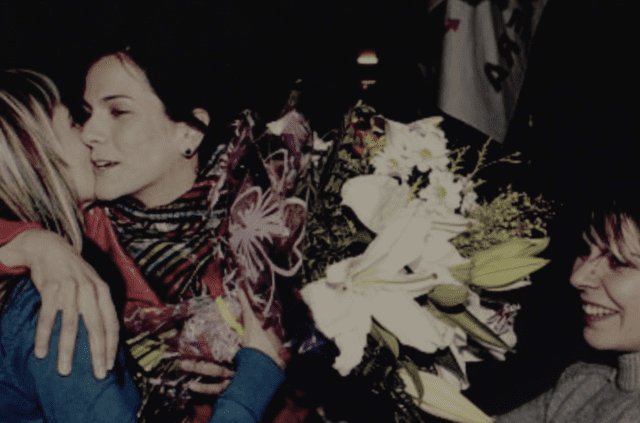
When she was released, everybody treated her as a returning hero. The camera flashbulbs went off. Friends all wanted to hug her. However, Santesteban wasn’t at all comfortable with her new-found status.
This was a politicised community and she was applauded for her sacrifice and courage. Everyone wanted to do her favours. If she went into a cafe, she wouldn’t be allowed to pay for her coffee. If she went shopping for clothes, the storekeepers would give them to her for free.
“For me, that was a very contradictory idea. I didn’t feel that way,” the director says of the idea that she was some kind of political martyr.
Eventually, Santesteban left the town and went to Barcelona to study filmmaking. “Deep down, I wanted to be anonymous. I needed to be anonymous, to remain anonymous.”
When the time was right, she decided to make her documentary. “I have a box with my prison archive. In this box, I have some photographs and some letters from jail. I thought that I have to do a film with this archive.”
She started working with this material but soon realised it would be “very difficult” to make a film only with the archive. By her own admission, she became “a little lost.” The documentary therefore also includes material in which she talks directly into a small recorder about her experiences.
918 Nights isn’t the typical prison memoir. Santesteban wanted the film to give a sense of the day to day experience of life behind bars – the tedium, the embarrassment, the many petty humiliations, the misery and desperation of the other prisoners as well as her own feelings of helplessness and heartbreak. She used to read political activist Rosa Luxemburg’s letters and found some consolation in what Luxemburg wrote about her own prison experiences.
The film includes a tender, frankly shot footage of lovemaking between two women. “For me, it was important to show that a political militant can be a sensitive person, a sexual person. Normally in films about militants, they don’t show this aspect of the person.”
Another sequence shows her walking in a forest in Berlin. Being in nature was one way of dealing with the trauma of what she had experienced before. She talks of “duelo,” the sorrow and sense of mourning she sometimes used to feel.
Ask Santesteban if she ever would have become a documentary maker if it hadn’t been for her time in prison and she pauses. When she talks about her younger self, she sounds as if she is describing a different person.
“When I was very young, activism occupied my whole life,” she says of her years on the Basque political frontline. “All my life, it was around militancy and activism,” she repeats. After leaving prison, she felt she needed “to construct” herself in a different way. She also wanted to express herself as an artist. Making her film enabled her to look back at the past from a new perspective. It was also clearly a catharsis.





