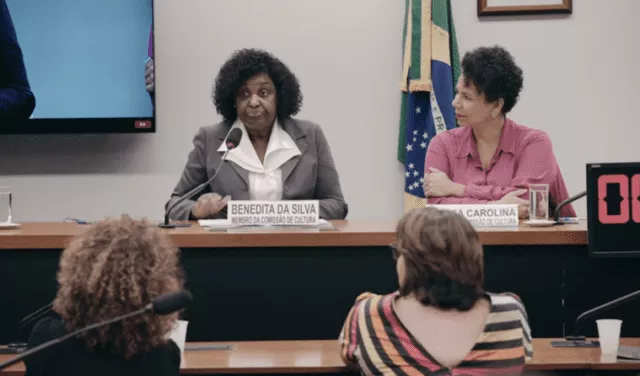
Pioneering new Brazilian political doc The Chamber/A Câmara (a world premiere in Doclisboa’s From The Earth To The Moon section) takes viewers deep into Brazil’s Chamber Of Deputies late during the highly controversial presidency of Jair Bolsonaro. The film follows the politicians in classic fly on the wall style – and all its subjects are female.
Filmmakers Cristiane Brum Bernardes and Tiago de Aragão list their participants in the opening credits and show photographs of the many women elected to the Parliament, but don’t disclose their names or job titles directly within the film itself. Nor is there any overt political bias in the film. Viewers are thrown into the middle of the debates and discussions the women are having, in the Chamber itself, in the corridors and within TV studios.
“I believe that when we don’t provide information with the character’s name, those who watch the film pay more attention,” de Aragão explains the film’s deliberately oblique narrative strategy. “The scenes present a wealth of information that makes it possible to understand the drama of those characters and the conflict condensed there…We tried to create a film that keeps the viewer attentive, that challenges them.”
Bernardes had initially wanted to provide far more information and context for viewers but her co-director convinced her that the “better way” was to focus on the institution itself rather than on the individual characters working within it. “We wanted to give the viewers a sense, a feeling, of the huge diversity these women represent,” Bernardes says. “They [the female politicians] are very, very different in perspectives, ideological positions, in ways of performing their daily tasks and in ways of approaching their voters.”
This, she jokes, is a “behind the scenes” or “making of” film about how Brazilian political life really works.
If the two directors give the impression that they know the Brazilian parliamentary system inside out, that’s because they do. Bernardes isn’t just a filmmaker. She is a highly distinguished journalist, academic and civil servant who actually works in the Chamber. “I’ve been researching parliaments for almost 20 years now,” she states. “I know a lot of people there.”
Consequently, the politicians were a “little more comfortable” with her presence as a filmmaker than they would have been if a complete stranger had suddenly turned up in their midst with a camera.
She is also part of the research team put together by Professor Emma Crewe at SOAS, “exploring collaborative ethnographies of parliaments, politicians and people in Brazil, Ethiopia, Fiji, India, the US, and the UK.” By making a film about women parliamentarians in Brazil, she hopes to bring her academic work to life – and to give it a chance of reaching a far broader audience. The aim is to provide the Brazilian public with insights that go beyond those generally available through TV and newspapers.
De Aragão also has first-hand knowledge of the Chamber of Deputies as this was where he did his doctorate in social anthropology.
Around 15 politicians agreed to participate in the doc. Several others declined. Those who allowed the filmmakers into their world were very open. Nonetheless, The Chamber wasn’t an easy film to make.
One of the biggest challenges was dealing with the ever-changing schedules of both the Chamber of Deputies and the female parliamentarians working with it.
“Commitments arise all the time and are cancelled, then rescheduled… Although life itself is full of unforeseen events, the parliament’s agenda – at least in Brazil – has this characteristic as an intrinsic element of its functioning. Therefore, this difficulty was already foreseen. In this type of film, having a team that understands how Congress works is essential. I highlight the work of Camilla Shinoda, who is assistant director and production director on this film,” De Aragão pays tribute to the organisational abilities of one of his key collaborators.
On one level, the documentary is optimistic. It may have been shot during a period of political division and post-pandemic turmoil but, within the Chamber itself, the system continues to work relatively efficiently. Different voices continued to be heard during debates. Bernardes speculates that some of the other [male] politicians may have modified their behaviour because the cameras were on them. Even so, there is generally respect between the subjects.
“They are still doing their work in a way…they all have this mission that no matter how disruptive the government is, or how they disagree with the government, they have to keep democracy going and they have to do their work on a daily basis. They have to keep this place alive. The Congress has this powerful symbolic function within the country,” Bernardes talks of the code by which the politicians abided.
“You can say that maybe the film is a tribute to the institution…and mostly to the political actors. They keep going no matter how bad the political context,” she continues. “Some of them were in a very bad position in the past four years [of the Bolsonaro administration], very persecuted, very harassed in a lot of ways. One of them two weeks ago had a brother killed. It is very difficult to be a woman in politics in Brazil but these women are leaders. In a way, this movie is a tribute to them…”
This wasn’t an easy project to finance. During Bolsonaro’s time in power, funding for culture, education and arts all but dried up. The directors therefore used funding that came to them through SOAS and the European Research Council to underwrite the project.
Following Doclisboa, A Câmara will be shown in London at the Brunei Gallery SOAS in early January. The Brazilian politicians should also get their chance to see the doc at some stage next year.