André Guiomar’s feature doc charts the lives of residents within Porto’s doomed Aleixo social housing project, as they prepare for its demolition and their own relocation. The film world-premiered at Sheffield Doc/Fest 2020.
Our Land Our Altar is a film of two halves filmed six years apart, although the threat of eviction is a constant throughout. What differentiates the two parts is the sense of hopelessness and neglect that can develop over time, made more poignant in this film by the deaths of some of the film’s core characters.
In 1974, following the Portuguese Carnation Revolution, the Aleixo housing project of five high-rise tower blocks was devised to house some of the city’s poor. But like other such developments across Europe (and beyond), little thought seemed to have been put into it. The buildings were situated in a low-lying suburb of Porto, so as not to offend the sensibilities (and spoil the view) of the city’s residents. What’s more, according to director André Guiomar, there was little by way of road infrastructure to connect the development with the city, which conversely led to a reinforced sense of community within this neo-ghetto.
In the first half of the film, in which three tower blocks are still standing, there are kids everywhere, roaming the stairwells and the streets, devising impromptu discos which are rendered even more exciting when water pipes are pierced, therefore drenching everybody in spray. We meet families who are having it tough, but so is everybody, which promotes a sense of solidarity. The women are house-proud, diligently scrubbing doorsteps, and families gather for barbecues on long communal tables.
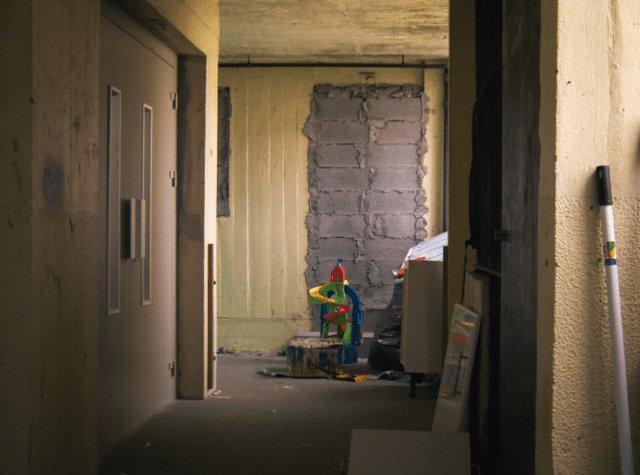
But the clock is ticking. And every time that somebody moves away, the door to their apartment is bricked up by the authorities.
Six years later, life is bleak. The place is close to deserted. There are no kids, and more and more doorways are bricked up, but the prospect of leaving the place is still heart-breaking for some of the community. Nevertheless, their leaving is a nailed-on certainty, as we see by the film’s conclusion, and with that comes dislocation, stress and illness and, as we gather during the end credits, the premature death of some of the people we have come to know.
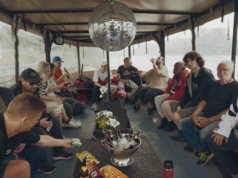
Yet before the arrival of the wrecking ball, the community gathers to party, to celebrate its own culture, its own proletarian uniqueness, dancing and crying together, and singing in unison of how “we are the night dogs and our pockets are empty.”
After Porto-born director Guiomar filmed the Aleixo community in 2013, he set sail for Mozambique where he lived for three and a half years, continually keeping tabs on developments back at home. His producer Mafalda Rebelo (Cimbalino Filmes) maintained regular contact with the residents during this time.
“I think the most important part was to have a producer that believed so much in the film,” says Guiomar. “When I was in Mozambique she constantly came back to the neighbourhood every week or every month, or when she could, to take some coffee, to help them with something, to be there, to be their friend. My producer has three kids now, and I believe that the neighbourhood, the project, saw the kids even before her grandparents. As soon as she left the hospital she drove there, showed them the kids and spent some time with them.”
“This friendship and this connection was very important so that they could trust us,” he adds. “They were so tired of this mass media and communication and journalists coming back to film the drugs or the criminal part. They see a camera and they see a tripod and they are completely afraid of that because they feel they [are given] an authentic voice.”
Guiomar adds how he found a tourist map of Porto in which a large red cross was placed on the area where the Aleixo project was located, effectively underlining it as a no-go zone. “When you create a community that receives no respect from the city they start to close this bubble and they live for each other. They had a school, they had a church, they had a supermarket, they had care for the elderly. Suddenly they don’t need the city, and the city doesn’t need them.”
The tragic heroine of the story is Maria João, who suffers the death of her son Israel as well as her brother Zé and sister Nada, the latter two through possible stress-induced illness. Israel’s death was in a car accident as he was returning from a locally arranged drag racing tournament referred to as ‘the drifts’, n
amed after the tendency of the cars’ back wheels to drift as they take tight of corners at high speeds.
Guiomar shoots a highly moving sequence as Maria João leads a tearful vigil at the road barrier where Israel was killed. But shooting the mother’s Lacrimosa was never going to be enough, it was underlined to the director. The group demanded more of him that evening, to return to ‘the drifts’ to capture the raw motorised essence of the experience. The very thing that Israel loved.
“They said ‘no, you’re not going home because it’s not over. We still have to go to the racing.’ They needed that. They needed to experience the ritual. Israel came from that place, he loved that place. ‘We need to go there,’ they said. So I went, and I filmed. And it was like a catharsis.”